


























Views
Downloads

Lowercase Letter j Worksheet | Essential Kindergarten Ready
Paste this activity's link or code into your existing LMS (Google Classroom, Canvas, Teams, Schoology, Moodle, etc.).
Students can open and work on the activity right away, with no student login required.
You'll still be able to track student progress and results from your teacher account.
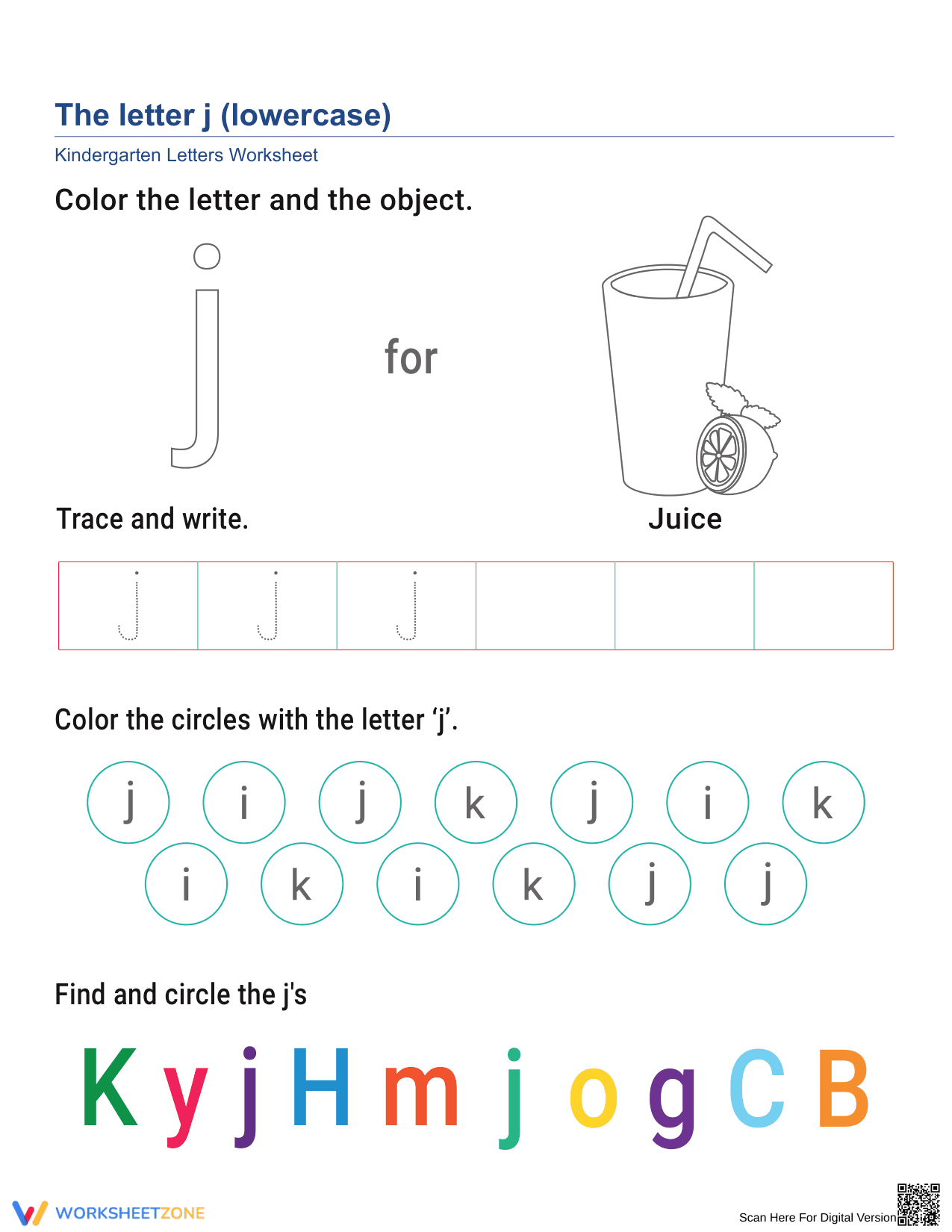
Master the lowercase letter j with this comprehensive alphabet practice page. Students develop phonemic awareness and fine motor skills through a multi-sensory approach that combines visual recognition with tactile writing practice. This resource ensures learners can distinguish the letter j from similar-looking characters while reinforcing the letter-sound connection with familiar imagery.
At a Glance
- Grade: Kindergarten · Subject: ELA Alphabet
- Standard:
CCSS.ELA-LITERACY.RF.K.1.D— Recognize and name all upper- and lowercase letters of the alphabet- Skill Focus: Lowercase letter j formation and identification
- Format: 1 page · 4 tasks · Answer key included · PDF
- Best For: Morning work or literacy centers
- Time: 10–15 minutes
This single-page PDF features four distinct activities to build letter mastery. It begins with a large "j" and a "juice" illustration for coloring, followed by a dedicated tracing and independent writing row. The bottom half focuses on discrimination, providing a letter-sorting circle grid and a mixed-case character string to sharpen visual scanning skills and letter-form constancy.
Zero-Prep Workflow
The zero-prep workflow is designed for busy educators. First, print the single-page PDF (30 seconds). Next, distribute the sheets to students along with crayons or pencils (1 minute). Finally, review the letter discrimination sections as a whole group or during small-group instruction (5 minutes). This resource is an ideal "grab-and-go" option for substitute folders or unexpected schedule changes.
Standards Alignment
This worksheet aligns with `CCSS.ELA-LITERACY.RF.K.1.D`, which requires students to recognize and name all lowercase letters of the alphabet. By isolating the letter j, students build the foundational fluency needed for decoding and early spelling. Both standard codes can be copied directly into lesson plans, IEP goals, or district curriculum mapping tools.
How to Use It
Use this worksheet as a formative assessment after introducing the letter j sound. Observe students during the "Find and circle" task to identify those struggling with visual discrimination between "j," "i," and "k." It works best as a 12-minute independent activity following a short direct instruction lesson on letter formation. The clear layout supports student autonomy during literacy rotations.
Who It's For
This resource is designed for preschool, kindergarten, and first-grade students who are beginning their literacy journey. It provides necessary scaffolding for English Language Learners and students with fine motor delays. Pair this worksheet with a letter j anchor chart or a tactile sand-tracing activity for a complete instructional block that addresses multiple learning styles.
Early literacy research emphasizes that letter name knowledge is one of the strongest predictors of later reading success. According to the National Assessment of Educational Progress (NAEP), students who master letter recognition in kindergarten demonstrate significantly higher reading comprehension scores in subsequent grades. This worksheet facilitates that mastery by providing structured, repetitive exposure to the lowercase letter j. By engaging in both motor-based tracing and cognitive-based discrimination, students move beyond rote memorization toward automaticity. Fisher & Frey (2014) highlight the importance of such scaffolded practice in the gradual release of responsibility model, where students transition from guided coloring to independent identification. This resource provides the necessary repetition to ensure the letter j is stored in long-term memory, supporting the phonological processing required for future decoding and spelling tasks. The clear layout and focused tasks minimize cognitive load, allowing young learners to concentrate entirely on the specific letter form.


