




























Views
Downloads
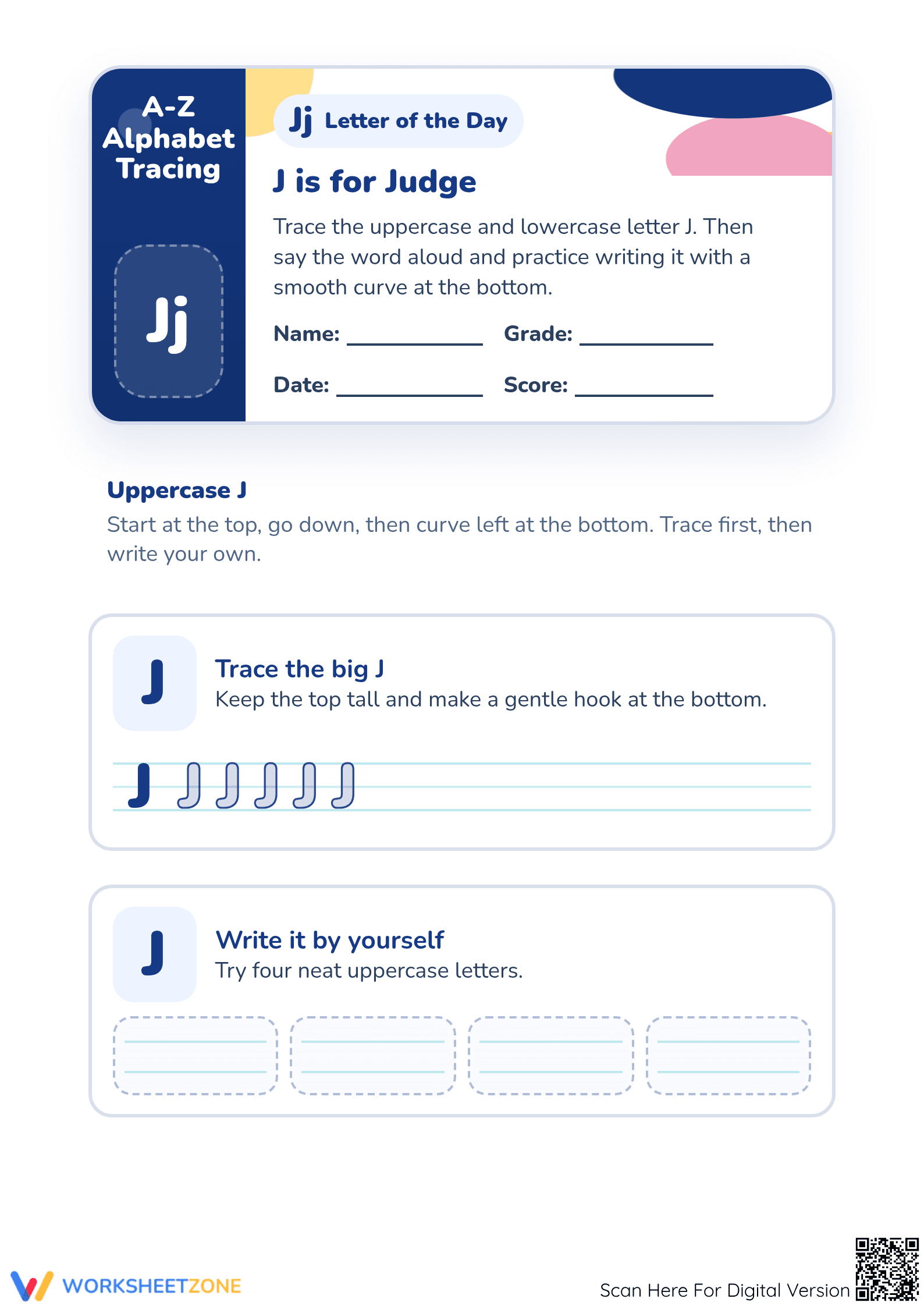


Printable Letter J Tracing Worksheet | Grade K Essential

Paste this activity's link or code into your existing LMS (Google Classroom, Canvas, Teams, Schoology, Moodle, etc.).
Students can open and work on the activity right away, with no student login required.
You'll still be able to track student progress and results from your teacher account.
Mastery of letter J is foundational for early literacy. This printable worksheet offers a structured environment for preschool and kindergarten students to develop fine motor control through systematic tracing and independent writing. Learners will confidently identify and form both uppercase and lowercase J using proper directional strokes, building essential mechanical skills for future reading and writing success.
At a Glance
- Grade: K · Subject: English Language Arts
- Standard:
CCSS.ELA-LITERACY.L.K.1.A— Print many upper- and lowercase letters accurately on lines- Skill Focus: Letter J Formation
- Format: 2 pages · 19 tasks · Answer key included · PDF
- Best For: Literacy centers and handwriting practice
- Time: 15–20 minutes
This comprehensive two-page set focuses exclusively on the letter J. Page one guides students through uppercase formation, while page two introduces the lowercase version and a thematic sentence. The worksheet includes clear visual cues, dashed tracing lines, and empty boxes for unassisted practice. A specific vocabulary connection to the word "Judge" helps reinforce letter-sound correspondence while students work on their penmanship. The clean layout minimizes distractions, making it ideal for young learners who are still developing their focus.
- Guided Practice: Students begin by tracing 10 instances of uppercase and lowercase J, following instructional cues that emphasize starting at the top and curving at the bottom.
- Supported Practice: Eight dedicated boxes allow students to attempt independent letter formation, providing enough structure to maintain size consistency while removing the tracing guides.
- Independent Application: The final task requires students to trace the complete sentence "J is for Judge," applying their handwriting skills to a real-world linguistic context.
This workflow follows a gradual-release model, moving from high-support tracing to independent production to ensure long-term retention.
Standards Alignment
This resource is directly aligned to CCSS.ELA-LITERACY.L.K.1.A: "Print many upper- and lowercase letters." It specifically targets the mechanical accuracy required for kindergarten writing standards. Both standard codes can be copied directly into lesson plans, IEP goals, or district curriculum mapping tools to demonstrate evidence-based instructional practice in the classroom.
How to Use It
Introduce this worksheet during your "Letter of the Day" curriculum after a brief oral phonics lesson. For the first case, use page one as a guided group activity where students follow your strokes on a whiteboard. For the second case, assign page two as a morning work task to reinforce the previous day's learning. During the activity, observe if students are starting their strokes from the top-down; this formative observation helps correct improper habits before they become ingrained. Most students will complete both pages in approximately 20 minutes.
Who It's For
This worksheet is designed for preschool and kindergarten students who are beginning their journey into alphabet recognition. It is particularly useful for students needing extra fine motor support or those in English Language Learner (ELL) programs. Pair this resource with a physical alphabet anchor chart or a short reading passage about the law to provide a richer context for the vocabulary word.
Educational research highlights the importance of explicit penmanship instruction in early childhood. This worksheet applies the gradual release of responsibility model (Fisher & Frey, 2014), moving students from guided tracing to independent letter formation to build confidence and accuracy. It provides clear directional cues for the letter J and ample space for unassisted practice. By integrating vocabulary like 'Judge' into the handwriting task, students strengthen the phonemic connection between the grapheme J and its sound. This dual-focus approach ensures fine motor development occurs alongside phonics acquisition, preparing students for complex writing tasks. Educators and parents can rely on this standard-aligned CCSS.ELA-LITERACY.L.K.1.A resource for high-frequency practice, establishing the muscle memory needed for fluent, legible handwriting.


