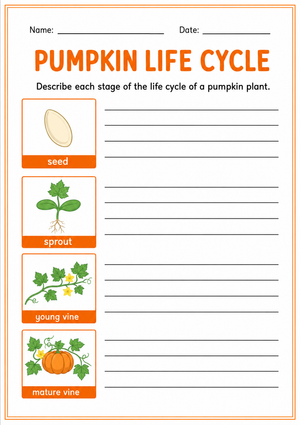
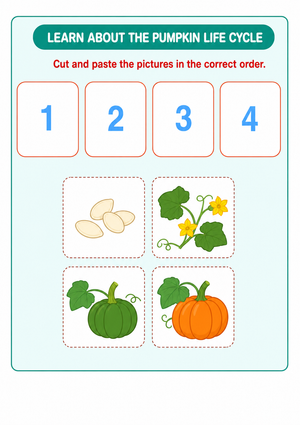
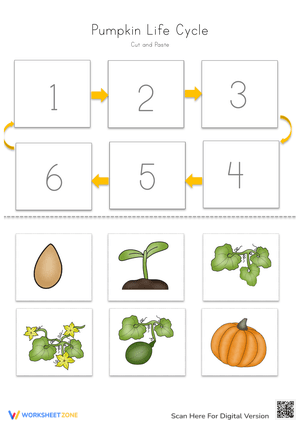
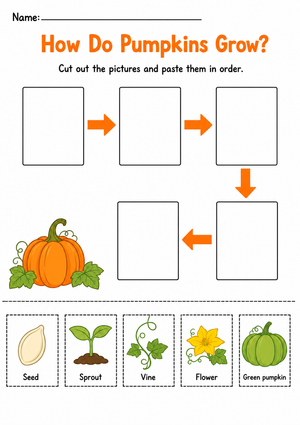
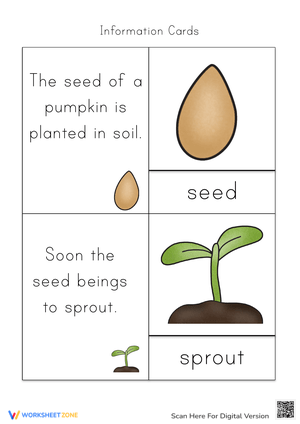
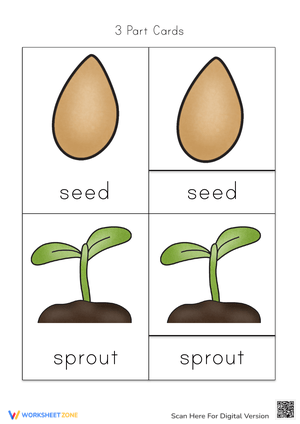
These pumpkin life cycle worksheets for 3rd grade give teachers a focused set of resources for the plant science unit — cut-and-paste sequencing activities, anatomy labeling diagrams, short informational reading passages, and a comparison chart that places the pumpkin's growth stages alongside a second plant species. The resources print cleanly and require no additional materials beyond scissors and glue for the sequencing worksheet.
The Six Stages and What Students Do With Them
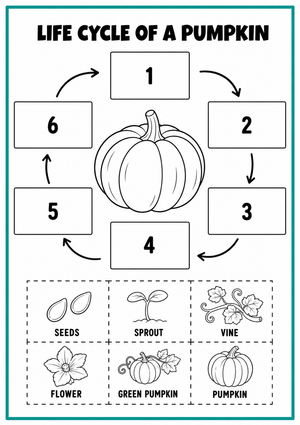
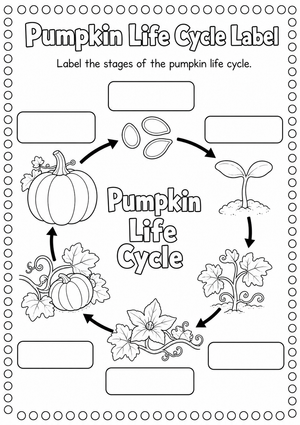
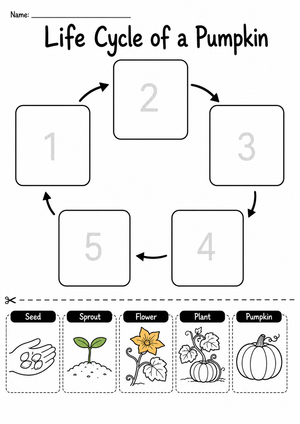
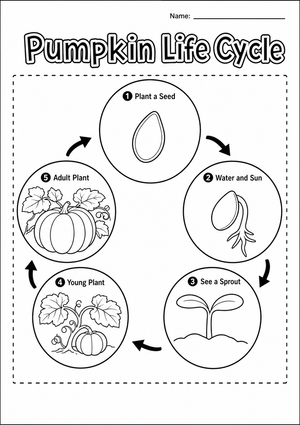
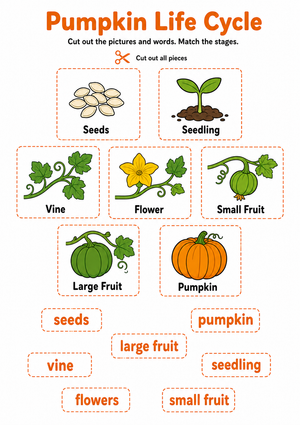
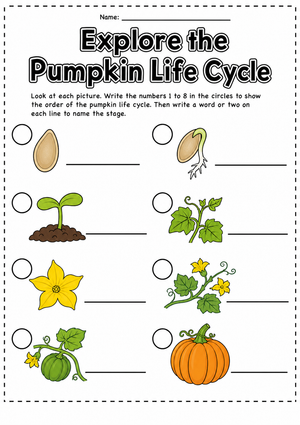
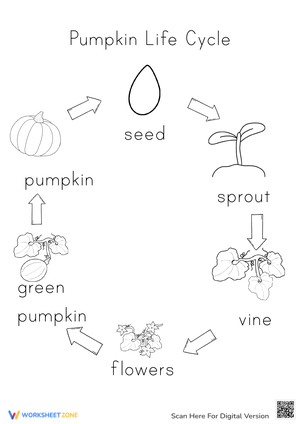
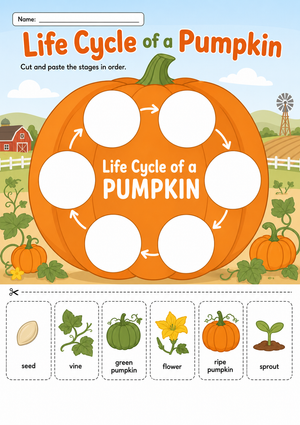
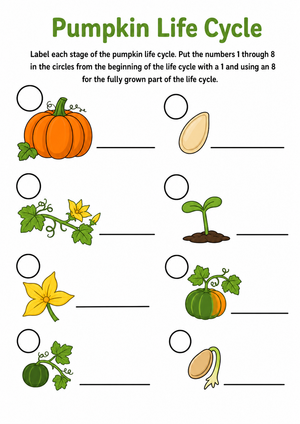
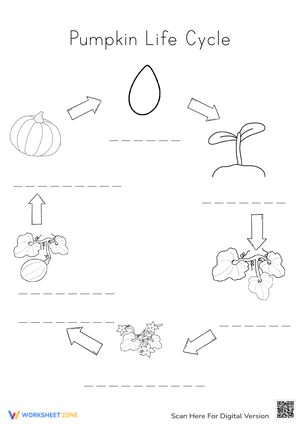
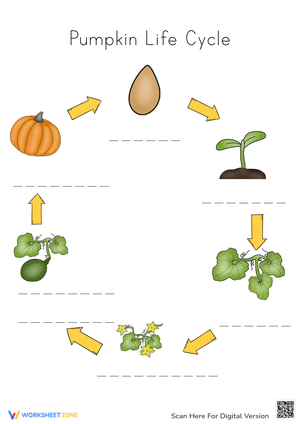
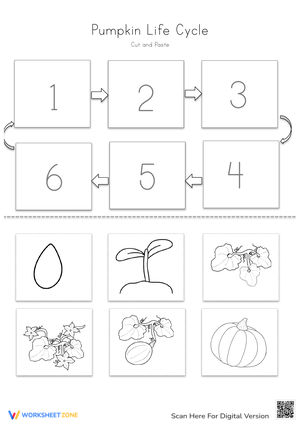
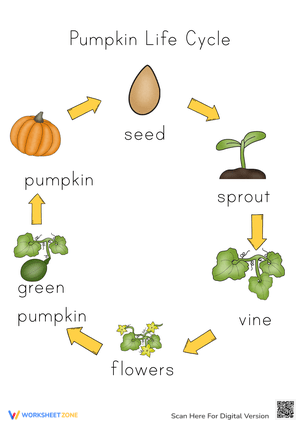
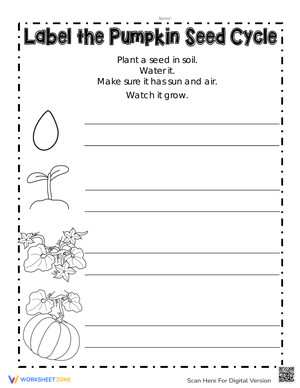
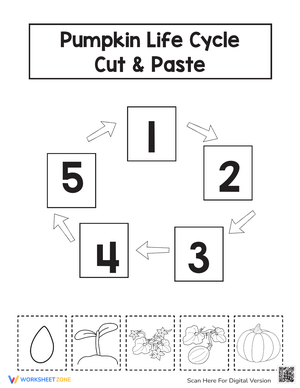
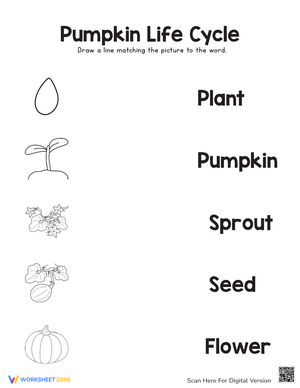
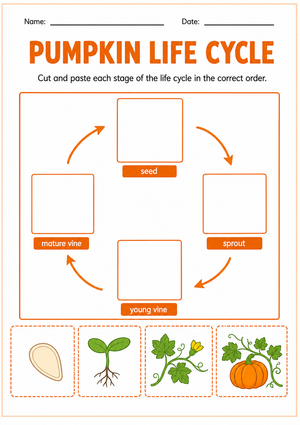
Each worksheet in the set targets the same six-stage progression — seed, sprout, vine, flower, green pumpkin, and mature orange pumpkin — but approaches it from a different angle. On the labeling worksheet, students write each stage name beneath its illustration. On the sequencing worksheet, they cut out the stage images and arrange them in the correct order before pasting. On the comparison chart, they map the pumpkin's stages against a sunflower or bean plant and mark where the progressions overlap and where they diverge.
The reading comprehension worksheet pairs a short informational passage on pollination, photosynthesis, and the flower-to-fruit transition with six follow-up questions. Two of those questions ask students to cite evidence from the text, which connects the science work to the informational reading expectations most grade 3 teachers are already tracking across literacy blocks.
What Makes the Pumpkin a Strong Teaching Model at This Grade
Third grade is when the NGSS expects students to shift from simple observation toward actual modeling — describing what makes an organism's life cycle unique, not just reciting the names of its stages. The pumpkin earns its place here because all six stages are visually distinct enough for students to draw and describe independently. A sunflower works conceptually, but the gap between seedling and full-grown sunflower is wide. An oak tree is worse. A pumpkin that moves from seed to harvestable fruit in 90 to 120 days gives students a growth arc that feels real and bounded — something they can hold in their heads as a complete sequence.
It also helps that pumpkins produce large, clearly differentiated male and female flowers. The pollination step carries more weight when there is a visible structure students can examine in a photograph or a classroom specimen rather than a generic abstract description of pollen transfer.
Standard Alignment
These worksheets align directly with NGSS performance expectation 3-LS1-1: Develop models to describe that organisms have unique and diverse life cycles but all have in common birth, growth, reproduction, and death. In classroom terms, that expectation asks students to show relationships and sequence — not just name stages in isolation. The labeling and sequencing worksheets satisfy the basic modeling requirement. The comparison chart pushes toward the "diverse life cycles" portion of the standard by asking students to identify what differs between two plant species. Assign the comparison chart after students have worked through the labeling worksheet, not before — the cognitive load of learning the pumpkin stages and comparing them simultaneously is too high for most students in this grade band.
Mistakes Students Make That These Worksheets Help You Catch
The most consistent sequencing error is placing the flower before the vine. Students assume the plant blooms early and then grows long afterward, when in fact the sprawling vine stage precedes flowering. This misconception is worth addressing whole-class before the cut-and-paste worksheet goes out, because a large portion of students will paste the same wrong sequence with confidence if they haven't been prompted to examine the order carefully first.
A subtler pattern shows up on the reading comprehension worksheet. When students encounter the fact that pumpkins are botanically fruits, many write explanations that correctly reference seeds and flowers, then revert to calling pumpkins vegetables two sentences later. That slippage reveals that the grocery-store definition is still running as a background assumption the new science content hasn't fully displaced. A brief class discussion before the written response is more effective than correcting it after.
Students also regularly omit the green pumpkin stage on diagram worksheets, jumping from flower directly to the mature orange fruit. If that pattern shows up across a class set, it usually means students don't yet understand that the pumpkin ripens gradually after the flower drops — a two-minute clarification with a photograph of an unripe pumpkin on the vine tends to resolve it.
How to Build These Worksheets Into Your Week
The pumpkin life cycle worksheets for 3rd grade work best spread across three or four sessions rather than assigned in a single block. A workable sequence: open with a short read-aloud or video, then distribute the labeling worksheet as a supported first encounter with the vocabulary. The following session, move to the cut-and-paste sequencing. Before students glue anything down, ask them to write one explanatory sentence beneath each stage image — that written step satisfies the NGSS modeling expectation and doubles as a quick formative check you can scan at a glance while circulating.
One classroom move that consistently improves retention: on Day 2 or Day 3, bring a small pie pumpkin, cut it open, and let students count the seeds. Students who misremembered the seed stage during the sequencing activity will self-correct without being prompted once they're holding an actual seed from an actual pumpkin. It takes about ten minutes and requires no advance preparation beyond picking up a pumpkin from the grocery store.
The comparison chart fits best at the end of the unit, not the beginning. By that point students know the pumpkin stages solidly, and the chart becomes an application task rather than a learning task. Collect completed charts as a formative artifact — they document where students sit on the 3-LS1-1 modeling continuum before any summative assessment.
Adjusting the Resources for Different Student Levels
The pumpkin life cycle worksheets for 3rd grade are structured so teachers can increase or reduce difficulty without creating new materials. For students who need more support on the sequencing worksheet, pre-cut the stage images and arrange them loosely on the desk — the task then becomes ordering and pasting rather than cutting, reading, and ordering at the same time. Adding a numbered word bank to the labeling worksheet gives those students a retrieval cue without removing the thinking.
For students who move quickly, remove the word bank from the labeling worksheet entirely and ask them to write a one-sentence scientific explanation beneath each label rather than just naming the stage. On the comparison chart, extend the task by asking them to identify which organism's life cycle they would want to study next and explain their reasoning — a small written synthesis that requires generalizing beyond the worksheet content. Both adjustments take under two minutes to set up and keep advanced students engaged without separating them from the rest of the class.
Frequently Asked Questions
What are the six stages of the pumpkin life cycle in order?
Seed, sprout, vine, flower, green pumpkin, and mature orange pumpkin. Each worksheet presents all six stages with illustrations, giving students a visual reference as they sequence and label rather than relying on text alone.
How long does it take for a pumpkin to grow from seed to mature fruit?
Most varieties take 90 to 120 days, depending on cultivar, soil temperature, and moisture levels. That range matters instructionally — it illustrates that growth rates vary across individual organisms even within the same species, which is a detail the 3-LS1-1 standard touches on when it refers to life cycles being both unique and diverse.
Why is the pumpkin classified as a fruit rather than a vegetable?
Botanically, any structure that develops from a fertilized flower and encloses seeds qualifies as a fruit. Pumpkins meet both conditions. Most grade 3 students find this surprising because their working definition of "fruit" runs on taste and texture, not botanical structure. That gap between everyday language and scientific classification is itself a productive teaching moment — one the reading passage and follow-up questions are built to surface.
Do these resources work for homeschool families?
Yes. The pumpkin life cycle worksheets for 3rd grade print and function the same way at home as in a classroom. The recommended sequence — labeling first, sequencing next, comparison chart last — works with one student as well as with a full class, and the pumpkin dissection extension requires nothing beyond a small pumpkin from a grocery store.












 Interactive Worksheet Maker
 Quiz Maker
 Word Search Maker
 Crossword Puzzle Maker
 Word Scramble Generator
 Sentence Scramble Generator
 Handwriting Worksheet Generator
 Name Tracing Generator
 Fill In The Blank Generator