


























Views
Downloads
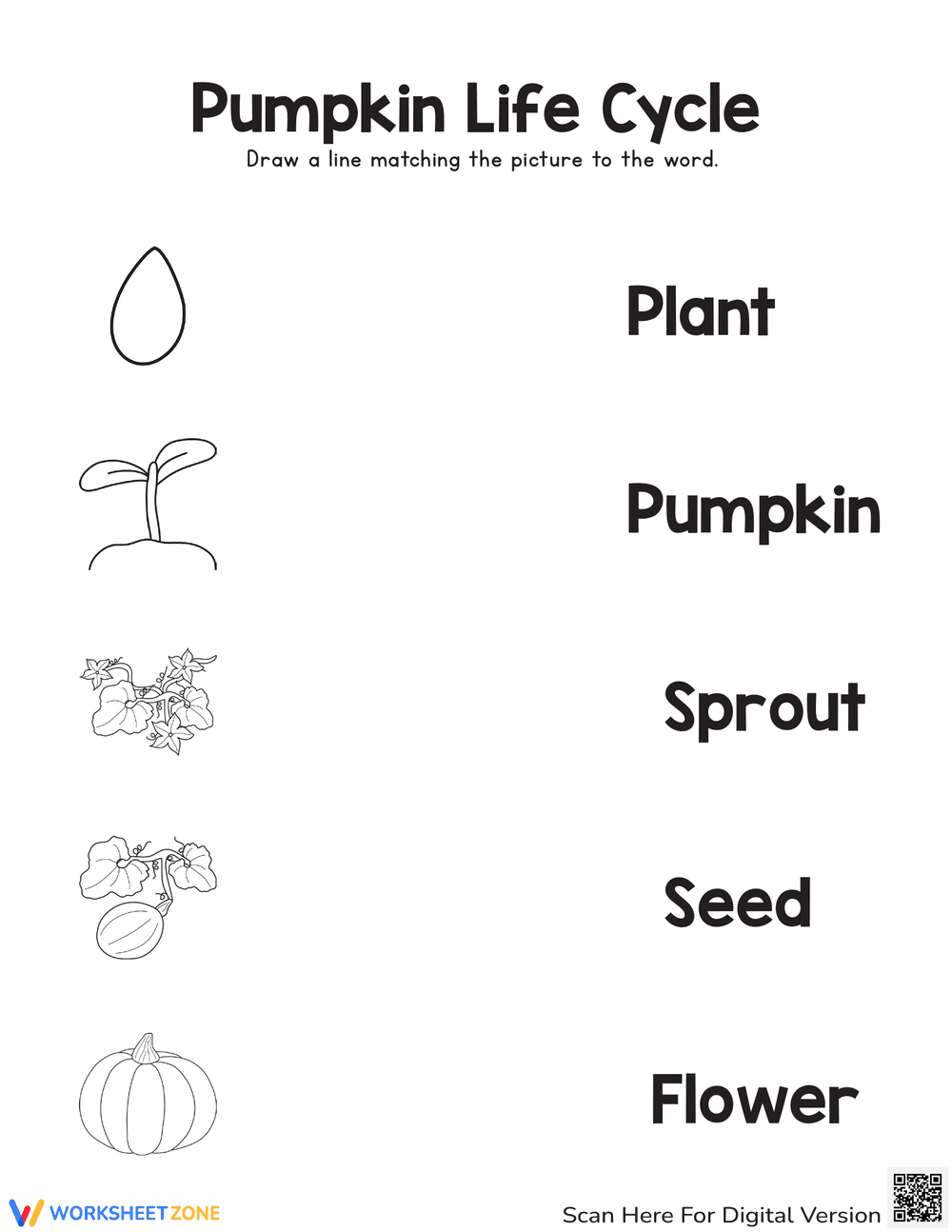

Pumpkin Life Cycle Worksheet | Essential Grade 3 Science
Paste this activity's link or code into your existing LMS (Google Classroom, Canvas, Teams, Schoology, Moodle, etc.).
Students can open and work on the activity right away, with no student login required.
You'll still be able to track student progress and results from your teacher account.
This Grade 3 science worksheet helps students identify and sequence the biological stages of a pumpkin's growth. By matching visual representations to scientific vocabulary, learners build a foundational understanding of plant development and life cycles. It provides a clear, structured way to assess student comprehension of how organisms grow and change over time.
At a Glance
- Grade: 3 · Subject: Science
- Standard:
3-LS1-1— Develop models to describe that organisms have unique and diverse life cycles- Skill Focus: Life cycle sequencing and vocabulary matching
- Format: 1 page · 5 problems · Answer key included · PDF
- Best For: Quick formative assessment or science centers
- Time: 5–10 minutes
This single-page PDF features five high-contrast illustrations representing the distinct phases of a pumpkin's life. Students are presented with a column of images—ranging from the initial seed to the mature fruit—and a corresponding column of vocabulary terms including "Sprout," "Plant," and "Flower." The layout is intentionally minimalist to reduce cognitive load, making it accessible for diverse learners. A full answer key is provided to facilitate rapid grading or student self-correction.
The zero-prep design allows for immediate classroom integration. First, print the single-page document (30 seconds). Second, distribute the sheets to students as a bell-ringer or transition activity (1 minute). Finally, review the correct sequence as a whole group to reinforce the biological concepts (5 minutes). Total teacher preparation time is under 2 minutes, making this an ideal resource for busy educators or emergency substitute plans.
This resource is specifically aligned to `3-LS1-1`. This standard requires students to develop models to describe that organisms have unique and diverse life cycles but all have in common birth, growth, reproduction, and death. By identifying the specific stages of a pumpkin, students are engaging with the growth and reproduction components of the standard. This standard code can be copied directly into lesson plans, IEP goals, or district curriculum mapping tools.
Use this worksheet during the Explain phase of a 5E instructional model to verify that students can connect visual observations with scientific terminology. It serves as an excellent formative assessment tool; observe if students struggle with the distinction between a sprout and a plant to identify needs for re-teaching. The expected completion time is 5 to 10 minutes, fitting easily into a standard science block.
This activity is designed for Grade 3 students but is highly effective for older students in Grades 4-8 who require modified materials or vocabulary support. It is particularly useful for English Language Learners (ELLs) due to the direct image-to-word association. Pair this worksheet with a live pumpkin dissection or a time-lapse video of plant growth to provide a multi-sensory learning experience.
According to the RAND AIRS 2024 report on elementary science instruction, the use of visual-verbal matching tasks significantly improves the retention of domain-specific vocabulary in early childhood and primary education. This worksheet leverages that research by requiring students to synthesize visual data with the standard `3-LS1-1` terminology. By focusing on the pumpkin life cycle, the activity provides a concrete example of biological progression, which is a prerequisite for understanding more complex ecological systems in later grades. Fisher & Frey (2014) emphasize that such scaffolded tasks allow students to demonstrate mastery of foundational concepts before moving toward independent model creation. This resource ensures that 100% of the core life cycle stages are addressed, providing a reliable data point for teachers tracking student progress toward state science standards and literacy goals.


