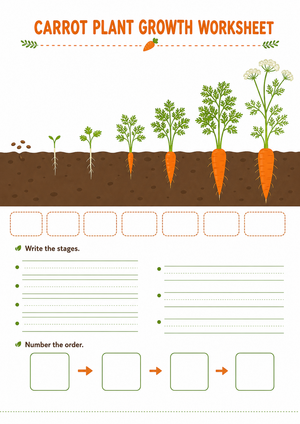
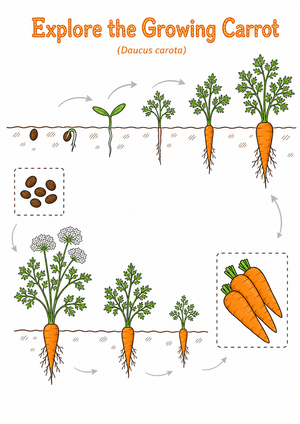
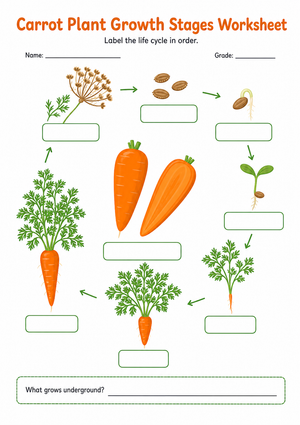
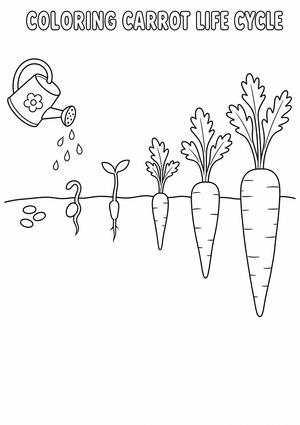
These 3rd grade carrot worksheets resources give teachers a focused set of printable activities for plant parts, life cycle sequencing, and science vocabulary — all centered on a vegetable students already recognize from lunch boxes and grocery runs. The set works inside a short plant unit or as standalone practice within a broader life science sequence. What makes the carrot particularly useful here is that its edible portion is the root, which opens a direct line into one of the trickier plant science concepts at this grade: the fact that major plant structures grow entirely below the soil, invisible until someone pulls one up.
Skills These Worksheets Build
Each worksheet targets a specific aspect of plant science rather than asking students to handle everything at once. The core skills across the set include:
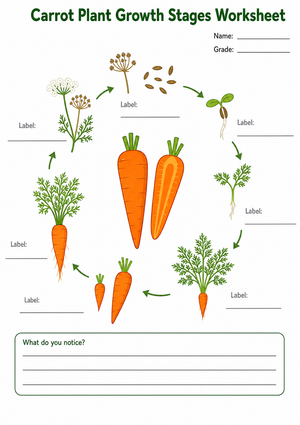
- Labeling carrot plant parts: Students identify and write the names of the root, stem, leaves, flower, and seeds on a diagram that shows both above-ground and underground structures together.
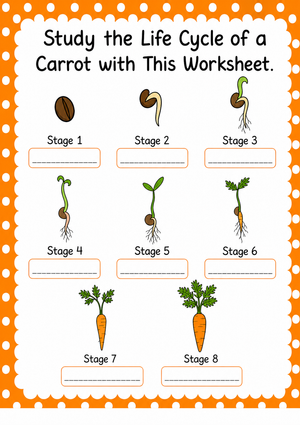
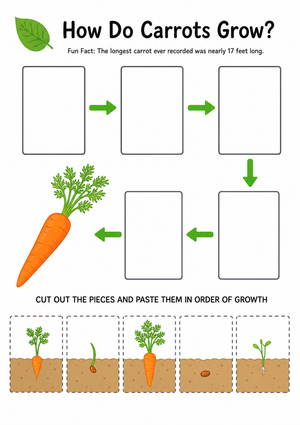
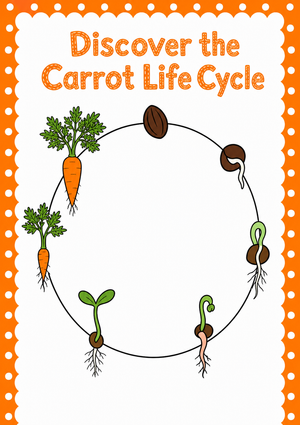
- Life cycle sequencing: Students arrange growth stages — seed, seedling, growing plant, mature flowering plant, seed production — by writing them in order or sorting and pasting cut-apart cards.
- Observation recording: Students document changes in a carrot seedling or a carrot-top regrowth project over time, using sentence starters and a drawing area to practice precise description.
- Science vocabulary matching: Students connect terms such as taproot, seedling, sprout, and germinate to definitions or illustrations.
- Short reading response: Students read a brief passage about underground plant growth and underline evidence before answering text-based questions — combining literacy practice with science content without abandoning the topic.
- Explanatory writing: Students describe what a carrot plant needs to survive or explain why the root matters to the plant's long-term growth.
This range matters because 3rd grade plant science involves both direct observation and conceptual understanding. Labeling practice builds vocabulary; sequencing practice builds pattern recognition; writing practice forces students to explain causation rather than just recall a list. Together, the 3rd grade carrot worksheets set moves students from naming parts to explaining how those parts function within the life cycle.
Student Errors to Address Before They Harden Into Habit
The most consistent mistake in student work on this topic is labeling the orange carrot as the stem. Students know stems hold plants upright, and the long tapered shape looks enough like a stalk that the "stem" label gets applied confidently — and incorrectly. The root anchors the plant underground and stores food; the actual stem on a carrot plant is a short section connecting the root to the leafy green top. Once a student writes "stem" on a diagram and moves on without correction, that error tends to reappear on the next plant unit and the one after that. These worksheets address it directly by including a diagram that shows both the underground root and the above-ground stem as clearly separated structures.
A second pattern worth watching: students who correctly identify the carrot as a root often overgeneralize and assume all roots look like carrots — long, single, and tapered. When they later encounter fibrous root systems or beets, their mental model doesn't fit. A brief teacher-guided discussion after the labeling worksheet, pointing out that carrots have a specific root type called a taproot, helps prevent that narrowing from sticking.
Students also tend to place "flower" last in the life cycle sequence, treating it as the endpoint rather than the stage that leads to seed production and a new cycle beginning. When they see the carrot as a food item rather than as a plant completing a reproductive cycle, the seed-production stage feels like an afterthought. Sequencing worksheets that explicitly place seed production after the flower stage — and ask students to draw an arrow looping back to the beginning — make the cyclical structure visible rather than just stated.
Fitting These Worksheets Into Your Science Sequence
A practical approach: use the plant parts labeling worksheet on the first day of the unit, ideally with a real carrot that still has some green top attached. Students who can hold the carrot while they fill in the diagram are far less likely to call the root a stem on the next assessment. Ten minutes of hands-on labeling on day one prevents ten minutes of reteaching later. The physical object reduces cognitive load by giving students something concrete to match against the diagram rather than working from verbal description alone.
The life cycle sequencing worksheet works well on day two as a guided activity before students attempt it independently. Walk through the stages together — seed in the ground, seedling emerging, root enlarging and storing sugars, flower stalk appearing in the second year — then ask students to complete the sequence on their own. Moving from whole-group modeling to independent work within the same class block gives students a low-stakes opportunity to demonstrate what they retained.
Later in the week, the reading response worksheet fits naturally into a literacy block or a science-reading rotation. Students who have already seen the vocabulary and labeled the diagram find the passage easier to follow, and they can underline evidence rather than guessing at meaning. The 3rd grade carrot worksheets set works especially well this way — staggered across the week so each worksheet reinforces what came before rather than introducing everything at once.
For science centers, the vocabulary matching worksheet and the observation recording worksheet both work well as independent station tasks. Neither requires teacher proximity once students understand the format, freeing the teacher to run a small-group reteach or conduct a check-in while the rest of the class works.
Standard Alignment
These worksheets connect directly to NGSS 3-LS1-1, which asks 3rd grade students to develop models to describe that organisms have unique and diverse life cycles but all share the common features of birth, growth, reproduction, and death. The carrot maps cleanly onto this standard: students trace the plant from seed through root development, flowering, and seed production, and the labeling and sequencing worksheets serve as the "develop models" component — students build a visual representation of the cycle rather than simply reciting the stages from memory.
In most 3rd grade pacing guides, LS1-1 appears mid-year, after students have established foundational science practices and before the ecology-focused work of 4th grade. Placing the carrot unit at this point keeps instruction grounded in a concrete organism while still pushing students toward the generalization the standard requires: that the cycle pattern applies across many different living things, not just the carrot.
Adjusting the Set for Different Learners
For students who need more support with written output, the labeling and sequencing worksheets work well paired with an index-card word bank. Rather than producing two separate document versions, prepare one word-bank card per student and let them use it or set it aside. Students who need the support use the card; students who do not leave it on their desk untouched. The class stays on the same worksheet without requiring additional prep for different groups.
Students who move quickly through the labeling tasks benefit from the explanatory writing worksheet, particularly the prompt asking them to explain why the root matters to the plant's survival over the growing season. That question requires applying the concept rather than recalling a label — a more demanding task and a natural extension for students who find the identification exercises easy. A follow-up question asking them to predict what would happen if an early frost killed the root before seed production pushes thinking further without requiring any additional materials.
The observation recording worksheet is the most flexible in the set for mixed-readiness classrooms. Students who are still building vocabulary use the sentence starters and the drawing space; students who are ready to write more detailed descriptions ignore the starters and fill the space with their own observations. A single worksheet handles a range of writing development without requiring separate preparation. When teachers use the 3rd grade carrot worksheets set this way — matching each worksheet to a specific instructional purpose on a specific day — differentiation happens through planning rather than through creating multiple document versions.
Frequently Asked Questions
Are carrots roots, stems, or fruits?
Carrots are taproots — the main downward root of the plant, storing food and anchoring the plant in soil. The orange portion people eat grew underground before harvest. This makes the carrot one of the clearest examples available for teaching the root-versus-stem distinction at this grade level, which is why it appears so frequently in 3rd grade plant science materials.
Do students need access to a classroom garden for these worksheets to be useful?
No. A whole carrot from the grocery store or cafeteria provides everything needed for the labeling and observation activities. A seed packet from a hardware or garden store works well for vocabulary and life cycle discussions. If neither is available, the diagram-based worksheets stand on their own — though having a physical carrot on the desk during the labeling activity reduces the root-versus-stem error significantly.
How long does each worksheet typically take in a 3rd grade class?
The labeling and sequencing worksheets take most 3rd grade students 8–12 minutes to complete independently. The reading response worksheet runs closer to 15–20 minutes, depending on how much pre-reading discussion the teacher builds in. The observation recording worksheet is open-ended — it can run as short as 5 minutes for a quick sketch or span multiple sessions if used as an ongoing journal across a plant unit.
Can these worksheets be used for formative assessment?
Yes. The plant parts labeling and life cycle sequencing worksheets both produce student work that shows clearly what a student understands and where gaps remain. If a student places "flower" before "mature plant" in the sequence, or labels the root as a stem, that error is visible and actionable before the next lesson. Collecting the worksheets between class sessions gives teachers specific information about which concepts need reinforcement — more targeted than a general class discussion and faster to review than a written quiz.












 Interactive Worksheet Maker
 Quiz Maker
 Word Search Maker
 Crossword Puzzle Maker
 Word Scramble Generator
 Sentence Scramble Generator
 Handwriting Worksheet Generator
 Name Tracing Generator
 Fill In The Blank Generator