


























Views
Downloads
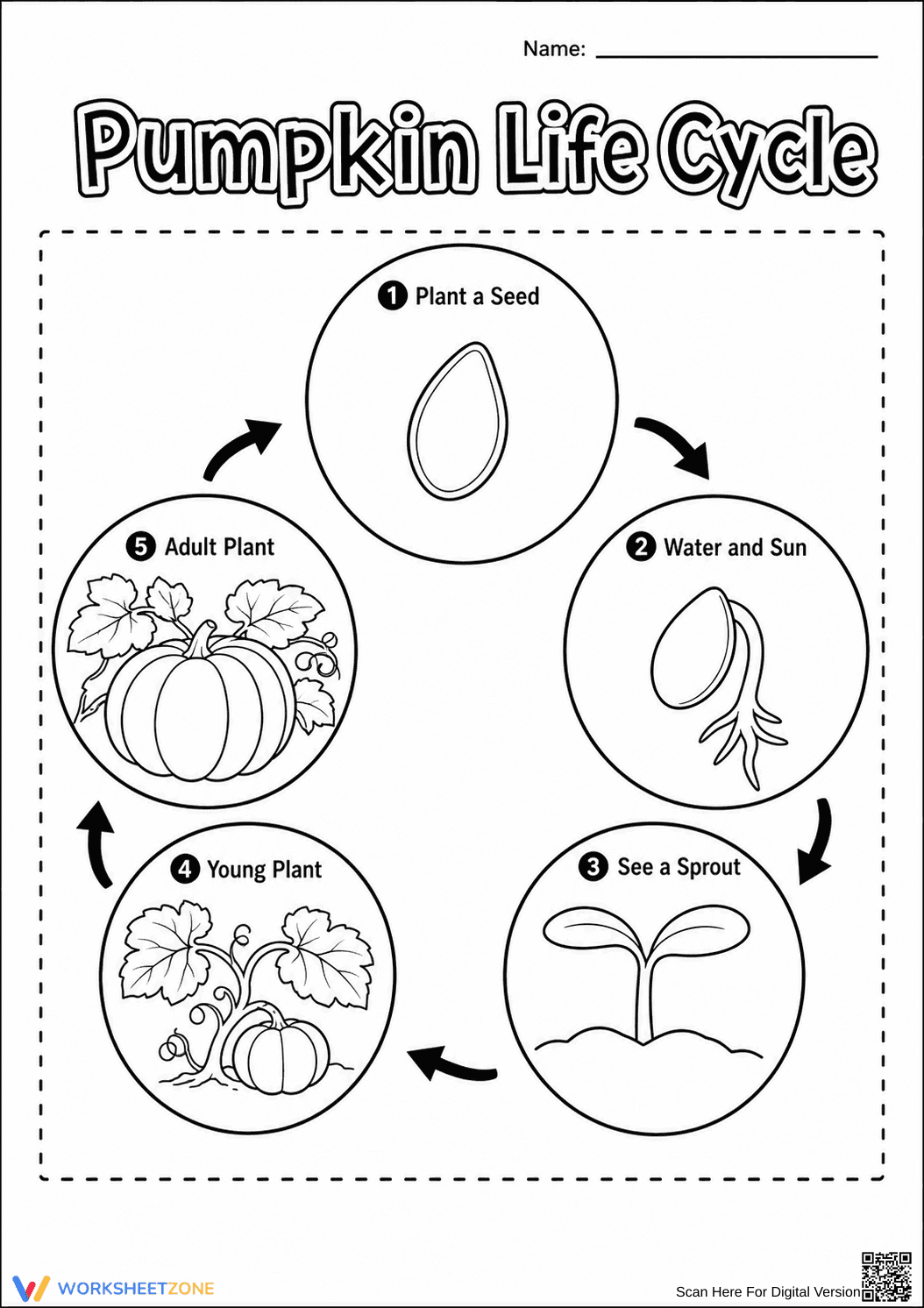

Pumpkin Life Cycle Worksheet | Grade 3 Printable
Paste this activity's link or code into your existing LMS (Google Classroom, Canvas, Teams, Schoology, Moodle, etc.).
Students can open and work on the activity right away, with no student login required.
You'll still be able to track student progress and results from your teacher account.
This pumpkin life cycle worksheet provides a clear visual model for students to understand the biological progression of flowering plants. By identifying five distinct stages from germination to maturity, learners build a foundational understanding of plant biology and chronological sequencing. It simplifies complex botanical concepts into an accessible, one-page diagram for immediate classroom use.
At a Glance
- Grade: 3 · Subject: Science
- Standard:
3-LS1-1— Develop models to describe that organisms have unique and diverse life cycles- Skill Focus: Plant growth sequencing
- Format: 1 page · 5 stages · Answer key included · PDF
- Best For: Independent practice or science centers
- Time: 15–20 minutes
What's Inside
Inside this resource, you will find a high-quality circular diagram featuring five numbered stages of a pumpkin's development. Each stage includes a clear illustration and a concise descriptive caption, such as "Plant a Seed" and "The young plant." The layout uses directional arrows to reinforce the concept of a continuous cycle, making it an ideal visual aid for primary learners.
Zero-Prep Workflow
The zero-prep workflow for this resource is designed for maximum efficiency. First, print the single-page PDF (30 seconds). Next, distribute the sheets to students during your life science block (1 minute). Finally, review the completed diagrams as a whole group to check for understanding (5 minutes). Total teacher preparation time is under two minutes, making this an excellent choice for emergency sub plans.
Standards Alignment
This worksheet aligns with 3-LS1-1, requiring students to develop models to describe that organisms have unique and diverse life cycles but all have in common birth, growth, reproduction, and death. It also supports ELA sequencing standards by asking students to follow a multi-step scientific process. Both standard codes can be copied directly into lesson plans, IEP goals, or district curriculum mapping tools.
How to Use It
Use this worksheet as a formative assessment after a read-aloud about autumn harvests or plant biology. During the activity, observe if students can explain the transition between the "sprout" and "young plant" stages. It typically takes 15 to 20 minutes to complete, fitting perfectly into a science center rotation or as a quiet transition activity after recess.
Who It's For
This resource is designed for Grade 3 and Grade 4 students, particularly those who benefit from visual learning and clear, numbered steps. It serves as a great scaffold for English Language Learners (ELLs) who are building scientific vocabulary. Pair this diagram with a real pumpkin seed dissection or a time-lapse video of a growing vine for a comprehensive lesson.
According to the RAND AIRS 2024 report on elementary science instruction, visual models like the 3-LS1-1 pumpkin life cycle diagram are essential for helping young learners internalize the concept of biological continuity. By breaking down the complex process of plant maturation into five observable stages, this worksheet reduces cognitive load while reinforcing the specific vocabulary of the life sciences. Research from Fisher & Frey (2014) emphasizes that instructional models are most effective when supported by clear graphic organizers that bridge the gap between abstract concepts and concrete observations. This printable resource provides that bridge, allowing students to demonstrate mastery of plant growth patterns through a structured, evidence-based format. It is a reliable tool for meeting NGSS requirements while ensuring that students can accurately sequence the birth, growth, and reproduction phases common to all flowering organisms in a classroom setting.


