


























Views
Downloads
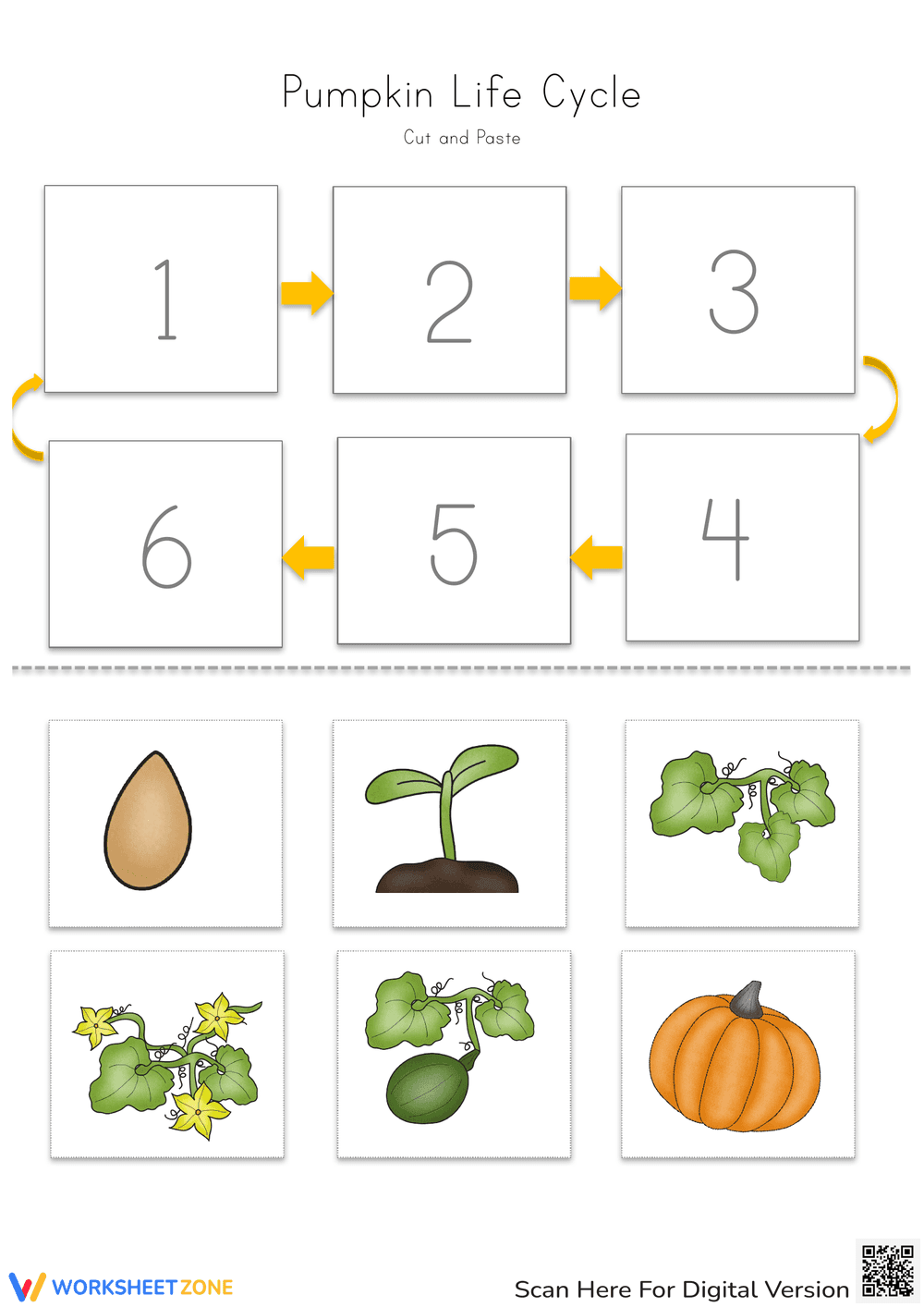

Pumpkin Life Cycle Worksheet | Grade 3 Printable
Paste this activity's link or code into your existing LMS (Google Classroom, Canvas, Teams, Schoology, Moodle, etc.).
Students can open and work on the activity right away, with no student login required.
You'll still be able to track student progress and results from your teacher account.
This Grade 3 pumpkin life cycle worksheet provides a hands-on way for students to master biological sequencing. By organizing six distinct growth stages from seed to mature fruit, learners develop a concrete understanding of plant development. It serves as an ideal supplemental tool for life science units or seasonal autumn classroom activities.
At a Glance
- Grade: 3 · Subject: Science
- Standard:
3-LS1-1— Develop models to describe that organisms have unique and diverse life cycles- Skill Focus: Sequencing life cycle stages
- Format: 1 page · 6 problems · Answer key included · PDF
- Best For: Science centers and seasonal fall lessons
- Time: 15–20 minutes
This single-page PDF features a clear, numbered sequencing grid and six high-quality illustrations representing the pumpkin's journey. Students interact with visual representations of a seed, sprout, vine, flower, green fruit, and mature orange pumpkin. The layout includes a dashed cutting line to separate the workspace from the manipulatives, ensuring a tidy and organized student experience.
The workflow for this activity is designed for maximum efficiency in busy classrooms. Teachers can print the required copies in under 1 minute, distribute them along with basic supplies like scissors and glue in another minute, and facilitate a whole-class review of the sequence in approximately 5 minutes. This makes it an excellent choice for emergency sub plans or transition periods.
This resource is aligned with 3-LS1-1, which requires students to develop models to describe that organisms have unique and diverse life cycles. By physically arranging the stages, students create a visual model of plant growth and reproduction. Both standard codes can be copied directly into lesson plans, IEP goals, or district curriculum mapping tools.
Use this worksheet during the "elaborate" phase of a 5E science lesson to reinforce direct instruction on plant biology. It also functions well as a formative assessment tool; observe students as they sequence to identify misconceptions about the transition from flower to fruit. Expect students to complete the cutting, arranging, and pasting within 20 minutes.
This activity is designed for third-grade students but is accessible for English Language Learners and students with IEPs due to its heavy reliance on visual cues. It pairs naturally with a non-fiction text about agriculture or a classroom pumpkin carving demonstration to provide a comprehensive learning experience.
Research by Fisher & Frey (2014) emphasizes that visual sequencing and hands-on manipulatives are critical for developing mental models in early science education. This worksheet addresses the 3-LS1-1 standard by requiring students to identify the chronological order of birth, growth, and maturity in a common organism. By engaging with 6 specific stages, students move beyond simple beginning and end concepts to understand the continuous nature of biological cycles. According to NAEP data, students who engage in active modeling of scientific processes show higher retention of core concepts compared to those using passive reading alone. This resource provides the necessary structure for that active modeling, ensuring that the transition from seed to fruit is understood as a predictable, repeating biological process essential for life science literacy.


