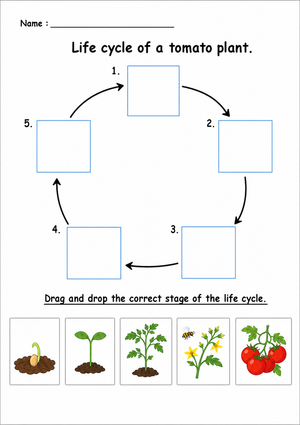
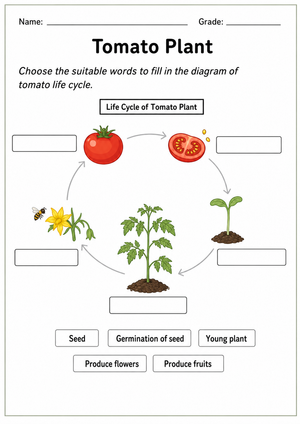
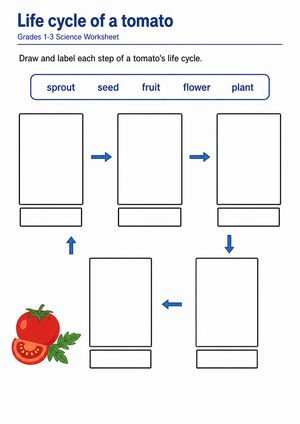
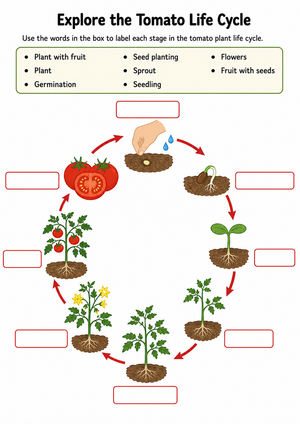
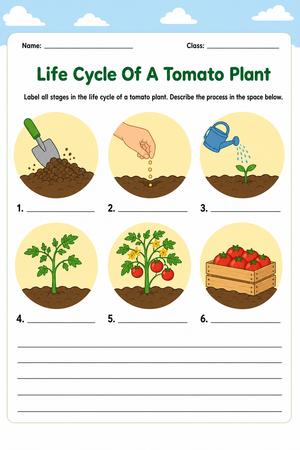
These tomato pdf worksheets for 3rd grade give teachers a focused set of resources covering plant anatomy, life cycle sequencing, and the botanical classification of a fruit that most students have eaten without ever thinking about scientifically. Each worksheet targets a distinct concept, which keeps the cognitive load appropriate for eight- and nine-year-olds who are still building science vocabulary alongside reading skills.
The Five Stages Students Work Through
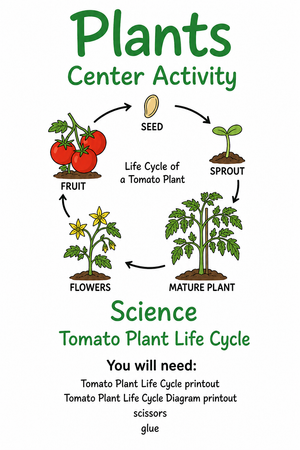
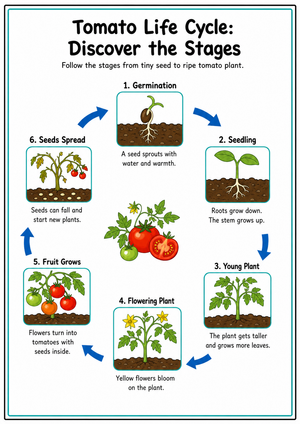
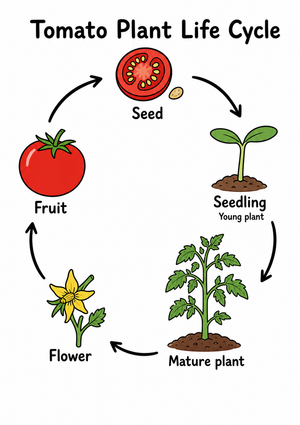
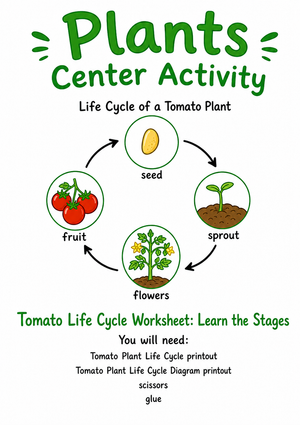
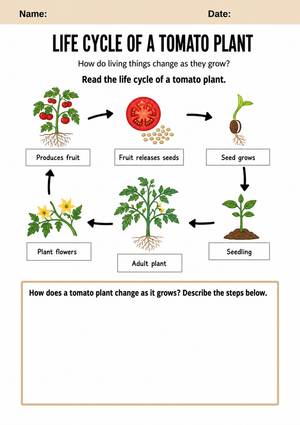
The life cycle sequence runs through five distinct stages, each introducing a new biological function rather than just a new shape or size:
- Seed — The embryo sits dormant until germination conditions are met: warmth, moisture, and oxygen. Students often underestimate how specific those conditions are.
- Seedling — The first leaves to emerge are cotyledons, which burn through the seed's stored food supply while true leaves develop. Once the true leaves open, photosynthesis takes over.
- Mature plant — The stem thickens, the root system spreads, and the plant builds the structural capacity to hold fruit. Nothing reproductive has happened yet.
- Flower — Yellow flowers appear and require pollination — usually by wind or bees — before they can set fruit. This is the stage where most students have the deepest conceptual gaps.
- Fruit and seed — After pollination, the ovary swells into a green tomato, ripens, and carries new seeds that restart the cycle.
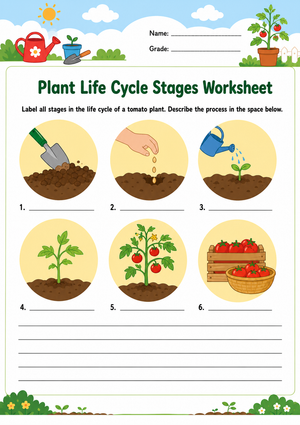
Each worksheet in the sequence asks students to do something concrete with that stage: label a diagram, rewrite a description in their own words, or place events in order using a cut-and-sort format. The sequencing worksheet in particular works well as a formative check after the initial lesson — you can see at a glance whether students understand that flowering comes after the mature plant stage, which is a predictable stumbling point.
Plant Parts and What They Actually Do
Anatomy worksheets have students label roots, stem, leaves, flowers, and fruit on a tomato plant diagram. The goal isn't identification alone — it's function. A student who writes "roots" next to the correct arrow but can't explain that roots absorb water and minerals from the soil hasn't yet understood how the plant's system works. The worksheets push past labeling by including a matching component that connects each structure to its role in the plant's survival.
One teaching moment the anatomy worksheet naturally sets up: ask students where the seeds appear on the diagram, then ask where those seeds will end up next season. That single question bridges anatomy directly back to the life cycle, and it tends to stick because students arrive at the connection themselves rather than being told it.
The Fruit-or-Vegetable Debate as a Science Lesson
Botanically, a tomato is a fruit. It develops from the ovary of a flower and carries seeds — that is the scientific criterion, full stop. In cooking, it functions as a vegetable because of its savory flavor and how it's used in sauces and salads. The U.S. Supreme Court actually weighed in on this in 1893, ruling that tomatoes qualified as vegetables for trade and tariff purposes, which gives teachers a genuine opening to explain that scientific categories and legal or culinary ones don't always align. Third graders find this surprising, which is exactly the kind of productive cognitive friction that makes a concept memorable.
Students resist the botanical answer at first — they know tomatoes belong in pasta sauce, not fruit salad. That resistance is worth leaning into rather than bypassing. The classification worksheet asks students to sort produce images based on whether each item contains seeds and develops from a flower. The sorting activity generates real argument in the room, especially when students encounter bell peppers, cucumbers, and squash and realize those are technically fruits too.
Lesson-Planning Strategies to Get the Most From These Worksheets
The most effective sequence starts with a whole-group introduction before students touch any paper. Cut a tomato open in front of the class and point to the seeds while asking where they think those seeds come from on the plant. That five-minute moment connects the abstract worksheet content to something physical and immediate. Then move to the anatomy labeling worksheet as direct instruction practice, followed by the life cycle sequencing worksheet a day or two later once students are ready to synthesize.
These tomato pdf worksheets for 3rd grade also work well as the anchor activity during a two-week seed-germination investigation. Plant seeds in clear plastic cups lined with damp paper towels so the root emergence is visible from outside the cup — students can observe the radicle appearing before the shoot breaks the surface. Pair each stage of that live investigation with the corresponding worksheet so students are recording what they're seeing in real time. An observation journal format — where students note plant height, leaf count, and visible changes each session — supports the data-collection practices in NGSS alongside the life cycle content, and it gives you written evidence of student thinking across the unit.
Common Misconceptions to Watch For and Correct
The most frequent sequencing error is placing the flower stage before the mature plant stage. Students intuitively reason that "big plant equals finished growing," so they order: seed → seedling → flower → mature plant → fruit. That logic has surface plausibility, but it's incorrect — flowers appear on a plant that has already reached structural maturity. The cut-and-sort format surfaces this error quickly, and it's worth pausing to address it in discussion rather than just marking it wrong. Asking students to explain why the plant needs to be fully grown before it can flower usually generates the right reasoning.
On anatomy worksheets, students frequently reverse the functions of stem and roots — writing that the stem absorbs water from the soil and the roots transport it upward. A quick analogy helps: the roots are the straw, and the stem is the tube it connects to. More persistent is the phrase "leaves make food" appearing in student work without any connection to sunlight. Students who write that have memorized a sentence without grasping photosynthesis. The worksheets address this directly by asking students to name what the leaves need to do their job, not just what their job is.
Standard Alignment
NGSS 3-LS1-1 asks third graders to develop models describing that organisms have unique and diverse life cycles but all share the stages of birth, growth, reproduction, and death. The tomato plant maps cleanly onto all four: germination maps to birth, the seedling and mature plant stages map to growth, flowering and pollination map to reproduction, and the plant's natural senescence after fruiting maps to death. The worksheets are organized around this framework, so students build the model the standard requires rather than simply reading about it.
The classification activities — sorting produce by botanical definition — connect to NGSS Science and Engineering Practice 6, constructing explanations using evidence. That's a natural extension for classes that need to engage the practices alongside the content standard, and it makes the fruit-or-vegetable debate genuinely disciplinary rather than just a fun fact.
Differentiating the Work for a Range of Learners
For students who struggle with the sequencing worksheet, reduce the number of stages to three first — seed, mature plant, and fruit — and add seedling and flower once the three-step version is solid. The diagram-labeling worksheets work well for students who need visual anchors; print a reference copy with one label already filled in to give them a starting point without removing the thinking entirely.
These tomato pdf worksheets for 3rd grade extend cleanly for students ready for more: ask them to compare the tomato life cycle to another plant — a corn stalk, a sunflower, a bean vine — and identify what the two cycles share versus where they diverge. That comparison reinforces the "unique and diverse but sharing common stages" language in NGSS 3-LS1-1 at a deeper level. Students who are strong readers can research the role of specific pollinators and annotate the flowering worksheet with that additional information, which turns a labeling task into a genuine research application.
Frequently Asked Questions
Do these worksheets require students to have live plants in the classroom?
No. Each worksheet stands on its own using diagrams, descriptions, and sorting activities. That said, pairing the life cycle sequencing worksheet with a classroom germination experiment — even a single seed in a clear plastic cup — gives students a direct observational reference that makes the abstract stages concrete. The worksheets work without the plants; they work better with them.
What is the reading demand on these worksheets?
The vocabulary is at the 3rd grade science level — words like "germination," "cotyledon," "pollination," and "photosynthesis" appear with context clues built into the activity. Students reading below grade level may need support with those terms the first time through, but the visual and sorting components mean that reading ability alone doesn't determine whether a student can demonstrate understanding of the life cycle content.
How should I assess these — as classwork or as a quiz grade?
The sequencing and labeling worksheets work best as formative classwork, not summative grades. Use them to see where students are mid-unit so you can address errors before they calcify into wrong mental models. The classification activity — sorting produce items by botanical definition — makes a reasonable end-of-unit performance check, since it asks students to apply a concept rather than recall a label. That application task gives cleaner information about actual understanding than a diagram-labeling exercise does.
Do these worksheets connect to anything beyond a standalone plant unit?
These tomato pdf worksheets for 3rd grade fit naturally inside a broader life cycles unit that also covers animal life cycles. The plant-versus-animal comparison is central to what NGSS 3-LS1-1 asks students to think about — the idea that a tomato plant and a frog both move through birth, growth, reproduction, and death, even though the specifics look nothing alike. Making that parallel explicit is one of the strongest conceptual moves in the unit, and the worksheets are organized to support it.












 Interactive Worksheet Maker
 Quiz Maker
 Word Search Maker
 Crossword Puzzle Maker
 Word Scramble Generator
 Sentence Scramble Generator
 Handwriting Worksheet Generator
 Name Tracing Generator
 Fill In The Blank Generator