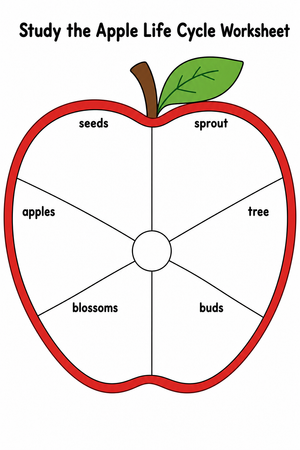
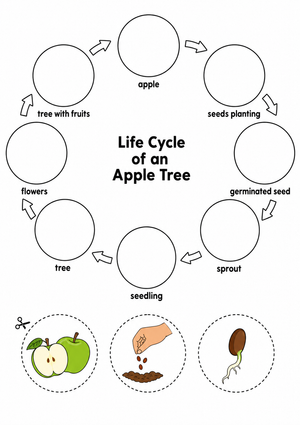
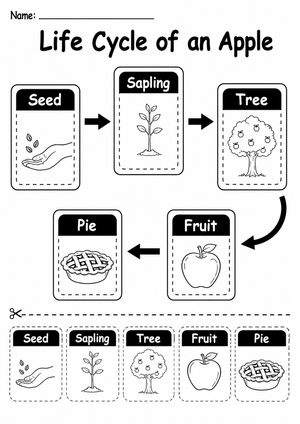
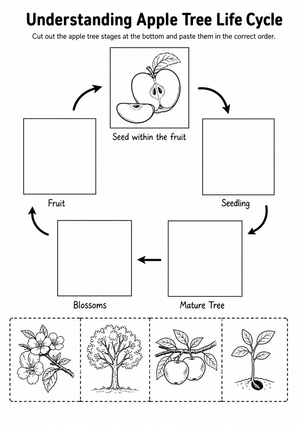
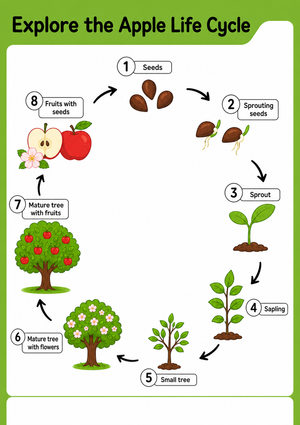
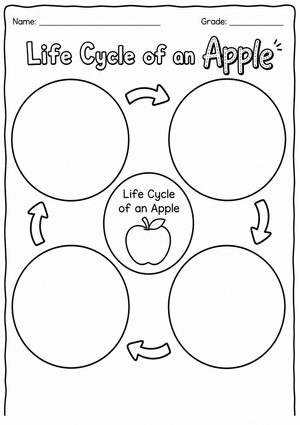
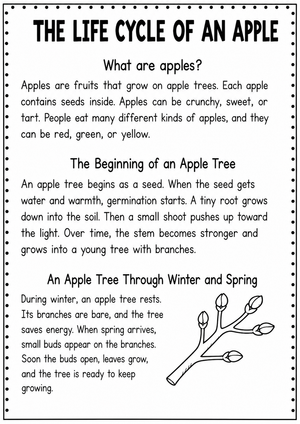
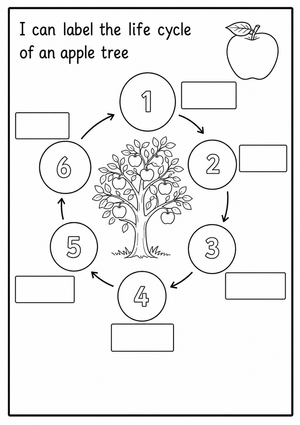
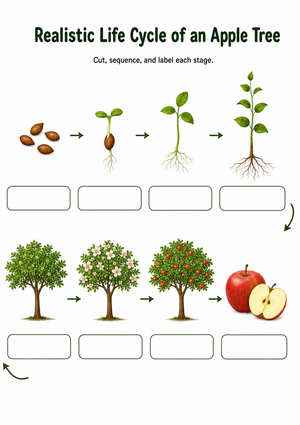
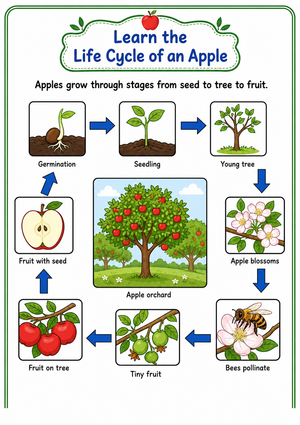
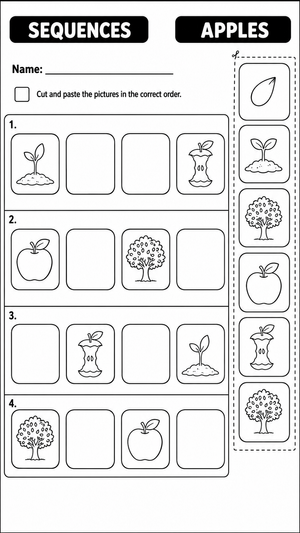
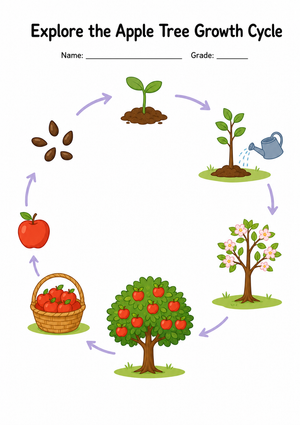
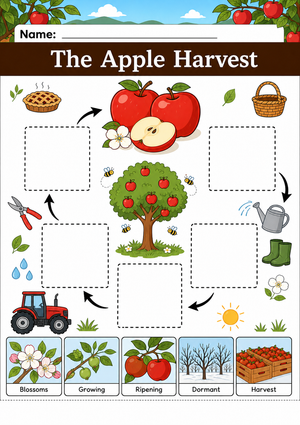
These 3rd grade apple life cycle printable worksheets give teachers a print-ready set of activities covering all six phases of apple tree development — seed germination, early sprout growth, sapling establishment, mature tree, spring blossom and pollination, and fruit formation with seed dispersal. Each worksheet addresses one phase in depth, so the set works as a sequenced unit or as standalone review materials teachers can pull individually when a concept needs revisiting.
What Each Worksheet Covers
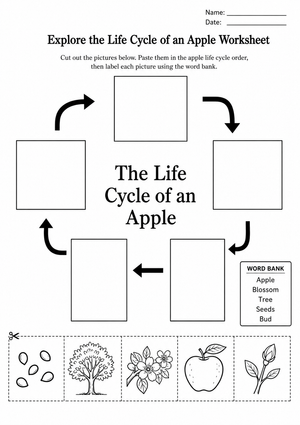
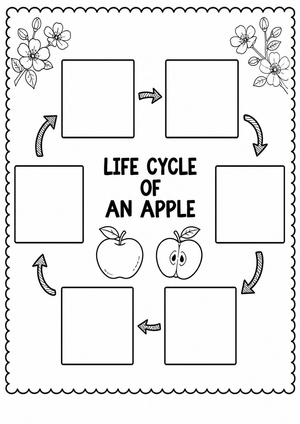
The tasks across the set move between four skill types: sequencing, labeling, diagram completion, and short written explanation. The sequencing worksheet asks students to number or physically arrange six stage cards in correct order — a task that looks straightforward but surfaces a predictable gap between recognizing a labeled diagram and being able to reconstruct it independently. The labeling worksheets cover two separate structures: the apple fruit itself (skin, flesh, core, seed) and the apple blossom (petal, stamen, pistil). Getting the blossom vocabulary established early matters because pollination becomes much harder to describe in writing without it.
Two worksheets focus on written response. In one, students describe how a bee moves pollen between flowers and explain what would happen to the orchard if no bees visited that spring. In the other, students explain the tree's seasonal cycle — why it drops its leaves and fruit in autumn, what dormancy means, and why the same tree that looks lifeless in January produces blossoms in April. These written tasks show teachers whether students understand biological process or are simply repeating a vocabulary list.
One worksheet targets dormancy exclusively, which gets skipped or rushed in many units. Most third graders believe plants die in winter, so a living tree resting through freezing temperatures is a genuinely surprising concept that requires active instruction, not just exposure. The dormancy worksheet pairs a labeled cross-season diagram with a short cloze passage that provides the vocabulary before students write independently — giving them language to work with rather than asking them to invent it from scratch.
These 3rd grade apple life cycle printable worksheets are built around consistent NGSS vocabulary, so terms like germinate, pollinate, disperse, and dormant appear across every worksheet in the set rather than shifting word choices from one activity to the next.
Student Mistakes That Surface Every Time This Unit Runs
The most persistent sequencing error is placing fruit before pollination. Third graders know apples grow on trees, so they tend to anchor the apple as the obvious result and work backward through the diagram. This isn't a reading problem — it reflects how students experience apple trees in real life, where the visible fruit is the starting point and the invisible biology happens before it. The sequencing worksheet addresses this by having students trace the path from blossom to bee activity to seed development, rather than labeling a finished apple and calling the cycle complete.
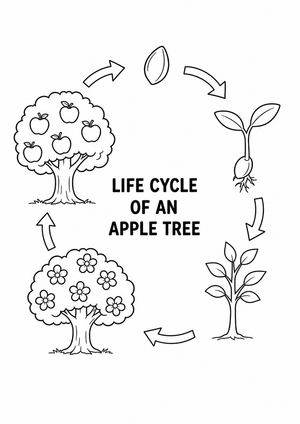
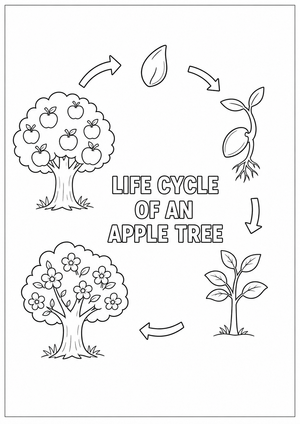
A related problem: students treat the apple as the endpoint of the cycle rather than a stage within it. They draw the fruit at the bottom of a diagram and stop, never connecting the seed inside the apple back to germination. Life cycle diagrams that use arrows curving from fruit back to seed — and from seed back to sprout — force students to engage with the circular structure. A student who draws a line rather than a loop probably hasn't internalized the concept yet, regardless of how accurate their individual labels are.
Dormancy generates a specific, recurring written error. When asked "What happens to the apple tree in winter?" a predictable student response is: It dies and a new tree grows in the spring. This matters more than it might seem. If the tree dies each year, then pollination, fruit production, and the next year's harvest belong to a new organism — and the student's mental model of a single living tree producing crops for decades falls apart entirely. Correcting this misconception early, before students encounter the fact that a tree grown from seed takes five to eight years to bear its first fruit, prevents a second wave of confusion later in the unit.
Building These Worksheets Into Your Science Block
Most teachers run this unit over two to three weeks, assigning each worksheet as a follow-up activity after a brief direct instruction segment. The sequencing worksheet is most effective on day two — after students have seen a labeled diagram but before they've had to reconstruct it on their own. That gap between "I recognize it" and "I can reproduce it" is exactly where the activity does its real work.
The 3rd grade apple life cycle printable worksheets hold up well as Monday warm-ups during apple season, roughly mid-September through late October, when the topic connects directly to the trees students walk past every day. One worksheet per week as a brief review keeps vocabulary active without requiring a full re-teach each time.
For teachers who can bring a few apples into the classroom, the anatomy labeling worksheet becomes noticeably sharper when students cut an apple open first. Let them find the seeds, count them, and observe the core before they pick up a pencil. The number of blank or guessed answers on that worksheet drops considerably when students have handled the actual object. The same principle applies to blossoms — even a close-up photograph shown under a document camera before the labeling task reduces confusion between petals and stamens.
Before students complete the pollination worksheet, a brief classroom simulation helps considerably. Give students a pipe cleaner and a pinch of yellow craft material to represent a bee carrying pollen between paper flower cutouts. Even five minutes of that hands-on activity sharpens the written responses, particularly for students who struggle to describe processes they've never observed directly.
Standard Alignment
These worksheets address NGSS 3-LS1-1, which asks third graders to develop models to describe that organisms have unique and diverse life cycles but share the core components of birth, growth, reproduction, and death. The apple tree maps directly onto all four: seed germination represents birth, sapling and tree growth covers the growth component, pollination and fruit production address reproduction, and seasonal dormancy leading to eventual decline covers the death component. Teachers working toward a summative model task for 3-LS1-1 find that the sequencing and diagram worksheets serve as reliable formative checkpoints in the days before that final assessment.
The anatomy labeling work also connects to NGSS 3-LS3-2, which addresses how the environment influences traits. Students who understand that seeds from one apple tree may produce fruit that differs from the parent tree are beginning to engage with this standard at its most accessible level. These two standards frequently appear within the same instructional unit, and the worksheets support both without treating either as secondary.
Adjusting the Set for Mixed-Ability Learners
Students who need additional support work best with the labeling and sequencing worksheets that include a word bank. Rather than retrieving vocabulary cold, they can focus on matching the right term to the right structure — a task that still requires real understanding but reduces the cognitive load of simultaneous recall and application. Pairing these students with a partner during the card sort before asking them to write independently is an effective in-class move that doesn't require producing a separate version of the worksheet.
Students who move quickly through the set benefit from the open-ended extension prompt on the pollination worksheet: Why would an apple orchard containing only one tree have difficulty producing fruit? That question requires applying cross-pollination knowledge to a new context, and it isn't answerable by re-reading a labeled diagram.
The 3rd grade apple life cycle printable worksheets work across a range of reading levels because the core tasks are visual and structural — labeling, sequencing, diagram completion — rather than reading-dependent. Written response sections are brief by design. Teachers working with students who find written production difficult can accept annotated diagram labels as equivalent evidence of understanding without compromising what the assessment is actually measuring.
Frequently Asked Questions
Do the worksheets require any special materials?
No special materials are required. Each worksheet prints on standard letter paper. The cut-and-paste sequencing activity needs only scissors and a glue stick. Some teachers bring in a real apple for the anatomy labeling worksheet, which sharpens student accuracy noticeably, but the worksheet functions without one.
What prior knowledge do students need before starting this set?
Students benefit from some familiarity with basic plant parts — stem, root, leaf — before beginning the blossom labeling worksheet, but no prior apple-specific knowledge is required. Most third graders who completed a basic plants unit in second grade are ready for this set without additional preparation.
Can these worksheets be used for assessment purposes?
The sequencing and labeling worksheets work well as formative checks — a completed diagram tells a teacher quickly whether a student can reconstruct the life cycle without support. The written response worksheets give a clearer picture of conceptual understanding and work well as informal formative data collected midway through a unit. For summative purposes, these resources pair best with a teacher-designed task that asks students to produce their own life cycle model, which aligns more directly with what NGSS 3-LS1-1 actually requires students to demonstrate.
How long does each worksheet take to complete in class?
The labeling and sequencing worksheets typically take eight to twelve minutes for most third graders working independently. The written response worksheets run longer — about fifteen to twenty minutes — depending on how much discussion precedes independent work. The dormancy worksheet, which includes both a cloze passage and a written explanation, tends to run closer to twenty minutes and works best when students have already completed the seasonal diagram worksheet in a prior session rather than attempting both on the same day.












 Interactive Worksheet Maker
 Quiz Maker
 Word Search Maker
 Crossword Puzzle Maker
 Word Scramble Generator
 Sentence Scramble Generator
 Handwriting Worksheet Generator
 Name Tracing Generator
 Fill In The Blank Generator