


























Views
Downloads

Printable Pumpkin Life Cycle Worksheet | Grade 3 Science
Paste this activity's link or code into your existing LMS (Google Classroom, Canvas, Teams, Schoology, Moodle, etc.).
Students can open and work on the activity right away, with no student login required.
You'll still be able to track student progress and results from your teacher account.
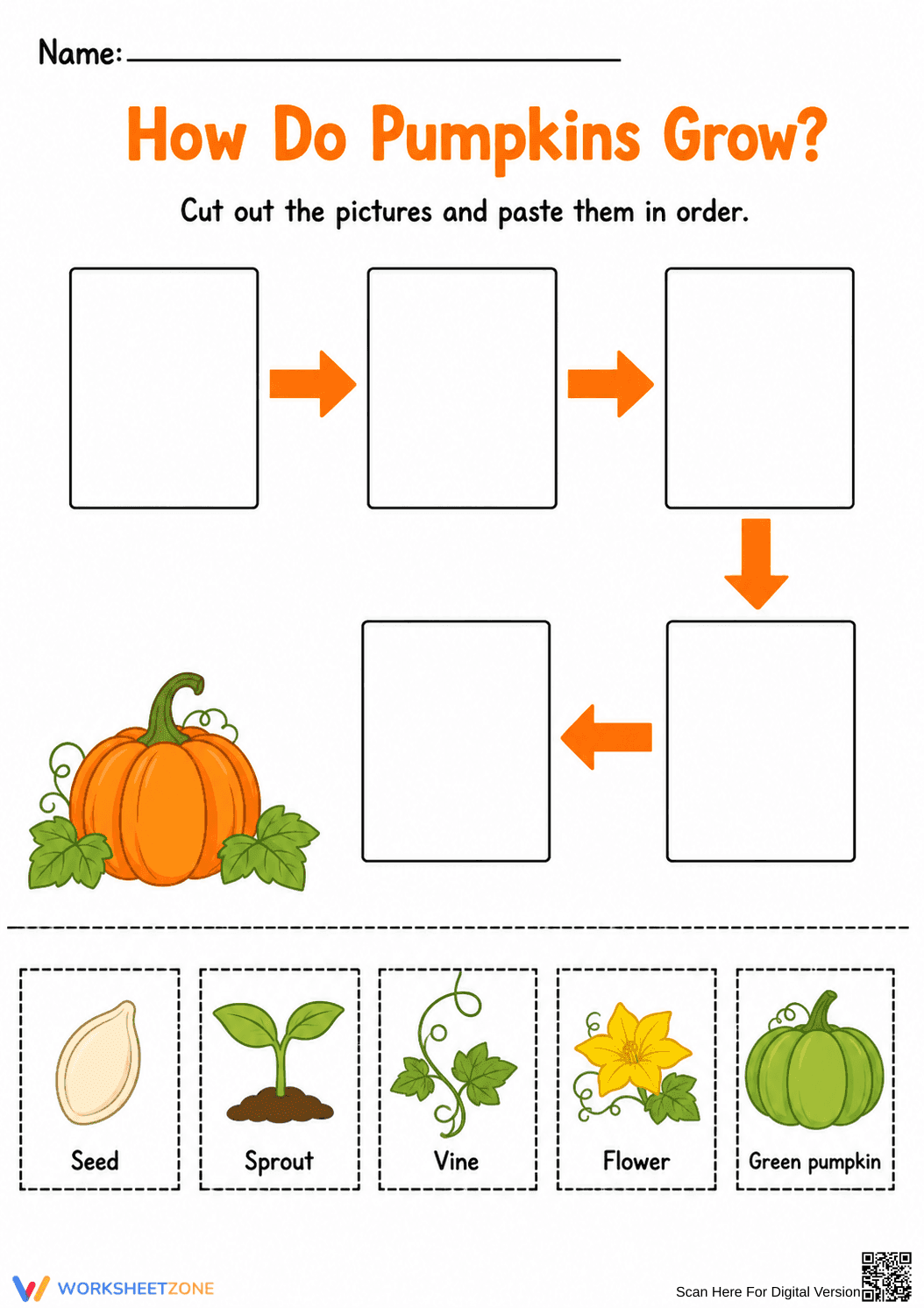
This Grade 3 science worksheet provides a hands-on approach to learning plant life cycles. Students cut and paste five distinct growth stages to sequence how a pumpkin develops from a seed into a mature fruit. This visual activity reinforces chronological thinking and biological concepts while keeping young learners actively engaged.
At a Glance
- Grade: 3 · Subject: Science
- Standard:
3-LS1-1— Sequence the growth stages of a plant life cycle- Skill Focus: Life Cycle Sequencing
- Format: 1 page · 5 problems · Answer key included · PDF
- Best For: Independent practice and science centers
- Time: 15–20 minutes
This single-page resource features a five-step flowchart with directional arrows. The bottom includes five labeled cut-out illustrations: seed, sprout, vine, flower, and green pumpkin. Students snip these visual cues and glue them into the correct sequential boxes. An answer key is provided for immediate feedback.
Zero-Prep Workflow
This worksheet is designed for immediate classroom implementation. The entire preparation process takes under two minutes:
- Print (1 minute): Generate copies of the single-page PDF for your class roster.
- Distribute (1 minute): Hand out the sheets along with scissors and glue sticks.
- Review (5 minutes): Check student sequences against the provided answer key.
Because the instructions are self-explanatory and the task is highly visual, this activity is an excellent addition to any emergency sub plan.
Standards Alignment
This activity aligns to 3-LS1-1: Develop models to describe that organisms have unique and diverse life cycles but all have in common birth, growth, reproduction, and death. It also supports CCSS.ELA-LITERACY.RI.3.3 by reinforcing sequential relationships. Both standard codes can be copied directly into lesson plans, IEP goals, or district curriculum mapping tools.
How to Use It
Deploy this worksheet during independent practice, immediately following direct instruction on plant growth. It serves as an excellent hands-on science center activity. Expect completion to take 15 to 20 minutes. For a formative assessment observation tip, watch how students handle the transition from vine to flower. If a student places the flower before the vine, it provides a quick intervention moment to discuss how plants must grow structural supports before blooming.
Who It's For
This resource is optimized for third-grade general education students, but its highly visual nature makes it exceptionally accessible for English Language Learners and students requiring modified assignments. The combination of text labels and clear illustrations provides built-in scaffolding. Pair this worksheet with a read-aloud book about autumn harvests or a classroom anchor chart detailing the parts of a plant to maximize comprehension.
Understanding biological progressions through visual modeling is a critical component of elementary science education. When students sequence the growth stages of a plant life cycle, they move beyond rote memorization and begin to recognize predictable patterns in nature. According to EdReports 2024, hands-on sequencing tasks significantly improve long-term retention of STEM concepts in early elementary grades. By physically manipulating the stages of development, learners build stronger cognitive connections regarding how organisms grow and change over time. This specific activity targets 3-LS1-1, ensuring that the foundational concepts of birth, growth, and reproduction are firmly established before students encounter more complex ecosystems in upper grades. Utilizing tactile methods like cutting and pasting provides the dual benefit of fine motor practice alongside rigorous scientific modeling.


