


























Views
Downloads

Printable Pumpkin Life Cycle Writing | Grade 2 Science
Paste this activity's link or code into your existing LMS (Google Classroom, Canvas, Teams, Schoology, Moodle, etc.).
Students can open and work on the activity right away, with no student login required.
You'll still be able to track student progress and results from your teacher account.
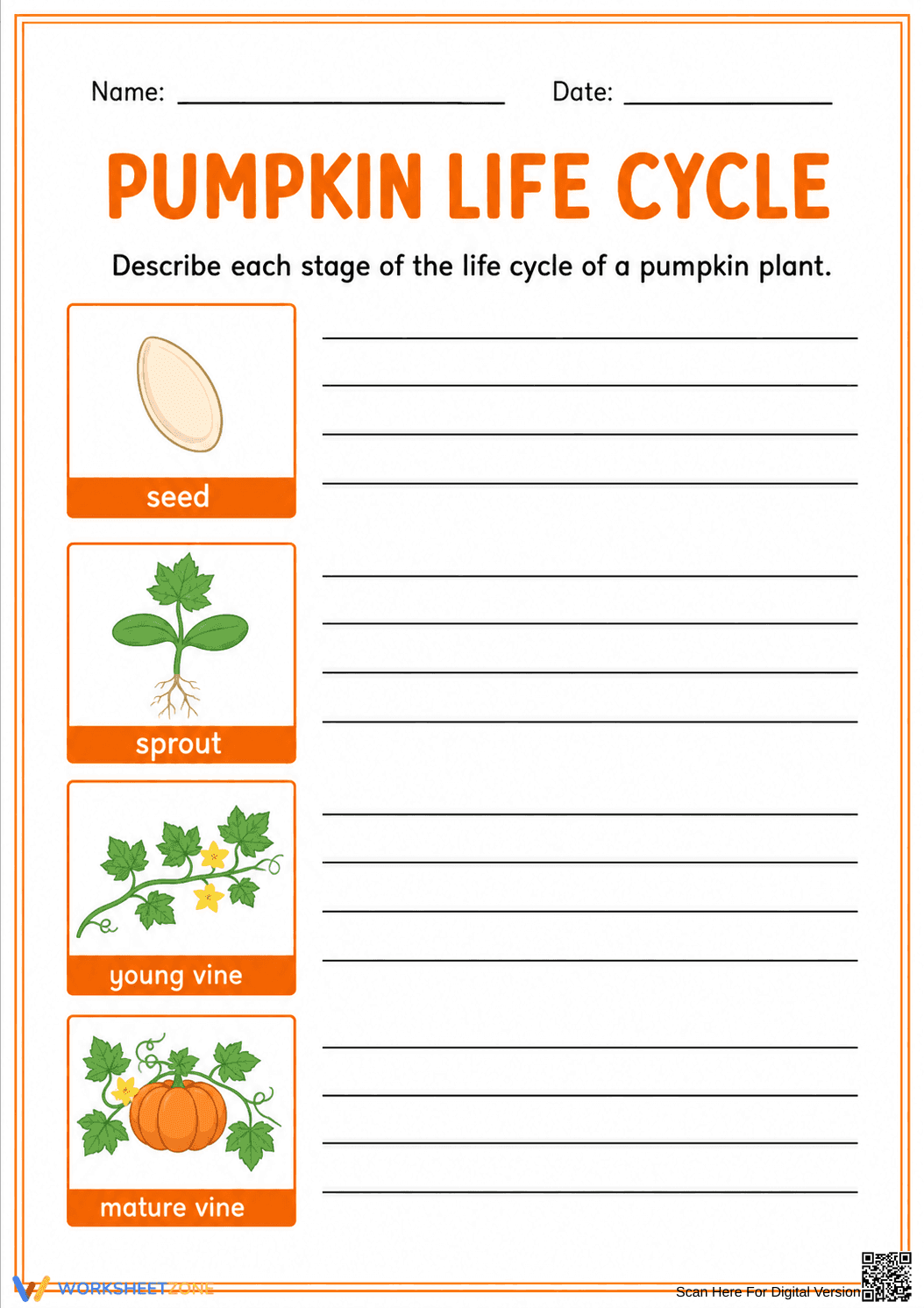
This cross-curricular worksheet helps second-grade students practice informative writing while exploring the stages of a pumpkin's life cycle. By combining science concepts with literacy skills, learners observe visual prompts and write descriptive sentences for each developmental phase, strengthening both their scientific vocabulary and sentence structure.
At a Glance
- Grade: 2 · Subject: Science & ELA
- Standard:
CCSS.ELA-LITERACY.W.2.2— Write informative texts using facts and definitions.- Skill Focus: Informative Writing & Life Cycles
- Format: 1 page · 4 problems · Answer key included · PDF
- Best For: Independent practice
- Time: 15–20 minutes
This single-page resource features four distinct writing tasks corresponding to the key stages of a pumpkin's growth: seed, sprout, young vine, and mature vine. Each section provides a clear illustration alongside a labeled vocabulary word and lined space for student writing. The straightforward layout encourages students to focus on constructing complete sentences without overwhelming them. A sample response guide is included to help educators evaluate scientific vocabulary.
Designed for immediate use, this activity requires minimal preparation:
- Print (1 minute): Download the PDF and print a class set.
- Distribute (1 minute): Hand out during a science block or writing center.
- Review (3 minutes): Briefly discuss the four vocabulary words before independent work.
With under two minutes of prep time, this worksheet is an excellent option for sub plans or quick transitions.
This activity aligns with primary standard CCSS.ELA-LITERACY.W.2.2: Write informative/explanatory texts in which they introduce a topic, use facts and definitions to develop points, and provide a concluding statement or section. It also supports Next Generation Science Standards by encouraging students to observe and describe the unique life cycles of organisms. Both standard codes can be copied directly into lesson plans, IEP goals, or district curriculum mapping tools.
This worksheet functions perfectly as independent practice following a lesson on plant life cycles. Teachers can also utilize it as a formative assessment during a literacy block to evaluate informative sentence writing. While students work, educators can observe whether learners successfully incorporate the provided stage labels into their sentences. Expect second graders to complete the four tasks within 15 to 20 minutes.
This resource is primarily designed for second-grade students developing their informative writing skills, though it can easily be adapted for advanced first graders or third graders needing foundational review. For students requiring additional scaffolding, teachers can provide sentence frames or a supplementary word bank featuring action verbs like "grows," "develops," and "produces." It pairs exceptionally well with a read-aloud book about pumpkins or a hands-on seed-planting activity.
Integrating literacy into science instruction significantly enhances student comprehension and vocabulary retention across multiple domains. When students engage with standard CCSS.ELA-LITERACY.W.2.2 to write informative texts using facts and definitions, they actively process and internalize domain-specific knowledge rather than just memorizing it. According to Fisher & Frey (2014), cross-curricular writing tasks require learners to synthesize visual information and articulate their understanding, which deepens cognitive engagement compared to passive reading alone. This pumpkin life cycle worksheet provides the exact structured opportunity students need to practice this critical synthesis. By prompting learners to describe sequential scientific processes using specific vocabulary, educators facilitate stronger connections between observational science and expressive language skills. Regular, targeted practice with these integrated tasks ensures students build the foundational communication abilities necessary for more advanced academic writing and scientific inquiry in later elementary grades.


