


























Views
Downloads

Essential Pumpkin Life Cycle Worksheet | Grade 3 Ready
Paste this activity's link or code into your existing LMS (Google Classroom, Canvas, Teams, Schoology, Moodle, etc.).
Students can open and work on the activity right away, with no student login required.
You'll still be able to track student progress and results from your teacher account.
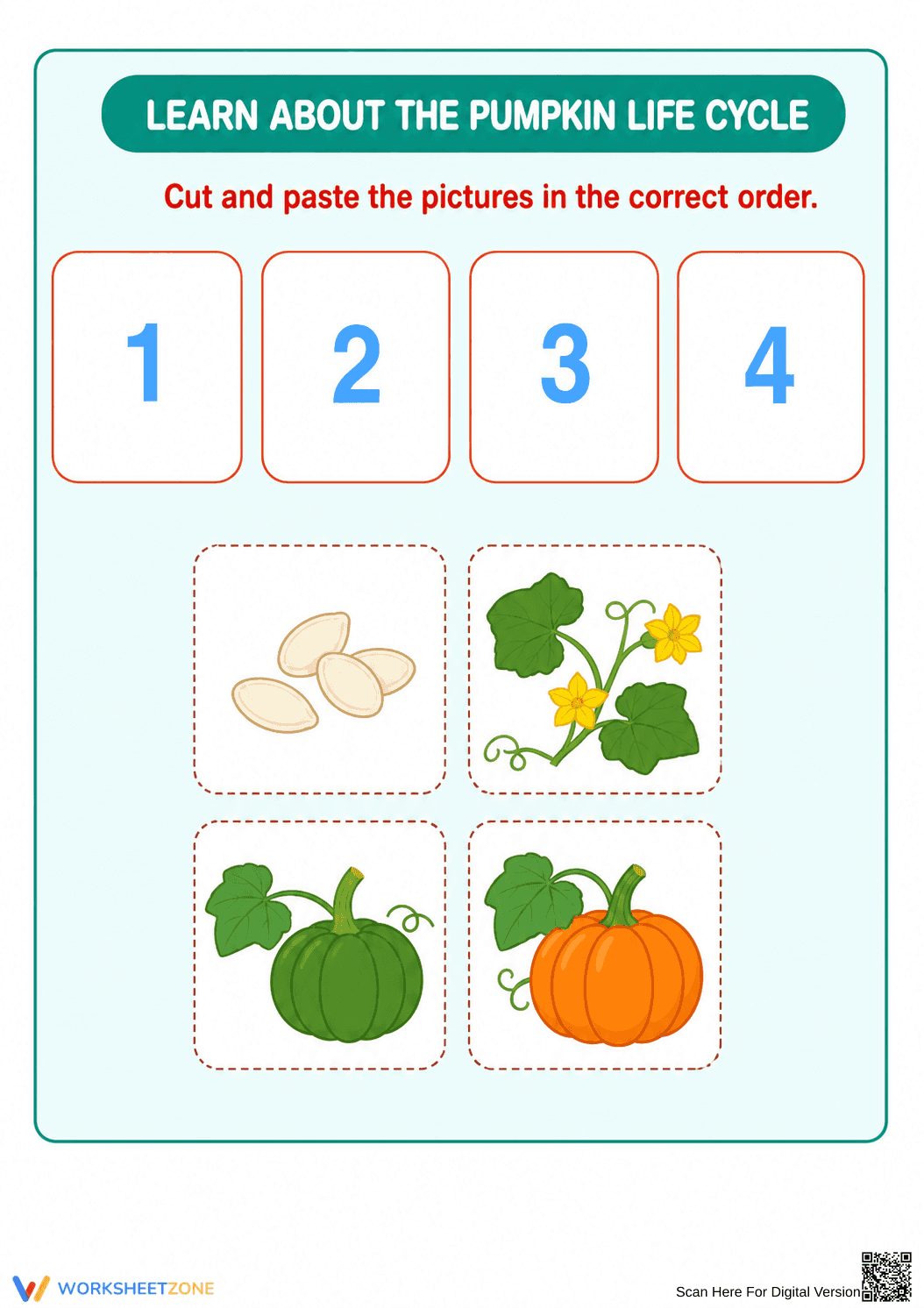
This Grade 3 pumpkin life cycle worksheet provides a hands-on sequencing activity to help students visualize the biological progression of a plant. By ordering the stages from seed to harvest, learners develop a concrete understanding of plant growth and development while practicing fine motor skills through a cut-and-paste format.
At a Glance
- Grade: 3 · Subject: Science
- Standard:
3-LS1-1— Develop models to describe that organisms have unique and diverse life cycles- Skill Focus: Biological Sequencing
- Format: 1 page · 4 tasks · Answer key included · PDF
- Best For: Fall science centers and introductory biology
- Time: 15–20 minutes
This single-page PDF features a clear, numbered sequencing grid and four high-quality illustrations representing the pumpkin's growth. Students interact with images of seeds, flowering vines, immature green fruit, and mature orange pumpkins. The layout is designed for easy cutting and pasting, requiring only basic classroom supplies like scissors and glue sticks to complete the model.
Teachers can implement this activity in under 2 minutes. First, print the required number of copies for the class. Second, distribute the sheets along with scissors and glue. Third, facilitate a brief review of the results as a whole group. This worksheet is an ideal emergency sub plan or a quick formative assessment during a larger botany unit, requiring zero teacher preparation time.
Standards Alignment: Primary standard `3-LS1-1`: "Develop models to describe that organisms have unique and diverse life cycles but all have in common birth, growth, reproduction, and death." This activity serves as a foundational model for plant reproduction and life stages. Both standard codes can be copied directly into lesson plans, IEP goals, or district curriculum mapping tools.
Use this worksheet as a concluding activity after a read-aloud about autumn harvests to reinforce chronological order. It also works well as a formative assessment; observe if students can distinguish between the flowering stage and the immature fruit stage. Expected completion time ranges from 15 to 20 minutes depending on student scissor proficiency.
This resource is designed for Grade 3 science students, but is easily adaptable for Grade 2 or Grade 4 learners needing visual support. It pairs naturally with a classroom pumpkin dissection or a "seed to plant" anchor chart. The clear visual cues make it accessible for English Language Learners and students with diverse learning needs.
According to the RAND AIRS 2024 report on elementary science instruction, tactile sequencing activities significantly improve long-term retention of biological concepts in early elementary learners. This worksheet aligns with the 3-LS1-1 standard, focusing on the plain-English skill of modeling life cycles through chronological ordering. By engaging in the physical act of cutting and pasting, students move beyond passive observation to active participation in the scientific modeling process. Research from Fisher & Frey (2014) suggests that visual scaffolds, such as the four-stage progression used here, help bridge the gap between vocabulary acquisition and conceptual mastery. This resource provides a structured, evidence-based approach to teaching the pumpkin life cycle, ensuring that students can identify the critical transitions from seed to mature fruit within a classroom setting.


