


























Views
Downloads
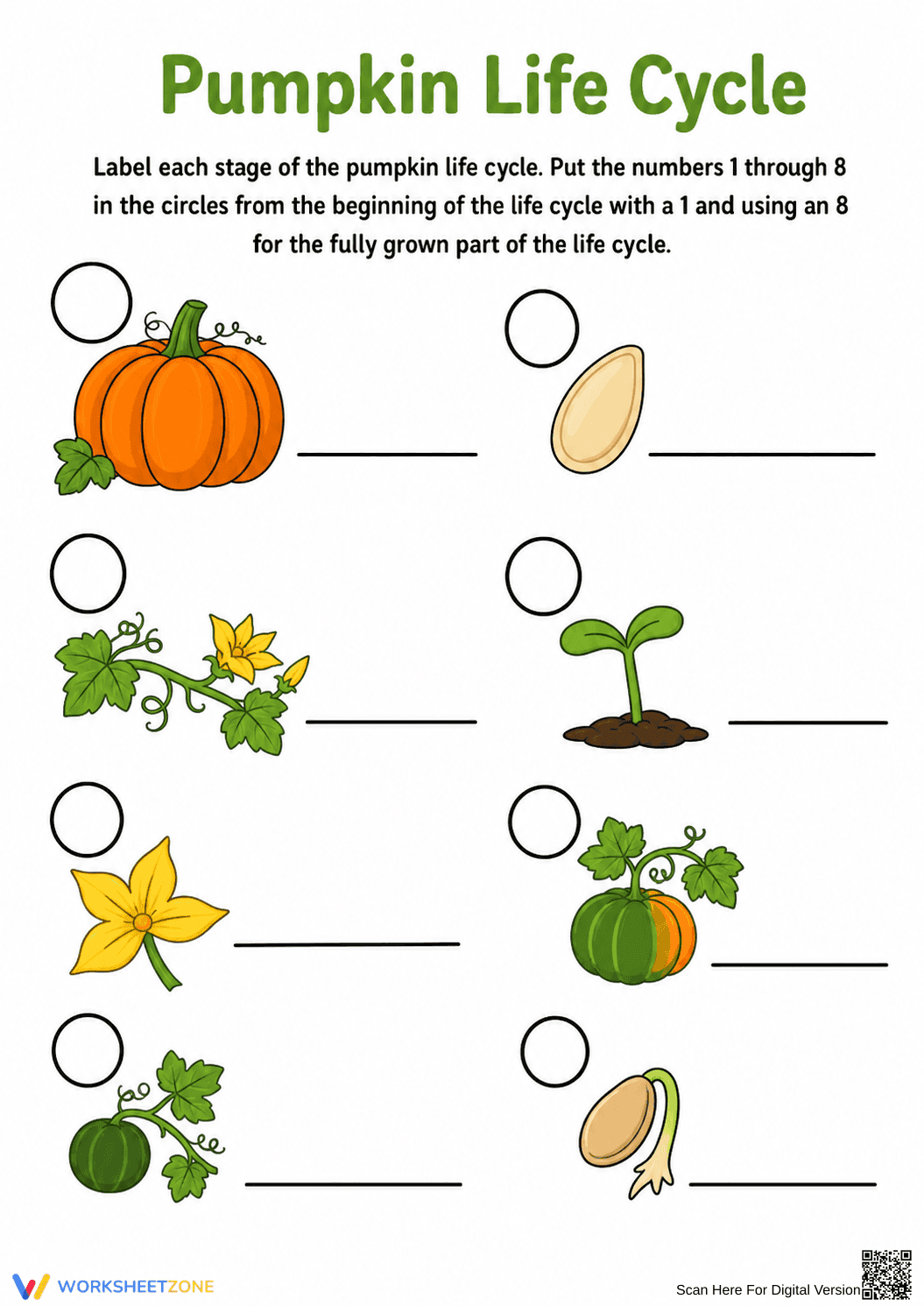

Grade 2 Pumpkin Life Cycle — Printable No-Prep Worksheet
Paste this activity's link or code into your existing LMS (Google Classroom, Canvas, Teams, Schoology, Moodle, etc.).
Students can open and work on the activity right away, with no student login required.
You'll still be able to track student progress and results from your teacher account.
This Grade 2 science worksheet helps students master the stages of plant growth by sequencing and labeling the pumpkin life cycle. By numbering and identifying each phase from seed to mature pumpkin, learners build foundational observation skills and scientific vocabulary in a fun, engaging format.
At a Glance
- Grade: 2 · Subject: Science
- Standard:
3-LS1-1— Describe that organisms have unique and diverse life cycles- Skill Focus: Sequencing and labeling plant growth stages
- Format: 1 page · 8 problems · Answer key included · PDF
- Best For: Independent practice or science centers
- Time: 10–15 minutes
What's Inside
This single-page resource features eight detailed, full-color illustrations depicting the journey of a pumpkin from a tiny seed to a fully grown orange gourd. Students are tasked with writing the correct stage name on the provided lines and numbering the corresponding circles from 1 to 8 to establish the correct chronological order. A complete answer key is included for quick grading.
Zero-Prep Workflow
- Print (1 min): Simply download the PDF and print a class set. The clear layout requires no special formatting.
- Distribute (1 min): Hand out the worksheets along with pencils. No extra materials or complex instructions are needed.
- Review (3 mins): Use the included answer key to quickly check student sequences or review together as a class.
Total teacher prep time is under two minutes, making this an ideal emergency sub plan or quick science center activity.
Standards Alignment
Aligned to 3-LS1-1, this worksheet supports the primary standard: "Develop models to describe that organisms have unique and diverse life cycles but all have in common birth, growth, reproduction, and death." It also supports the cross-curricular ELA standard CCSS.ELA-LITERACY.W.2.8 by having students recall information to label scientific diagrams. Both standard codes can be copied directly into lesson plans, IEP goals, or district curriculum mapping tools.
How to Use It
Use this worksheet as an independent practice activity after a direct instruction lesson on plant life cycles or fall seasonal changes. It also works perfectly as a formative assessment; observe whether students can correctly identify the transition from flower to green pumpkin, which is often a point of confusion. Expected completion time is 10 to 15 minutes.
Who It's For
This resource is designed for second-grade students, though it can easily be adapted for first graders with guided support or third graders needing a quick review. It pairs beautifully with a read-aloud book about pumpkins or a hands-on seed-planting activity to reinforce the concepts visually and physically.
Understanding biological sequencing is a critical component of early elementary science education, providing a foundation for more advanced ecological studies. By engaging with the 3-LS1-1 standard, students learn to describe that organisms have unique and diverse life cycles, recognizing the universal patterns of birth, growth, reproduction, and death. According to EdReports 2024, explicit instruction in sequencing and labeling scientific diagrams significantly improves students' ability to comprehend complex informational texts and biological processes. This targeted practice helps solidify the chronological progression of plant growth, ensuring learners can accurately track and predict developmental stages in various organisms. When young learners actively map out these stages, they transition from passive observers to analytical thinkers, building the essential cognitive frameworks required for future STEM success and environmental literacy.


