




























Views
Downloads
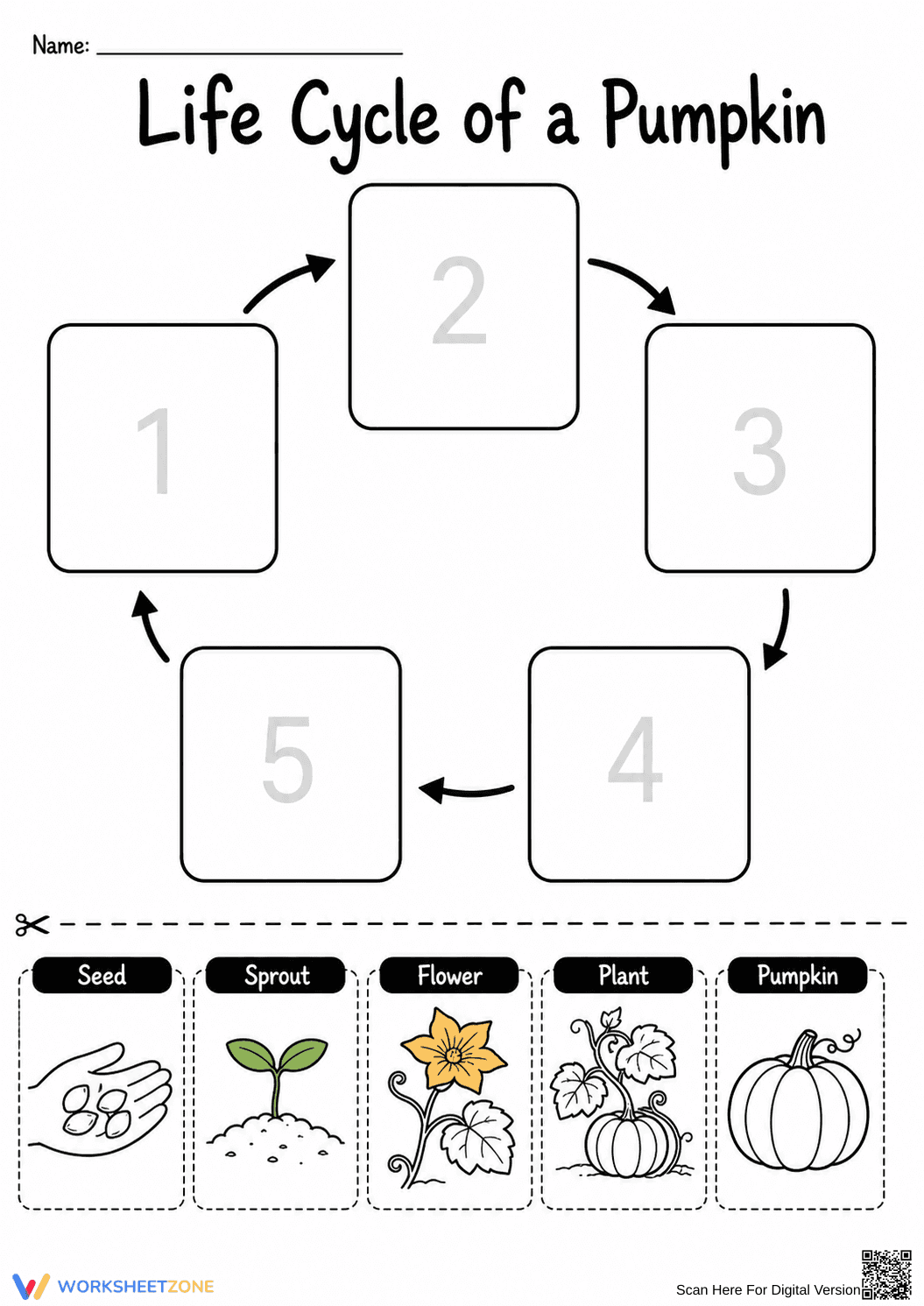

Pumpkin Life Cycle Worksheet | Grade 3 Printable

Paste this activity's link or code into your existing LMS (Google Classroom, Canvas, Teams, Schoology, Moodle, etc.).
Students can open and work on the activity right away, with no student login required.
You'll still be able to track student progress and results from your teacher account.
This Grade 3 science worksheet helps students master the stages of plant growth by sequencing the life cycle of a pumpkin. By cutting and pasting five distinct developmental phases, learners actively build their understanding of biological progression and reinforce essential fine motor skills in a single activity.
At a Glance
- Grade: 3 · Subject: Science
- Standard:
3-LS1-1— Develop models to describe organism life cycles- Skill Focus: Sequencing plant life cycles
- Format: 1 page · 5 problems · Answer key included · PDF
- Best For: Independent practice
- Time: 15–20 minutes
This resource features a clear, circular diagram with five numbered blank boxes representing the continuous loop of plant development. Students will find five distinct cut-out images depicting a seed, sprout, flower, plant, and mature pumpkin. The straightforward layout requires no additional teacher setup, and a complete answer key is provided to ensure accurate grading.
Designed for maximum efficiency, this zero-prep resource follows a simple workflow:
- Print (1 minute): Generate enough copies of the single-page PDF for your entire class.
- Distribute (1 minute): Hand out the pages along with scissors and glue sticks.
- Review (3 minutes): Quickly check the final pasted sequences against the provided answer key.
With under two minutes of total teacher preparation required, this activity functions perfectly as a reliable sub plan or a quick transition task during busy fall science units.
This activity is directly aligned to 3-LS1-1, requiring students to develop models to describe that organisms have unique and diverse life cycles but all have in common birth, growth, reproduction, and death. By physically arranging the stages of a pumpkin's growth, learners create a tangible model of this biological concept. Both standard codes can be copied directly into lesson plans, IEP goals, or district curriculum mapping tools.
Deploy this worksheet following direct instruction on plant biology to solidify concepts. It serves as an excellent independent practice station. Alternatively, use it as a formative assessment tool; observe students as they arrange the cut-outs before gluing to gauge their understanding of biological processes. Expect completion within 15 to 20 minutes.
This resource is primarily designed for third-grade science students, though it offers excellent foundational review for fourth graders needing extra support with life cycle concepts. The visual nature of the cut-and-paste format provides built-in differentiation for visual and kinesthetic learners, as well as English Language Learners acquiring new botanical vocabulary. Pair this activity with a read-aloud book about autumn harvests or a hands-on pumpkin seed observation lesson.
Aligning classroom materials with established scientific frameworks ensures students build accurate mental models of the natural world. This resource specifically targets 3-LS1-1, focusing on the critical ability to develop models to describe organism life cycles. According to a recent ScienceDirect TpT Analysis, interactive modeling activities like cut-and-paste sequencing significantly improve long-term retention of biological processes compared to passive reading alone. By physically manipulating the distinct stages of a pumpkin's development—from a tiny seed to a mature fruit—students engage multiple cognitive pathways, reinforcing both the specific botanical vocabulary and the broader concept of cyclical growth. This hands-on approach effectively bridges the gap between abstract scientific principles and concrete, observable phenomena. Consequently, it provides educators with a highly reliable, evidence-based tool for assessing student comprehension of foundational life science standards in the elementary classroom.


