These 3rd grade sunflower life cycle printable worksheets give students a concrete way to trace one of science's most satisfying storylines — seed to towering plant to seed again, all within a single growing season. Each worksheet addresses a specific part of that process: sequencing the five stages, labeling plant anatomy, matching vocabulary to definitions, and logging observations while classroom seeds sprout in cups on the windowsill. The resources stand alone, so teachers can pull one worksheet for a warm-up, build a full unit around the set, or drop individual activities into an existing plant science sequence.
The Specific Skills These Worksheets Target
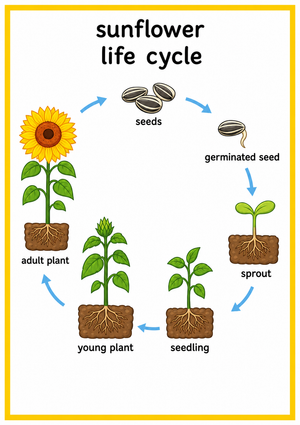
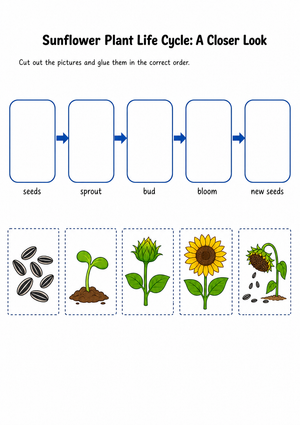
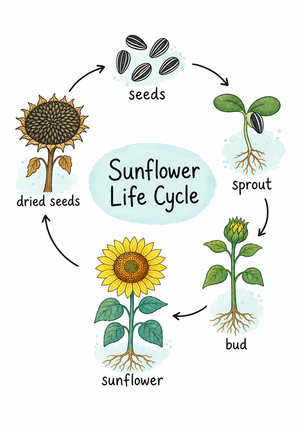
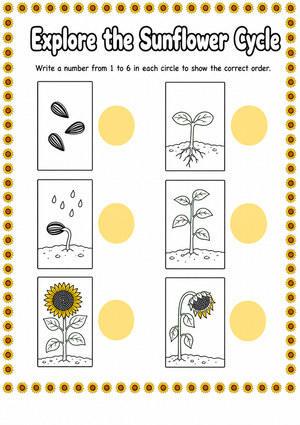
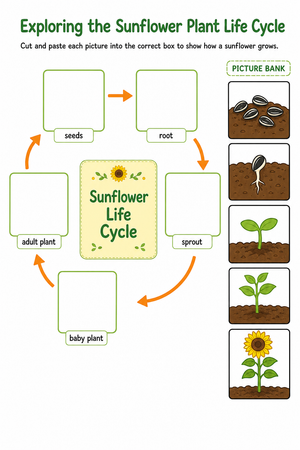
The five-stage sunflower life cycle — seed, germination, seedling, adult plant, seed production — drives the sequencing and labeling work across the set. Students cut out stage cards and arrange them in order, then narrate each transition in their own words. Anatomy labeling asks students to mark and identify structures including the taproot, cotyledons, true leaves, stem, flower head, and receptacle. Vocabulary work pulls terms directly from the sequencing activities so students encounter words like germination, pollination, and annual across multiple task formats before they are ever asked to define them independently.
Observation log worksheets add a data-collection layer. Students measure seedling height in centimeters, record leaf count, and sketch what they see on a given day. That combination — drawing, measuring, and writing — covers multiple skill areas in a single short session, which matters when science time runs 30 to 40 minutes in most third-grade blocks.
Standard Alignment
The set connects directly to NGSS 3-LS1-1, which asks students to develop models showing that organisms have diverse life cycles but share the common milestones of birth, growth, reproduction, and death. In classroom terms, that standard means students need to do more than name the stages — they need to explain the function of each stage and understand that the cycle repeats. The sequencing and cycle-wheel activities in 3rd grade sunflower life cycle printable worksheets ask students to articulate those connections rather than simply sort images. The vocabulary and observation work also supports the science and engineering practice of obtaining and evaluating information, a secondary NGSS strand built into the standard's implementation expectations.
Mistakes Students Make That These Worksheets Help You Catch
The most consistent error in this unit is conflating germination with the seedling stage. Students see the sprout pushing through the soil — a dramatic, visible event — and call that germination. The actual germination event happens underground: the seed coat splits, the radicle extends downward through the soil, and no above-ground growth has appeared yet. When students grow plants in opaque cups, that underground moment is invisible. Several worksheets in the set address this directly by asking students to describe what is happening beneath the soil during germination, which forces them to work with the conceptual process rather than the visual one.
A second pattern worth watching: students who correctly identify cotyledons on a labeled diagram will revert to calling them "the first leaves" in written responses, losing the precision the vocabulary work was meant to build. Asking students to use the term in one sentence before moving to the next worksheet keeps that language active. The observation logs are also where you discover which students understand that a life cycle is circular — they draw arrows looping from seed production back to the seed stage — versus those who treat it as a timeline with a beginning and a fixed end.
How to Build These Worksheets Into Your Plant Science Unit
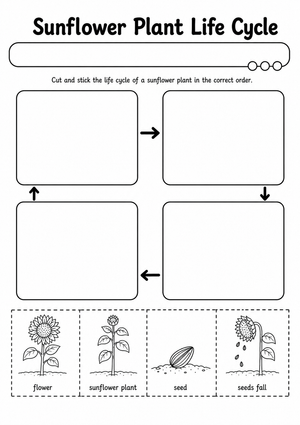
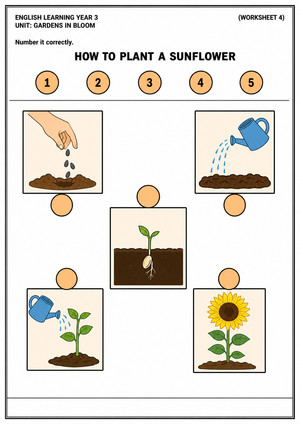
The sequencing worksheet works well as an entry task at the very start of the unit, before any direct instruction, so you get a baseline read on what students already know about plant growth. That same worksheet revisited at the unit's close becomes informal pre/post evidence of conceptual change — more useful in a grade-level data conversation than a multiple-choice quiz.
Pair the observation log worksheets with actual planted seeds from day one. Clear plastic cups let students see root growth below the soil line, which addresses the germination misconception directly. The Friday afternoon before morning meeting on Monday is a reliable slot for short observation entries — students have had two days away from the plant and notice change more acutely than they do during daily check-ins. The anatomy labeling worksheet slots neatly into the adult-plant phase of the unit, when students have a real flower or a detailed photograph to reference alongside the printed diagram.
Laminated sequencing cards stored in a labeled envelope at a science center give students repeated retrieval practice throughout the unit without consuming additional paper. Students arrange the order independently, check against a small answer key, and reset — a low-prep loop that takes less than five minutes and uses spaced retrieval rather than one concentrated review session.
Adjusting the Set for a Range of Learners
For students who need more support, word-bank versions of the vocabulary and labeling worksheets reduce the retrieval demand so students can focus on matching meaning to term rather than struggling with spelling. Sentence frames on the observation logs — "Today the seedling is ___ cm tall. I notice ___." — give reluctant writers a starting point without doing the thinking for them.
Students working beyond grade level do better with open-response extensions than with additional worksheets. Asking them to explain why the sunflower's one-year life cycle is an advantage compared to a tree's multi-year cycle pushes into the analytical thinking the standard implies. The heliotropism detail — that young sunflower buds track the sun east to west but stop turning once the stem stiffens — is a natural hook for students who want to go further, connecting back to photosynthesis rather than simply restating the life cycle sequence.
English language learners find the illustration-heavy worksheets especially accessible. The visual sequence work carries meaning even when academic vocabulary is still developing, and labeled diagrams double as personal reference tools students can keep in their science journals throughout the unit. The 3rd grade sunflower life cycle printable worksheets in this set include enough diagram detail that ELL students can participate in the same activities as their peers without needing a fully separate version.
Frequently Asked Questions
Why sunflowers rather than a generic flowering plant?
Sunflowers complete their full cycle in 80 to 120 days, which means students can observe real germination and seedling growth within a single semester. They are also large enough for students to make clear visual observations without magnification — a practical consideration in classrooms without microscopes. The plant anatomy is well-documented in student-facing reference materials, so vocabulary work connects directly to images students can find and check on their own.
Can each worksheet function without a live planting project?
Yes. The diagrams and stage descriptions in each worksheet include enough information for students to complete the activities without a living plant nearby. That said, the observation logs are most meaningful when students have something real to observe. Teachers who cannot run a classroom planting project can substitute time-lapse video footage of sunflower growth; students can log observations from the video almost as effectively as from a live plant, and the misconception about underground germination is easier to address when students can watch it frame by frame.
How does this topic fit into the broader 3rd grade science sequence?
NGSS 3-LS1-1 is typically introduced in the second or third unit of the year, after students have built basic observation and data-recording skills from earlier life science or earth science work. The sunflower life cycle unit reinforces those earlier skills while adding organism-specific vocabulary and the concept of reproduction as a biological function — not just a fact to memorize. The 3rd grade sunflower life cycle printable worksheets in this set assume students can already use a ruler and write a sentence-length observation, which most third-graders can manage comfortably by mid-fall.
Are there cross-curricular connections in the worksheets?
The observation logs ask students to measure in centimeters and record data across time, connecting directly to third-grade math work on measurement and data representation. Vocabulary matching and written-description tasks align with ELA informational writing standards. The seed-count activity — estimating how many seeds a single flower head produces, then comparing that figure to the one seed that started the plant — works as an entry point into multiplication and number-sense discussions that reinforce what students are doing in math concurrently.












 Interactive Worksheet Maker
 Quiz Maker
 Word Search Maker
 Crossword Puzzle Maker
 Word Scramble Generator
 Sentence Scramble Generator
 Handwriting Worksheet Generator
 Name Tracing Generator
 Fill In The Blank Generator