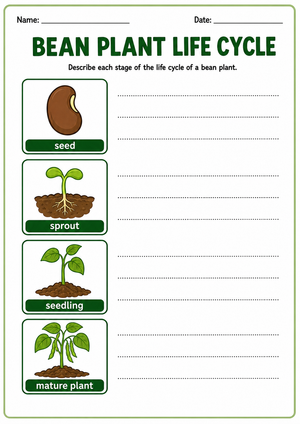
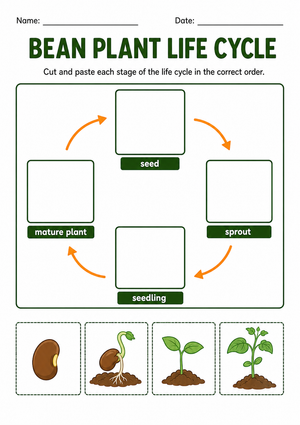
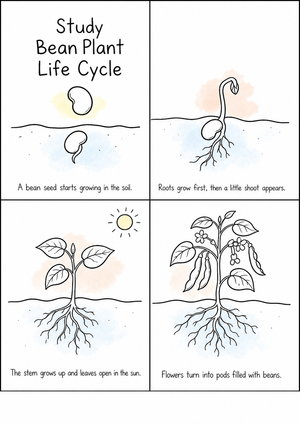
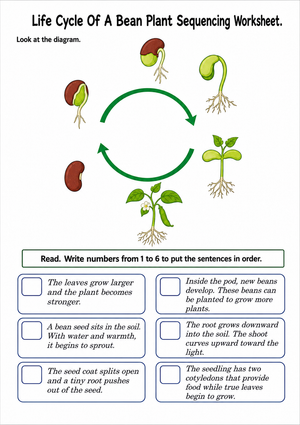
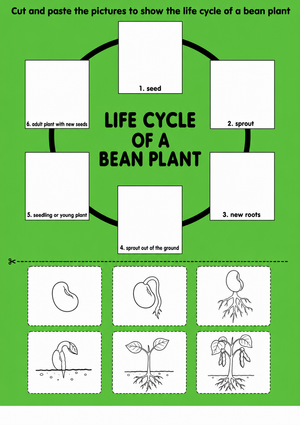
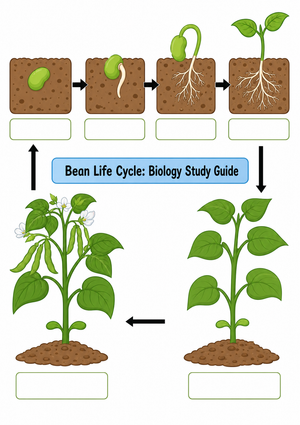
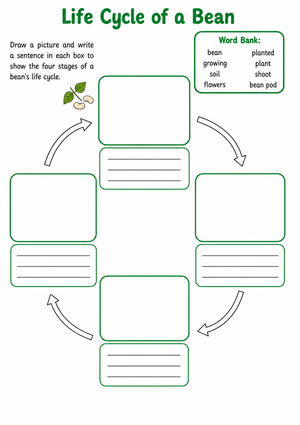
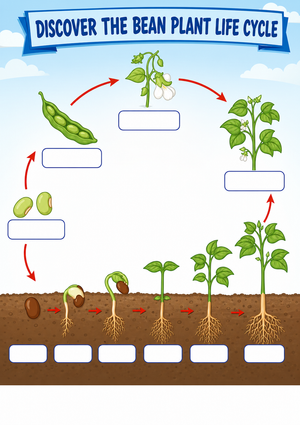
These 3rd grade bean plant printable worksheets give teachers a ready-to-use set of resources covering bean development from dormant seed to fruiting pod, with activities that run alongside a live germination experiment or stand on their own when growing conditions aren't available.
What Each Worksheet Covers
The set targets five skill areas that come up consistently in third-grade plant units:
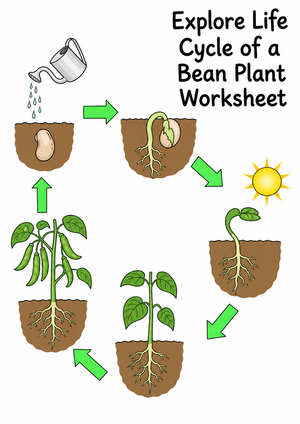
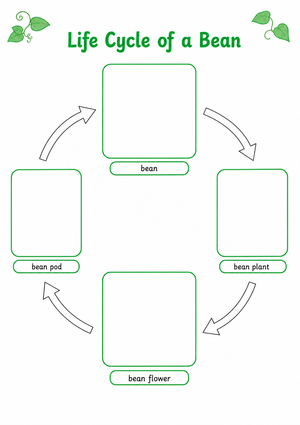
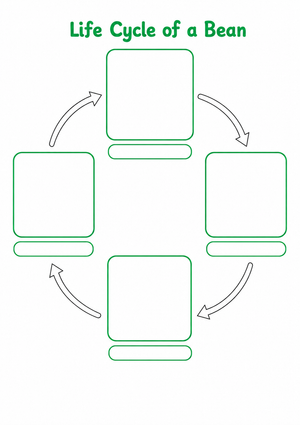
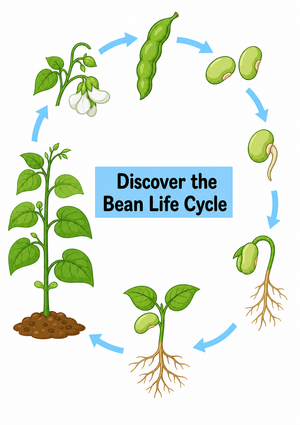
- Life cycle sequencing — students cut and paste or number the five stages (seed, germination, seedling, adult plant, flowering and fruiting) in correct order
- Seed anatomy labeling — students identify the seed coat, embryo, and cotyledon on a cross-section diagram
- Scientific vocabulary — matching, crossword, and fill-in-the-blank exercises covering imbibition, germination, pollination, photosynthesis, and dicot
- A 10-day observation log for recording germination data with daily sketches, height measurements, and written observations
- Comparative analysis — students map the bean life cycle alongside another flowering plant to identify shared and distinct features
The sequencing worksheet is where formative data tends to surface first. Students who can recite the stage names will still sometimes place germination before the seed has absorbed any water, or jump flowering ahead of the adult plant stage — a sign they've memorized labels without building a causal picture of what actually drives the sequence.
Inside the Seed Before Anything Sprouts
Bean plants are dicots, which means each seed holds two cotyledons packed with stored nutrients. Those cotyledons power the embryo through the entire germination window — before any leaves appear, before photosynthesis begins, before the stem has broken the soil surface. Most third graders arrive knowing that seeds grow into plants but haven't thought about what fuels that growth in the dark under wet soil. The anatomy labeling worksheets ask students to mark the seed coat, the embryo, and the cotyledons on a cross-section diagram. Paired with a soaked lima bean dissection — students peel back the seed coat and split the two halves apart — the labeling exercise becomes documentation of something they've physically handled rather than vocabulary drill. That distinction matters for retention.
Fitting These Worksheets Into Your Plant Unit
The vocabulary matching worksheets work well on the first day of the unit as preview rather than assessment. Students don't need to know the definitions yet — early exposure means that when imbibition and cotyledon come back in reading and lab discussion, they've already seen the words in context. Recognition comes faster than it would with cold introduction.
The bean-in-a-jar setup amplifies the rest of the set. Fold a damp paper towel inside a clear plastic cup and press a soaked bean between the towel and the cup wall. Roots and shoot grow against the transparent surface, so students observe germination directly rather than waiting to dig up soil. Pair this with the observation log and students move back and forth between the living plant and the diagram worksheets every morning. That 15-minute block right after attendance tends to produce the most careful student drawings — the novelty of watching the root elongate is still fresh. By day four or five, the entries get more analytical on their own.
Comparative analysis worksheets fit toward the end of the unit, once students have enough context to ask whether the sequence applies to other plants. A fern comparison works particularly well because the absence of a flowering stage forces students to explain why beans flower, not just that they do.
Standard Alignment
The resources support NGSS LS1.B: Growth and Development of Organisms, which asks third graders to use evidence to describe patterns in the life cycles of organisms. The standard calls specifically for students to recognize that different organisms have unique life cycles while sharing common patterns — birth, growth, reproduction, and death. Bean plants fit this standard well because the entire cycle is fast enough to observe within a single classroom unit, and the reproductive stage is concrete enough to trace without abstraction: students watch a flower form, watch it close, and watch a pod swell where it was. The 3rd grade bean plant printable worksheets address each element the standard identifies — the observation log handles evidence gathering, the sequencing worksheet addresses life cycle patterns, and the comparative analysis worksheet targets the "diverse cycles, shared patterns" core idea directly.
Where Student Thinking Breaks Down in Bean Plant Units
Almost universally, third graders believe seeds need light to germinate. The inference is reasonable — they've seen plants grow toward light — but germination runs on water absorption and warmth, not photosynthesis. The embryo has no leaves yet; there is nothing to capture light with. Students who hold this belief predict that a bean in a dark closet won't sprout, and they are surprised when it does. The germination worksheets give a natural moment to address this head-on, before the misconception gets folded into a written explanation that's harder to revise.
A different confusion shows up in the anatomy section. Students frequently describe the cotyledon as "the food the plant takes from the dirt," conflating stored seed nutrients with soil-absorbed minerals. In actual student writing, you'll see explanations like "the cotyledon pulls nutrients from the ground." The fix is usually faster than re-explaining the definition: show the seed before it's in any soil and ask where the cotyledon is relative to the soil line. The stored-food idea clicks once students see the seed as a self-contained package — already carrying what it needs.
On sequencing tasks, there's a consistent third error: students correctly name all five stages but drop the adult plant stage entirely, jumping from seedling directly to flowering. This is understandable — small bean plants in classroom cups don't always show an obvious mature phase before buds appear. Adding a photograph of a full-grown bean plant stem alongside the sequencing worksheet helps students distinguish the two stages visually before they try to place them in order.
Adjusting the Set Across Different Readiness Levels
For students who struggle with written production, the anatomy and sequencing worksheets shift well toward annotation tasks — circling, connecting, drawing arrows — rather than filling in blank lines. The diagram is already there; the cognitive work becomes identification and placement rather than recall and transcription. Students who freeze in front of blank lines often produce accurate thinking when the task asks them to mark something rather than generate from nothing.
The 3rd grade bean plant printable worksheets also extend naturally for students who move quickly. The observation log gains difficulty on its own as the plant develops — early entries ask for a sketch and a height measurement, but by day six or seven, students can shift to predictive entries: "Tomorrow I expect the cotyledons to..." and compare those predictions to what they observe the next morning. That extension requires no additional materials, just a brief classroom conversation about what a prediction is supposed to do and how to evaluate it honestly.
Frequently Asked Questions
How long does a bean seed typically take to germinate in a classroom cup?
Under typical classroom conditions — consistent moisture, a warm room, no cold air from an HVAC vent directly overhead — most bean seeds show visible root emergence within three to five days. Green bean varieties tend to sprout slightly faster than kidney or navy beans. Using a clear cup means students catch the very first root tip, which can appear as early as day two.
Can these activities work without a live growing plant?
The 3rd grade bean plant printable worksheets for diagram labeling, sequencing, and vocabulary work without any live plant present. The observation log requires a growing bean to be useful. The anatomy labeling worksheet functions independently, though it becomes considerably more concrete when paired with a soaked lima bean dissection — which costs almost nothing and takes fewer than ten minutes of class time.
How do I explain the difference between a cotyledon and a true leaf to third graders?
A cotyledon exists inside the seed before germination and contains stored food — it does not photosynthesize. A true leaf develops after the seedling breaks the soil surface and immediately begins capturing sunlight. A practical classroom distinction: cotyledons are usually pale, rounded, and slightly fleshy; true leaves are thinner, greener, and shaped like the leaves students associate with a plant. Most third graders find this clearest when they're looking at both structures at once — either on the live plant around day five or six, or on a labeled diagram from the set.
Why do bean plants produce flowers before the pods appear?
The flower is the plant's reproductive structure. Pollination — by insects visiting the flower or by wind — must occur before the base of the flower can develop into a seed pod. The pod is botanically a fruit, grown from a successfully pollinated flower. This is also the moment where the life cycle closes the loop: the seeds inside that pod are new seeds, capable of starting the whole sequence over again. Students who track this connection through the comparative analysis worksheet tend to understand the function of flowering in a way that pure memorization of stages doesn't produce.












 Interactive Worksheet Maker
 Quiz Maker
 Word Search Maker
 Crossword Puzzle Maker
 Word Scramble Generator
 Sentence Scramble Generator
 Handwriting Worksheet Generator
 Name Tracing Generator
 Fill In The Blank Generator