


























Views
Downloads

Pumpkin Life Cycle Worksheet — Grade 3 Printable
Paste this activity's link or code into your existing LMS (Google Classroom, Canvas, Teams, Schoology, Moodle, etc.).
Students can open and work on the activity right away, with no student login required.
You'll still be able to track student progress and results from your teacher account.
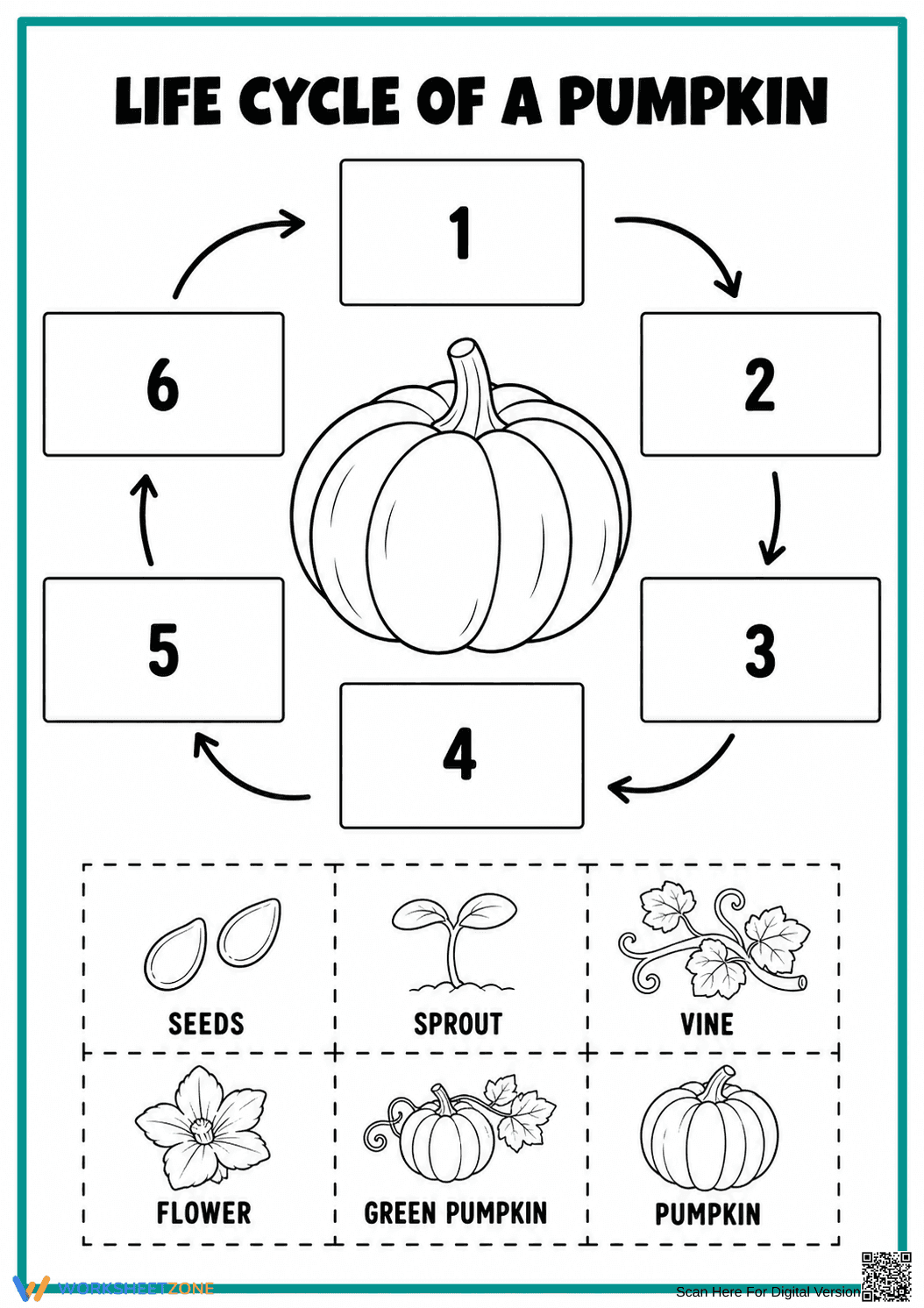
This Grade 3 pumpkin life cycle worksheet provides a hands-on sequencing activity where students organize the biological stages of plant growth. By identifying the progression from seed to mature fruit, learners develop a concrete understanding of life science cycles. This resource ensures students can visualize the continuous nature of plant development through active participation.
At a Glance
- Grade: 3 · Subject: Science
- Standard:
3-LS1-1— Develop models to describe that organisms have unique and diverse life cycles- Skill Focus: Pumpkin Life Cycle Sequencing
- Format: 1 page · 6 problems · Answer key included · PDF
- Best For: Fall science units and seasonal centers
- Time: 15–20 minutes
This single-page PDF features a central circular diagram with six numbered slots and a corresponding cut-out section at the bottom. The worksheet includes six distinct illustrations: seeds, sprout, vine, flower, green pumpkin, and the final orange pumpkin. Each image is clearly labeled to support vocabulary acquisition, and the layout is designed for easy cutting with safety scissors.
The zero-prep workflow for this activity is designed for maximum efficiency in busy classrooms. Teachers can print the master copy in under 30 seconds. Distribution to a standard class of 25 students takes approximately 1 minute. Finally, the review process is streamlined by the numbered diagram, allowing for a quick 2-minute visual check or peer-grading session. This makes it an ideal choice for emergency sub plans or transition periods.
This resource is aligned with `3-LS1-1`, which requires students to develop models to describe that organisms have unique and diverse life cycles but all have in common birth, growth, reproduction, and death. By physically constructing the cycle, students create a functional model of plant reproduction. Both standard codes can be copied directly into lesson plans, IEP goals, or district curriculum mapping tools.
Use this worksheet as a formative assessment after a read-aloud about plant biology or during a seasonal Halloween science lesson. During the activity, observe if students can explain why the flower must precede the green pumpkin to check for logical reasoning. It typically takes 15 to 20 minutes to complete, making it a perfect exit ticket or independent station activity.
This activity is tailored for Grade 3 students but is highly effective for Grade 2 learners needing a challenge or Grade 4 students requiring a visual review. It is particularly helpful for English Language Learners (ELLs) due to the heavy reliance on pictorial cues. Pair this with a real pumpkin dissection or a time-lapse video of plant growth for a comprehensive lesson.
According to the RAND AIRS 2024 report, tactile sequencing activities in early elementary science significantly improve long-term retention of biological concepts compared to passive observation. This worksheet addresses the 3-LS1-1 standard by requiring students to model the pumpkin life cycle, a fundamental skill in understanding how organisms grow and change over time. By engaging in the physical act of cutting and pasting, students reinforce the chronological order of plant development, moving from the dormant seed stage to the reproductive flowering stage. Research from Fisher & Frey (2014) suggests that such scaffolded, hands-on tasks bridge the gap between abstract scientific theory and concrete observation. This resource provides a structured environment for students to demonstrate mastery of life science progressions while simultaneously practicing fine motor skills essential for their developmental stage. It serves as a reliable tool for educators seeking to meet NGSS requirements through accessible, high-engagement materials.


