


























Views
Downloads

Pumpkin Life Cycle Printable Worksheet | Grade 3 Science
Paste this activity's link or code into your existing LMS (Google Classroom, Canvas, Teams, Schoology, Moodle, etc.).
Students can open and work on the activity right away, with no student login required.
You'll still be able to track student progress and results from your teacher account.
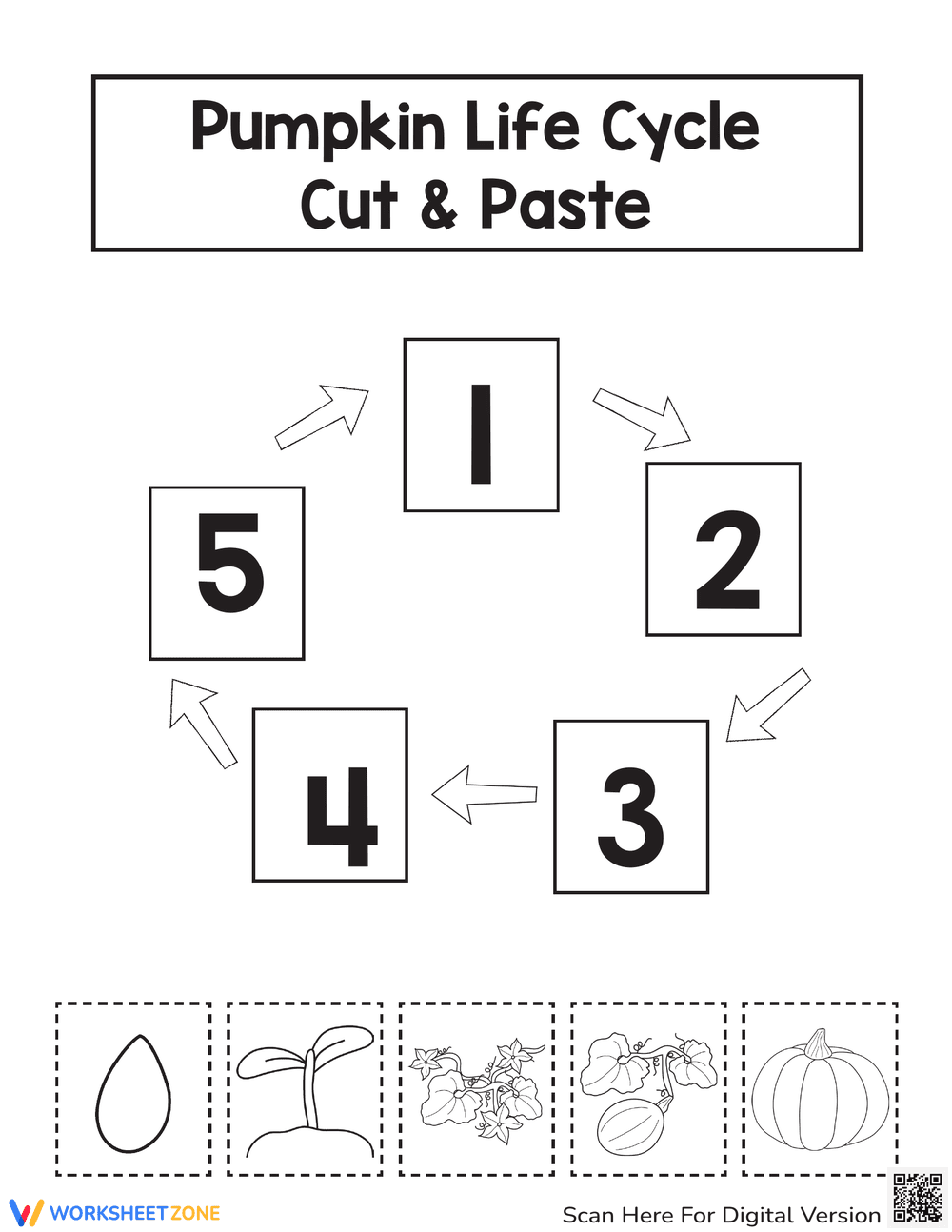
This Grade 3 science worksheet provides a hands-on approach to understanding biological growth. Students identify and sequence the five primary stages of a pumpkin's development, from seed to mature fruit. By physically manipulating the stages, learners build a concrete mental model of how organisms grow and change over time.
At a Glance
- Grade: 3 · Subject: Science
- Standard:
3-LS1-1— Develop models to describe that organisms have unique and diverse life cycles- Skill Focus: Biological sequencing
- Format: 1 page · 5 problems · Answer key included · PDF
- Best For: Fall science units and centers
- Time: 15–20 minutes
The worksheet features a circular flow diagram with five numbered stations. At the bottom of the page, students find five distinct illustrations representing the seed, sprout, vine, green pumpkin, and orange pumpkin. The layout is designed for high-contrast printing, ensuring that the visual cues remain clear for all learners even in black and white.
Zero-Prep Workflow
This resource is designed for immediate classroom implementation with three simple steps:
- Print: Select the single-page PDF and print enough copies for your cohort (30 seconds).
- Distribute: Hand out the sheets along with scissors and glue sticks (1 minute).
- Review: Use the completed diagrams for a quick whole-class check or formative assessment (5 minutes).
Total teacher preparation time is under two minutes, making it an ideal choice for busy mornings or unexpected sub plans during the autumn season.
Standards Alignment
This activity aligns with `3-LS1-1`, requiring students to develop models to describe that organisms have unique and diverse life cycles but all have in common birth, growth, reproduction, and death. It also supports CCSS.ELA-LITERACY.RI.3.3 by asking students to describe the relationship between a series of scientific ideas or steps in technical procedures. Both standard codes can be copied directly into lesson plans, IEP goals, or district curriculum mapping tools.
How to Use It
Use this worksheet as a concluding activity after a read-aloud about plant growth. It serves as an excellent formative assessment to check if students understand the chronological order of development. Teachers should observe if students can explain why the seed must come before the sprout, providing a window into their logical reasoning skills. Expected completion typically takes 15 to 20 minutes.
Who It's For
This resource is tailored for third-grade students but is accessible for older students requiring visual supports or a modified curriculum. It pairs naturally with a classroom pumpkin carving activity or a non-fiction text about agriculture. The visual nature of the cut-and-paste tasks makes it particularly effective for English Language Learners (ELLs) building scientific vocabulary.
According to research from Fisher & Frey (2014), the use of non-linguistic representations, such as the sequencing of life cycle stages, significantly enhances a student's ability to retain complex scientific concepts. This worksheet leverages that principle by requiring students to physically organize the 3-LS1-1 standard's requirements into a coherent visual model. By engaging in the tactile process of cutting and pasting, students move beyond rote memorization toward a functional understanding of biological progression. The 5-stage model used here provides a structured framework that reduces cognitive load while maintaining rigorous alignment with NGSS expectations for Grade 3. This approach ensures that learners can demonstrate mastery of the cycle through a concrete, observable task. Such interactive modeling is a cornerstone of effective elementary science instruction, providing the necessary scaffolding for future explorations into more complex ecological systems and hereditary traits.


