


























Views
Downloads
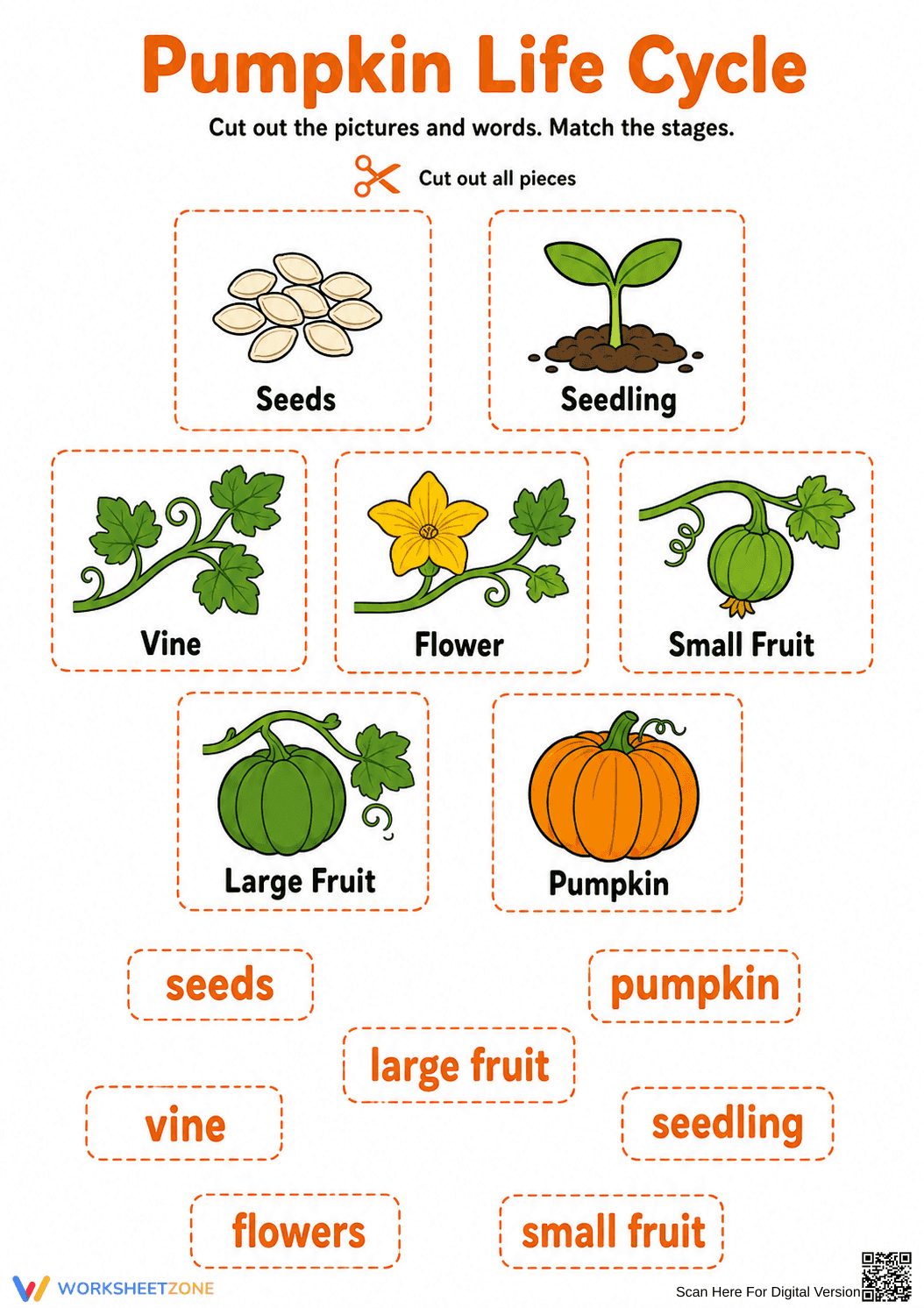

Grade 3 Pumpkin Life Cycle — Printable No-Prep Worksheet
Paste this activity's link or code into your existing LMS (Google Classroom, Canvas, Teams, Schoology, Moodle, etc.).
Students can open and work on the activity right away, with no student login required.
You'll still be able to track student progress and results from your teacher account.
This Grade 3 science worksheet provides a hands-on approach to understanding plant biology by having students sequence the developmental stages of a pumpkin. By matching illustrations to vocabulary words, learners build a concrete mental model of how flowering plants grow and reproduce over time.
At a Glance
- Grade: 3 · Subject: Science
- Standard:
3-LS1-1— Sequence the stages of plant growth and reproduction- Skill Focus: Plant life cycle sequencing
- Format: 1 page · 7 tasks · Answer key included · PDF
- Best For: Independent practice or science centers
- Time: 15–20 minutes
The resource features a single-page layout designed for tactile learning. It includes 7 illustrated cut-out pieces representing the pumpkin life cycle: seeds, seedling, vine, flower, small fruit, large fruit, and the final pumpkin. Below the cutting area, students find corresponding text labels to guide their placement, ensuring vocabulary reinforcement alongside biological concepts. A complete answer key is included for quick grading.
This activity is designed for immediate classroom implementation with a total teacher prep time of under 2 minutes. First, print the required number of copies (30 seconds). Second, distribute scissors and glue to students for the 15-minute activity. Third, conduct a quick 2-minute peer review or whole-class check using the provided answer key. It serves as an ideal sub plan or morning work task.
The primary focus is 3-LS1-1, which requires students to develop models describing the unique and diverse life cycles of organisms. By physically arranging the stages of growth, students create a visual model of plant development. Both standard codes can be copied directly into lesson plans, IEP goals, or district curriculum mapping tools.
Use this worksheet during the "Explain" or "Elaborate" phase of a 5E science lesson on botany. It works exceptionally well as a formative assessment after reading a text about plant growth. Teachers should observe if students can correctly distinguish between the "small fruit" and "large fruit" stages to gauge their attention to detail regarding plant maturation. Expect students to complete the matching in 15 to 20 minutes.
This resource is tailored for Grade 3 students but is adaptable for Grade 2 or Grade 4 learners needing review. It is particularly effective for kinesthetic learners and English Language Learners (ELLs) who benefit from the visual-to-word matching. Pair this with a real pumpkin dissection or a time-lapse video of a growing vine for maximum impact.
According to the RAND AIRS 2024 report on elementary science instruction, tactile modeling of biological processes significantly improves long-term retention of life science concepts compared to passive reading alone. This worksheet aligns with the 3-LS1-1 standard, focusing on the plain-English skill of sequencing the stages of plant growth and reproduction. By engaging in the 7-task sequencing activity, students move beyond rote memorization into active conceptual mapping. Combining visual cues with physical manipulation—such as cutting and pasting—supports the gradual release of responsibility by providing a structured framework for independent mastery. This resource provides a reliable, evidence-based tool for teachers to document student progress toward NGSS benchmarks while minimizing administrative burden. It is a high-utility asset for any primary science curriculum focused on the observable patterns of the natural world.


