


























Views
Downloads
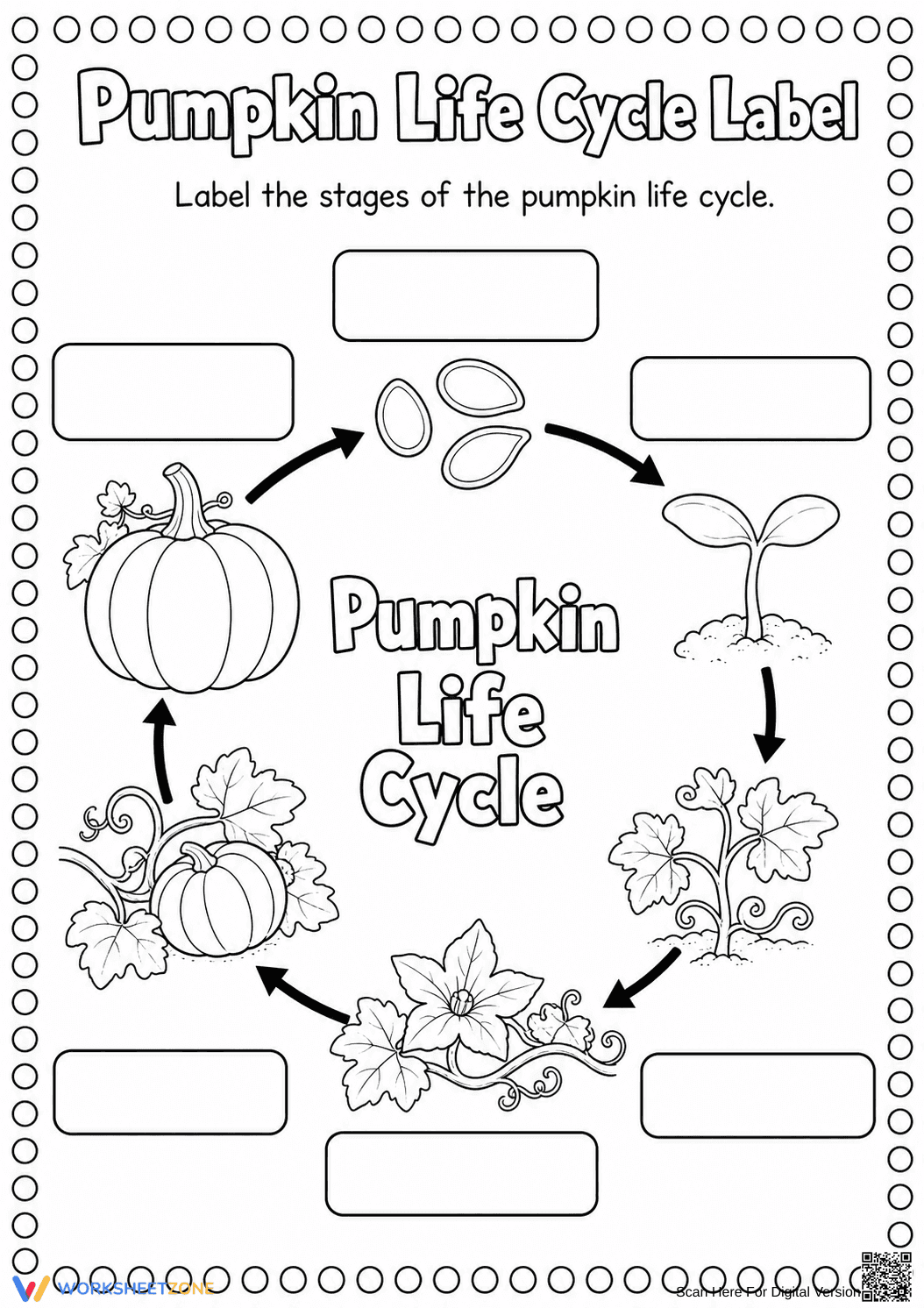

Essential Pumpkin Life Cycle Worksheet | Grade 3 Science
Paste this activity's link or code into your existing LMS (Google Classroom, Canvas, Teams, Schoology, Moodle, etc.).
Students can open and work on the activity right away, with no student login required.
You'll still be able to track student progress and results from your teacher account.
This Grade 3 science worksheet helps students master plant growth stages through a clear, circular diagram. By labeling six distinct phases of a pumpkin's development, learners build a concrete understanding of how organisms grow and change. It provides an immediate visual representation of life science concepts before students move to complex biological systems.
At a Glance
- Grade: 3 · Subject: Science
- Standard:
3-LS1-1— Develop models to describe that organisms have unique and diverse life cycles- Skill Focus: Plant life cycle sequencing
- Format: 1 page · 6 problems · Answer key included · PDF
- Best For: Fall science centers or formative assessment
- Time: 15–20 minutes
What's Inside
This single-page PDF features a circular diagram illustrating the progression from seed to mature fruit. The worksheet includes six labeling boxes positioned around the cycle, allowing students to identify the seeds, sprout, vine, flower, green pumpkin, and orange pumpkin. The clean, black-and-white design is optimized for easy printing and provides ample space for handwriting. A full answer key is provided for quick grading or self-correction.
Zero-Prep Workflow
- Print (1 minute): Print copies for your class or science center.
- Distribute (30 seconds): Hand out worksheets alongside a reference text or after an introductory lesson.
- Review (30 seconds): Use the answer key to verify understanding or display it for a whole-class check.
Designed for maximum efficiency, this resource requires under two minutes of prep time, making it ideal for sub plans or busy seasonal transitions.
Standards Alignment
This resource aligns directly with `3-LS1-1`: "Develop models to describe that organisms have unique and diverse life cycles but all have in common birth, growth, reproduction, and death." It specifically addresses the growth and reproduction phases of flowering plants. This standard code easily copies into lesson plans, IEP goals, or curriculum mapping tools.
How to Use It
Use this worksheet as a formative assessment during a life science unit. After reading about pumpkins, have students complete the diagram independently to check comprehension. Alternatively, place it in a science center with real pumpkin seeds and dried vines to provide a tactile connection to the visual model. Students typically complete the labeling in 15 minutes.
Who It's For
Tailored for Grade 3 students, this worksheet is also effective for Grade 2 learners ready for a challenge or Grade 4 students reviewing plant structures. It pairs naturally with an anchor chart on plant parts or a lesson on seasonal changes. Homeschool educators will find it useful for autumn nature studies.
Visual models in science education help students internalize complex sequences by reducing cognitive load. This worksheet specifically targets the 3-LS1-1 standard, requiring students to identify the cyclical nature of plant development. By isolating the six key stages of the pumpkin life cycle, the resource ensures learners can distinguish between the vegetative and reproductive phases of a flowering plant. Research indicates that labeling tasks reinforce domain-specific vocabulary and improve long-term retention of biological concepts. This printable resource provides a structured environment for students to demonstrate mastery of sequencing, a foundational skill in the Next Generation Science Standards. It serves as a reliable tool for documenting student progress toward life science benchmarks, ensuring the transition from seed to mature organism is clearly understood and accurately modeled by every learner.


