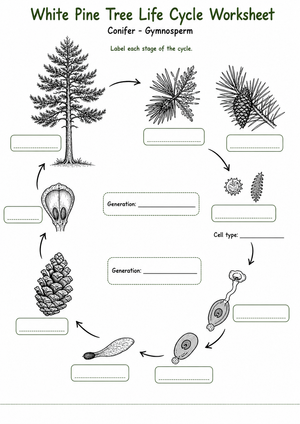
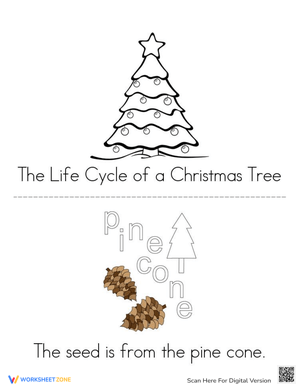
These 3rd grade tree life cycle worksheets resources give students structured practice with one of the harder conceptual problems in elementary life science: trees grow so slowly that third graders can't watch the cycle unfold the way they can with bean sprouts or mealworms, so they have to build the model from evidence rather than observation. The set includes diagram-and-label worksheets, cut-and-paste sequencing activities, fill-in-the-blank tasks, and compare-and-contrast exercises — enough variety to move students from initial vocabulary exposure to independent explanation.
What's Inside the Set
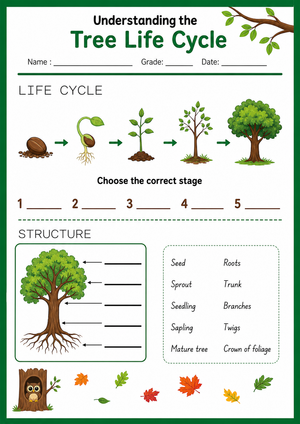
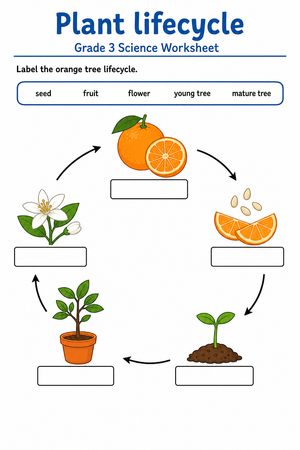
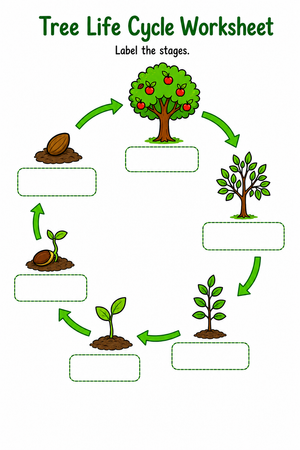
Each worksheet targets a distinct skill within the tree life cycle unit rather than repeating the same task type. The diagram-and-label worksheets give students an illustrated diagram of the cycle — seed, seedling, sapling, mature tree, decomposing tree — alongside a word bank. Students write the stage name and add a brief description in their own words. The labeling step is straightforward; the description step is where teachers see the gaps.
The cut-and-paste sequencing activities present jumbled images and written descriptions of each stage. Students sort and glue them in order, then draw arrows showing the cycle's continuity — including the arrow from decomposition back to seed germination, which many students initially omit. Fill-in-the-blank sentences go deeper into the biology: students complete statements about what conditions trigger germination, what cotyledons do, why the sapling stage is defined by its woody stem rather than its height, and how pollination connects to seed production. Compare-and-contrast worksheets pair the tree cycle against a sunflower or a frog, asking students to identify what all life cycles share and where they diverge.
Mistakes Students Make That These Worksheets Help You Catch
The most consistent error involves the seedling-sapling distinction. Students treat "seedling" and "sapling" as near-synonyms for "small tree." They don't connect "sapling" to the appearance of a woody stem — a structural change in the plant, not just a change in size. Watch for labeling worksheets where a student places the sapling image before the seedling because the sapling "looks bigger," without registering that the seedling is the stage where the first true root system and cotyledons establish themselves. That's a conceptual error, not a careless one.
Decomposition is the other persistent sticking point. Students understand that trees die. They don't automatically understand that death feeds the next cycle — that nutrients released from a decomposing trunk become part of the soil that germinates the next seed. A student who draws the cycle ending at "old tree" without connecting it back to "seed" has a genuine gap, not a vocabulary problem. The fill-in-the-blank sentences that prompt students to complete statements about what a decomposing tree returns to the soil surface this gap quickly.
A subtler issue worth knowing: students will list sunlight and water as conditions for germination but reliably omit oxygen and adequate temperature. This matters less for 3rd grade assessment, but it's worth a brief mention when you review those responses.
Lesson-Planning Strategies for Getting the Most From These Worksheets
The sequencing cut-and-paste works best as a second-day activity, after students have seen the stages introduced visually. Using it on day one, before any instruction, produces guessing rather than reasoning — you get completion without understanding. Introduce the stages with images on Monday, then send the sequencing worksheet home Tuesday as independent practice. By Wednesday, most students are ready for the fill-in-the-blank tasks, which demand recall rather than recognition.
If your school has mature trees nearby, a 10-minute walk before the labeling worksheet pays dividends. Have students find a fallen acorn, look for a seedling near the base of an old oak, and press a hand against the bark of a mature trunk. That physical contact — the roughness of bark versus the smoother surface of a young sapling's stem — gives students a tactile anchor for a distinction they otherwise carry only as vocabulary. The labeling worksheet lands differently after that walk.
For science centers, the worksheets split naturally across three stations: labeling and vocabulary at one table, sequencing at another, and compare-and-contrast at a third. The 3rd grade tree life cycle worksheets format prints cleanly, so running copies for rotations takes no extra preparation beyond the initial sort.
Standard Alignment
These worksheets address NGSS 3-LS1-1, which asks students to develop models showing that organisms have unique and diverse life cycles while sharing birth, growth, reproduction, and death in common. The disciplinary core idea is LS1.B: Growth and Development of Organisms. In most classrooms, this standard lands in the fall — which is useful timing, because deciduous trees outside the window are actively shedding leaves and exposing bare structure. The compare-and-contrast worksheet directly supports the crosscutting concept of Patterns by asking students to identify what is shared and what differs across the tree, sunflower, and frog cycles.
Adjusting These Worksheets for Different Student Levels
Students who need more support do better starting with the cut-and-paste sequencing rather than the labeling worksheet. The images carry more information than a blank diagram, and physically moving the stages — placing the seedling next to the seed, finding where decomposition reconnects to germination — reduces the cognitive load of recalling vocabulary and spatial relationships at the same time. Once students have sequenced correctly, the labeling worksheet becomes a consolidation task rather than a first introduction.
For students who move through the core worksheets quickly, the compare-and-contrast activities open into richer territory. Ask them to add a column for a Douglas fir versus a cherry tree, or push them to explain why a sapling needs years of growth before it can reproduce while an annual flower manages the full cycle in one season. That question gets at resource allocation and reproductive strategy without requiring third graders to know those terms. A 3rd grade tree life cycle worksheets used this way becomes a thinking tool, not just a review task.
For English language learners, the word-bank format on the labeling worksheets reduces the writing barrier while keeping the content demand intact. Students still match vocabulary to biological stage correctly — they're just not generating spelling from scratch under dual cognitive pressure.
Frequently Asked Questions
What are the stages of a tree's life cycle at the 3rd grade level?
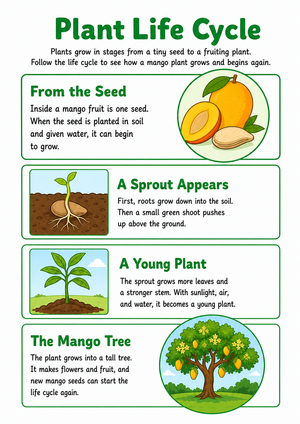
Most 3rd grade curricula identify five stages: seed, seedling, sapling, mature tree, and decomposition. The seed contains the embryo and stored energy needed for germination. The seedling develops the first true root system and cotyledons. The sapling is distinguished by its woody stem — a structural difference from the seedling, not merely a size difference. The mature tree produces flowers, fruit, and seeds. Decomposition closes the loop, returning nutrients to the soil where new seeds can germinate.
How does a tree life cycle differ from a frog or butterfly life cycle?
The most useful contrast for students is timeline. A monarch butterfly completes its full cycle in roughly two months; a frog can do it in a single warm season. A white oak may take 20 years to reach reproductive maturity and can live for more than 500 years. The underlying structure — birth, growth, reproduction, death — is identical across all three. What differs is the timescale and the form each transition takes. Trees also lack the dramatic metamorphosis of a butterfly, which makes the stage boundaries harder to visualize without direct instruction and labeled diagrams.
What vocabulary should students have before starting these worksheets?
Before the labeling and fill-in-the-blank worksheets, students need working definitions of seed, germination, seedling, sapling, mature tree, photosynthesis, pollination, and decomposition. Of these, germination and decomposition tend to be the least familiar coming in. A 10-minute vocabulary introduction with images — not a lengthy pre-teach — is enough to make the worksheet tasks productive rather than frustrating. The 3rd grade tree life cycle worksheets itself reinforces all eight terms through repeated exposure across multiple formats, so students don't need to have them memorized before they begin.
How long does a tree's full life cycle take?
It varies widely by species, and telling students this directly is worth the 30 seconds. A silver maple can produce seeds within three to five years. A white oak takes 20 or more years before its first acorns appear. Bristlecone pines can live more than 4,000 years. That range is pedagogically useful — it illustrates the "unique and diverse life cycles" language in NGSS 3-LS1-1 while reinforcing that the underlying cycle structure is shared across every species students encounter.












 Interactive Worksheet Maker
 Quiz Maker
 Word Search Maker
 Crossword Puzzle Maker
 Word Scramble Generator
 Sentence Scramble Generator
 Handwriting Worksheet Generator
 Name Tracing Generator
 Fill In The Blank Generator