


























Views
Downloads
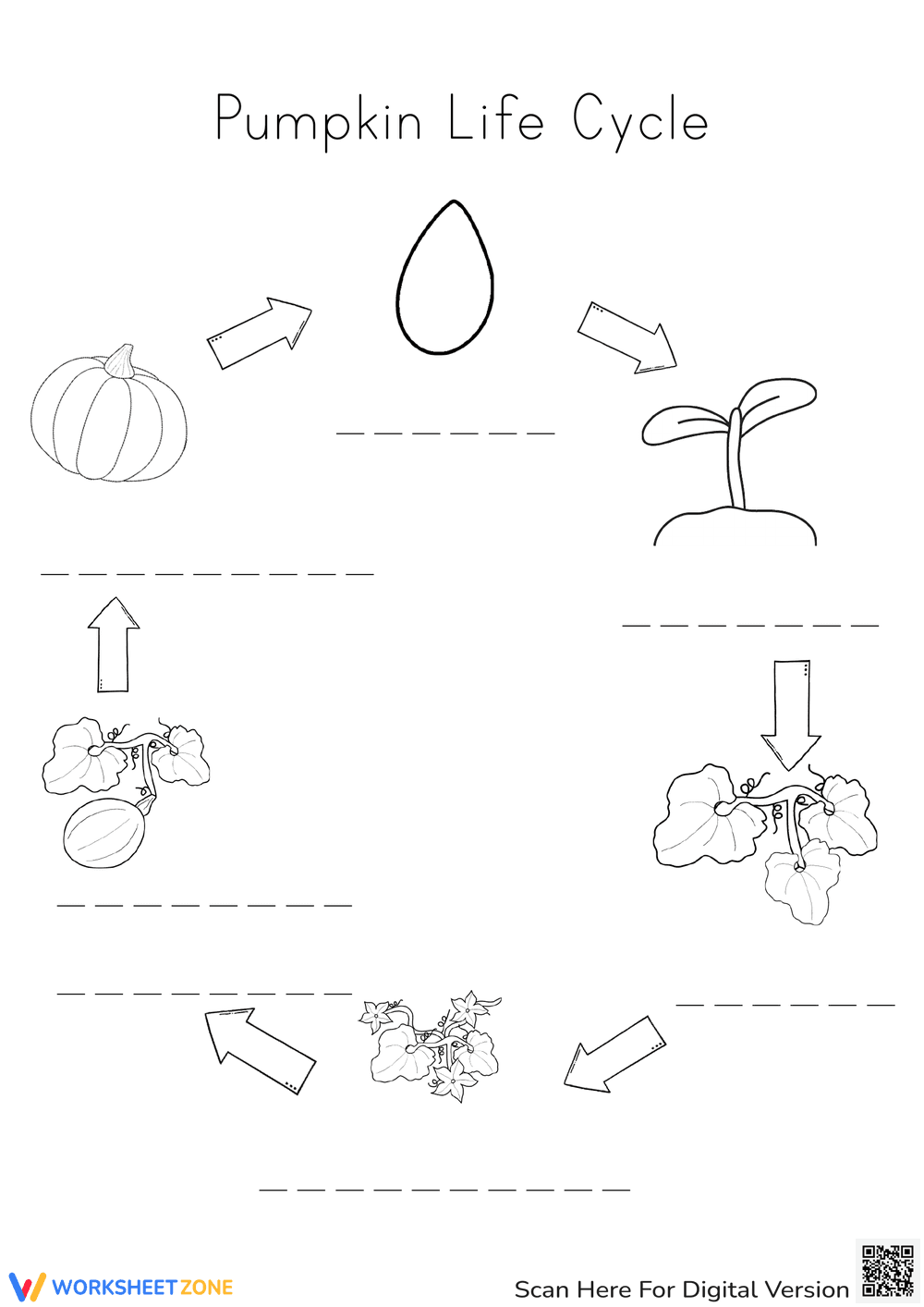

Pumpkin Life Cycle Worksheet | Grade 3 Essential
Paste this activity's link or code into your existing LMS (Google Classroom, Canvas, Teams, Schoology, Moodle, etc.).
Students can open and work on the activity right away, with no student login required.
You'll still be able to track student progress and results from your teacher account.
This Grade 3 pumpkin life cycle worksheet helps students visualize and sequence the biological stages of a plant's growth. By labeling the diagram, learners demonstrate their understanding of how organisms grow and change over time. It provides a clear, structured way to assess student knowledge of plant biology and life science concepts.
At a Glance
- Grade: 3 · Subject: Science
- Standard:
3-LS1-1— Develop models to describe that organisms have unique and diverse life cycles- Skill Focus: Life cycle sequencing
- Format: 1 page · 6 problems · Answer key included · PDF
- Best For: Independent practice or formative assessment
- Time: 10–15 minutes
This single-page PDF features a circular diagram representing the six distinct stages of a pumpkin's development. It includes clear illustrations of seeds, sprouts, vines, flowers, green pumpkins, and mature pumpkins. Students are provided with dashed lines to write the correct stage names, supported by directional arrows that emphasize the cyclical nature of the process.
The workflow for this resource is designed for maximum efficiency in busy classrooms. Teachers can print the single-sheet PDF in less than 30 seconds. Distribution takes approximately 1 minute, and because the layout is intuitive, students can begin working immediately without complex instructions. Reviewing the 6 tasks with the included answer key takes under 2 minutes, making it an ideal choice for sub plans.
The primary standard addressed is `3-LS1-1`, which requires students to develop models to describe that organisms have unique and diverse life cycles. This worksheet serves as a visual model for plant reproduction and growth. Both standard codes can be copied directly into lesson plans, IEP goals, or district curriculum mapping tools.
Use this worksheet as a formative assessment after a direct instruction lesson on plant biology. It is also an excellent choice for a science center activity or a quick exit ticket to gauge student understanding before moving to more complex biological systems. Expect students to complete the labeling in 10 to 15 minutes depending on their prior knowledge.
This resource is ideal for third-grade students beginning their study of life sciences. It provides enough visual support for English Language Learners and students with IEPs while remaining rigorous enough for general education. Pair this with a real pumpkin dissection or a time-lapse video of plant growth for a comprehensive learning experience that connects theory to reality.
According to the RAND AIRS 2024 report, high-quality visual models are critical for developing scientific literacy in elementary students. This worksheet aligns with the 3-LS1-1 standard by requiring students to identify and sequence the stages of a pumpkin's life cycle, from seed to mature fruit. Research from Fisher & Frey (2014) suggests that graphic organizers and diagrams help students internalize complex biological processes by reducing cognitive load. By focusing on the 6 key stages of growth, this resource provides a structured pathway to mastery of life science concepts. The inclusion of a clear, cyclical diagram ensures that students understand the continuous nature of reproduction and development in the natural world. This printable is a reliable tool for teachers looking to integrate NGSS-aligned content into their daily science curriculum without extensive preparation or setup time.


