


























Views
Downloads
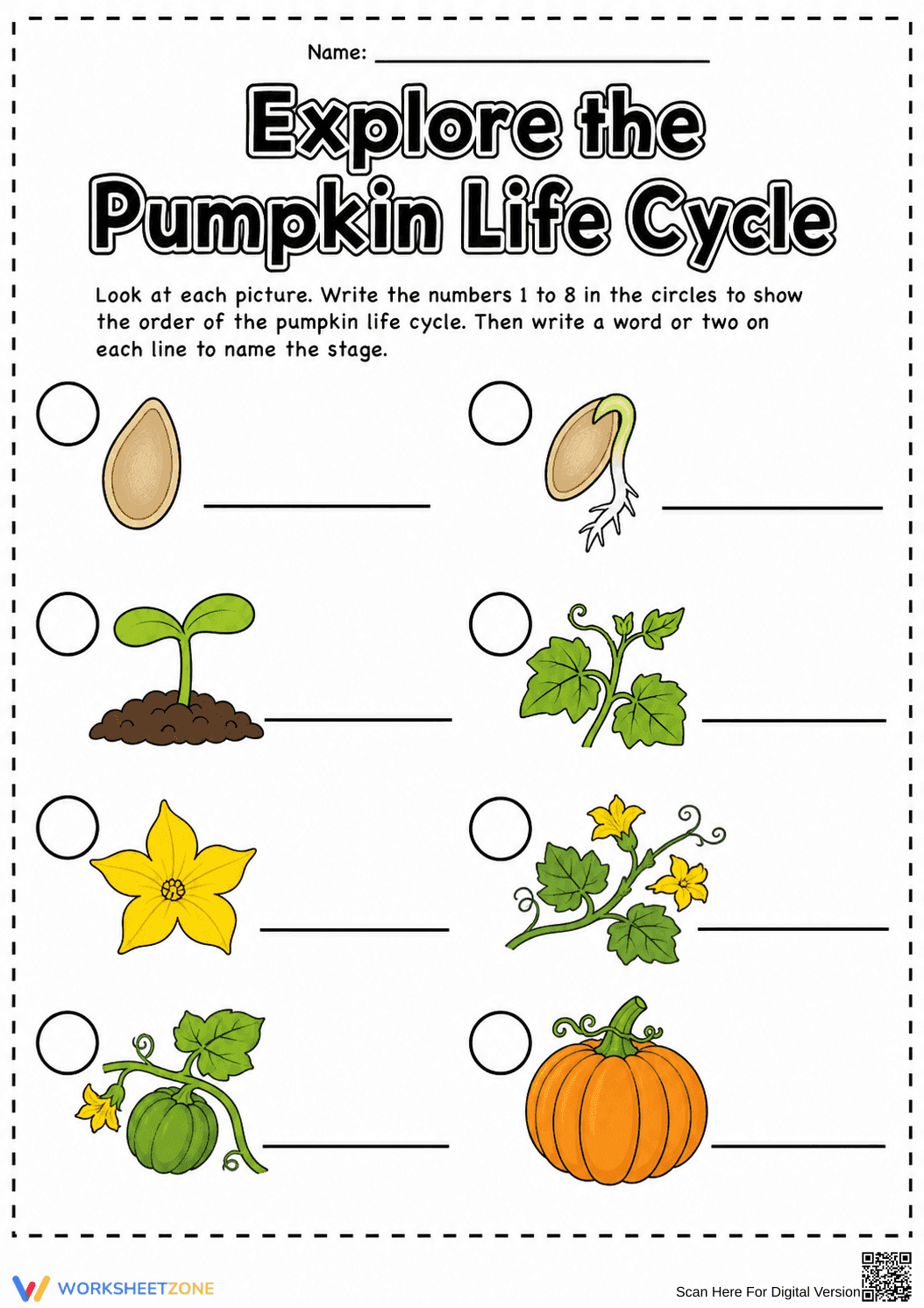

Grade 3 Pumpkin Life Cycle — Printable No-Prep Worksheet
Paste this activity's link or code into your existing LMS (Google Classroom, Canvas, Teams, Schoology, Moodle, etc.).
Students can open and work on the activity right away, with no student login required.
You'll still be able to track student progress and results from your teacher account.
This single-page science worksheet helps students master the stages of plant growth by sequencing and labeling the pumpkin life cycle. By numbering illustrations and writing descriptive terms, learners actively connect visual models to biological processes, building a strong foundation in life science concepts.
At a Glance
- Grade: 3 · Subject: Science
- Standard:
3-LS1-1— Describe that organisms have unique and diverse life cycles- Skill Focus: Sequencing and labeling plant life cycles
- Format: 1 page · 8 problems · Answer key included · PDF
- Best For: Independent practice or science centers
- Time: 10–15 minutes
Inside this resource, educators will find a straightforward activity page featuring eight stages of a pumpkin's development. Students write a sequence number from one to eight in the provided circle and a brief descriptive label on the adjacent line. The clear illustrations range from a single seed to a fully mature pumpkin, providing excellent visual scaffolding. A complete answer key is included.
Zero-Prep Workflow
- Print (1 minute): Download the PDF and print copies. The design ensures crisp reproduction.
- Distribute (1 minute): Hand out during your science block. Instructions are self-explanatory, requiring minimal setup.
- Review (3 minutes): Use the included answer key to quickly check sequences, or project it for whole-class self-correction.
With teacher preparation time under two minutes, this is ideal for any sub plan.
Standards Alignment
This activity is directly aligned to the Next Generation Science Standards, specifically 3-LS1-1: Develop models to describe that organisms have unique and diverse life cycles but all have in common birth, growth, reproduction, and death. By ordering the stages from seed to mature fruit, students create a sequential model of this biological process. Both standard codes can be copied directly into lesson plans, IEP goals, or district curriculum mapping tools.
How to Use It
This worksheet serves as an excellent independent practice activity immediately following direct instruction on plant life cycles or seasonal fall science units. Teachers can also utilize it as a formative assessment tool at the end of a biology week. While students are working, observe whether they correctly identify the transition from flower to small green pumpkin, as this is often a point of confusion for young learners. Expected completion time ranges from 10 to 15 minutes, making it a perfect bell-ringer or cool-down activity.
Who It's For
This resource is primarily designed for third-grade science students, though it functions beautifully as a review for fourth graders or an extension for advanced second graders. The clear visual cues provide built-in differentiation for English Language Learners and visual learners who benefit from seeing the physical transformation of the plant. It pairs perfectly with a read-aloud book about autumn harvests or a hands-on pumpkin exploration lesson.
Understanding biological sequencing is a critical component of early elementary science education. When students engage with materials aligned to 3-LS1-1, they learn to describe that organisms have unique and diverse life cycles. According to a ScienceDirect TpT Analysis, integrating visual models with vocabulary labeling significantly improves long-term retention of scientific concepts in young learners. By requiring students to both sequence numerically and label descriptively, this worksheet bridges the gap between visual recognition and academic language production. This dual-coding approach ensures that learners do not just memorize a static list of terms, but rather comprehend the dynamic, continuous nature of biological growth and reproduction. Providing structured, visually supported practice opportunities is essential for building the foundational scientific literacy required for more complex biological studies in upper elementary grades.


