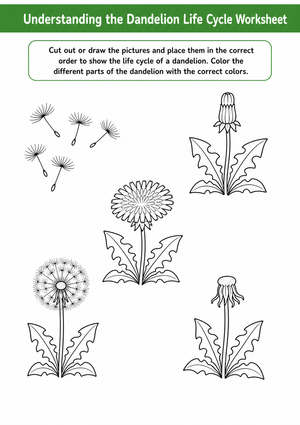
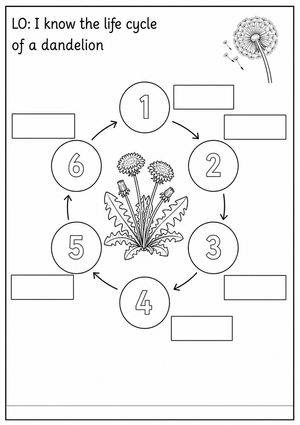
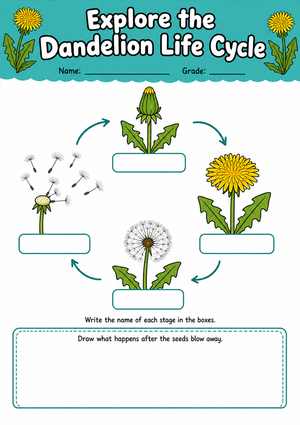
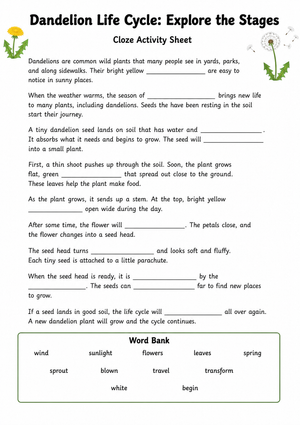
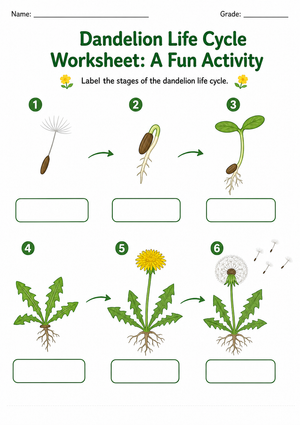
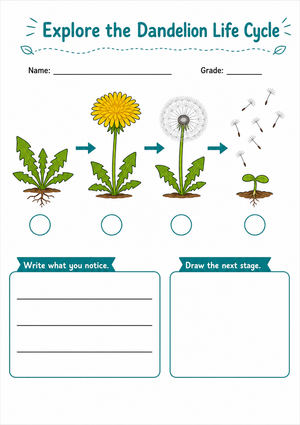
These 3rd grade dandelion worksheets resources give students a concrete model for plant life cycle study — one grounded in a plant they can find growing through sidewalk cracks and along fence lines. The set covers germination, rosette growth, flowering, pollination, seed formation, and wind dispersal, with anatomy labeling and adaptation analysis built into each worksheet.
What Students Work Through in Each Worksheet
The life cycle sequence starts at seed dispersal and follows the plant through germination, seedling development, the rosette stage, flower head formation, pollination, and puffball formation. Students label and sequence these stages rather than passively reading about them — the worksheets ask them to draw arrows, fill in stage names, and briefly describe what is happening at each transition.
Anatomy work centers on four structures: the taproot, the rosette leaves, the composite flower head, and the pappus. Each worksheet targets one or two of these at a time. For the taproot, students compare its depth to that of a grass root and explain why that difference matters for drought survival. For the composite flower head, they mark individual ray florets on a diagram — this one surprises almost every student who assumed they were looking at one flower with many petals.
Adaptation questions push students beyond simple identification. Rather than asking "what does the taproot do?" the worksheets ask students to explain how the taproot helps the dandelion survive in a lawn that gets mowed regularly. That framing requires students to connect structure to function, which is exactly what NGSS 3-LS1-1 asks them to do.
How to Work These Worksheets Into Your Science Week
The most effective use pattern starts outside. Before students touch any worksheet, send them out to the schoolyard to collect one specimen each — ideally a yellow flower head, a stem showing the milky white sap, and a puffball if the timing works out. Taping a real pappus next to the diagram on the seed dispersal worksheet changes how students interact with the labeled image. They stop treating the illustration as abstract and start reading it as a map of something they're holding.
Within the lesson sequence, these worksheets work well as the documentation layer for observation activities rather than standalone reading exercises. Running a fan dispersal experiment — dropping dandelion seeds from different heights and measuring distance — gives students data to reference when completing the wind dispersal worksheet. The questions land differently when students already know their seeds traveled 47 centimeters versus 12.
For review later in the unit, the life cycle sequencing worksheet holds up as a retrieval activity. Fifteen minutes at the start of class, no notes, students reconstruct the sequence from memory. That low-stakes recall practice before a unit assessment surfaces gaps that a chapter review often misses.
Mistakes Students Make That These Worksheets Help You Catch
The most common error in life cycle work is treating the stages as equally spaced in time. Students frequently draw life cycle diagrams with uniform arrows, implying that germination takes roughly as long as the dormant taproot phase in winter. The labeling worksheet addresses this by asking students to estimate how long each stage lasts — in days, weeks, or months. Most students initially write "a few days" for winter dormancy, and that wrong answer starts a useful conversation.
The composite flower misconception is stubborn. After instruction, students will correctly label "ray florets" on a worksheet, then describe the dandelion as "a flower with lots of petals" in their science journals two days later. The distinction between a single flower and a flower head composed of many complete flowers requires more than one encounter to stick. Using the anatomy worksheet alongside an actual dissection — or even a close-up photo projected on the board — gives students a second exposure in a different format.
Students also frequently confuse the pappus with the seed itself, circling the entire feathery structure when asked to identify "the dandelion seed" on a diagram. The worksheets address this directly by labeling the pappus and the achene separately and asking students to explain the function of each — not just name them.
Standard Alignment
The core standard the 3rd grade dandelion worksheets set addresses is NGSS 3-LS1-1, which asks students to develop models describing the unique and diverse life cycles of organisms, including birth, growth, reproduction, and death. The dandelion works as a model organism for this standard because all four phases are observable and visually distinct. The puffball-to-dispersal moment makes reproduction visible in a way that a diagram of a pine cone rarely manages for third graders.
The adaptation content also connects to NGSS 3-LS4-3, which asks students to construct arguments that populations survive in changing environments due to their individual traits. The taproot's drought tolerance, the rosette's low profile under mower blades, and the pappus's dispersal efficiency are all specific structural advantages students can name and explain — and all three appear directly in the worksheets.
Adjusting the Worksheets for a Range of Learners
Students who struggle with written explanation questions benefit from completing the anatomy diagrams first — filling in labels before attempting the "explain why" questions. That sequence builds familiarity with the vocabulary before asking them to deploy it in a sentence, which reduces the cognitive load of producing a written answer from nothing.
For students who move quickly through the labeling work, the composite flower structure opens into useful extension territory. A close-up photograph of a dandelion head, a hand lens, and the question "how many individual flowers can you count?" turns a five-minute task into a twenty-minute investigation. Some students will also want to check whether other familiar flowers — sunflowers, daisies — are also composite heads. They usually are, and that discovery tends to stick.
Frequently Asked Questions
Are these worksheets usable without access to real dandelions?
Yes, though the specimen-collection activity adds real value when dandelions are available. The worksheets work from diagrams alone. A projected close-up photograph of a puffball and a yellow flower head gives students enough visual detail to complete the labeling and anatomy work accurately.
How does this set fit alongside a broader plant unit?
These worksheets fit naturally mid-unit, after students have seen the general life cycle pattern for flowering plants and before they move into comparing multiple species. The dandelion's specific adaptations — especially the taproot and the composite flower structure — give students concrete examples to reference when they start comparing plant survival strategies across different environments.
Which worksheet works best as a formative check?
The life cycle sequencing and labeling worksheet, used without the anatomy references from earlier in the unit, functions well as a quick formative check. The 3rd grade dandelion worksheets set includes enough variation in question type — labeling, short answer, sequencing — that one worksheet gives a clear picture of where individual students are with the material.
Do students need direct instruction before using the anatomy worksheets?
Yes. The anatomy and adaptation worksheets assume prior instruction on plant structures. Students who haven't encountered vocabulary like "taproot," "germination," or "pappus" before opening the worksheet will struggle with the labeling questions. Use these as practice and documentation tools after introducing the concepts, not as first-exposure activities. The 3rd grade dandelion worksheets resources work best as the application layer, not the introduction.












 Interactive Worksheet Maker
 Quiz Maker
 Word Search Maker
 Crossword Puzzle Maker
 Word Scramble Generator
 Sentence Scramble Generator
 Handwriting Worksheet Generator
 Name Tracing Generator
 Fill In The Blank Generator