


























Views
Downloads

Pumpkin Life Cycle Worksheet | Grade 2 Essential
Paste this activity's link or code into your existing LMS (Google Classroom, Canvas, Teams, Schoology, Moodle, etc.).
Students can open and work on the activity right away, with no student login required.
You'll still be able to track student progress and results from your teacher account.
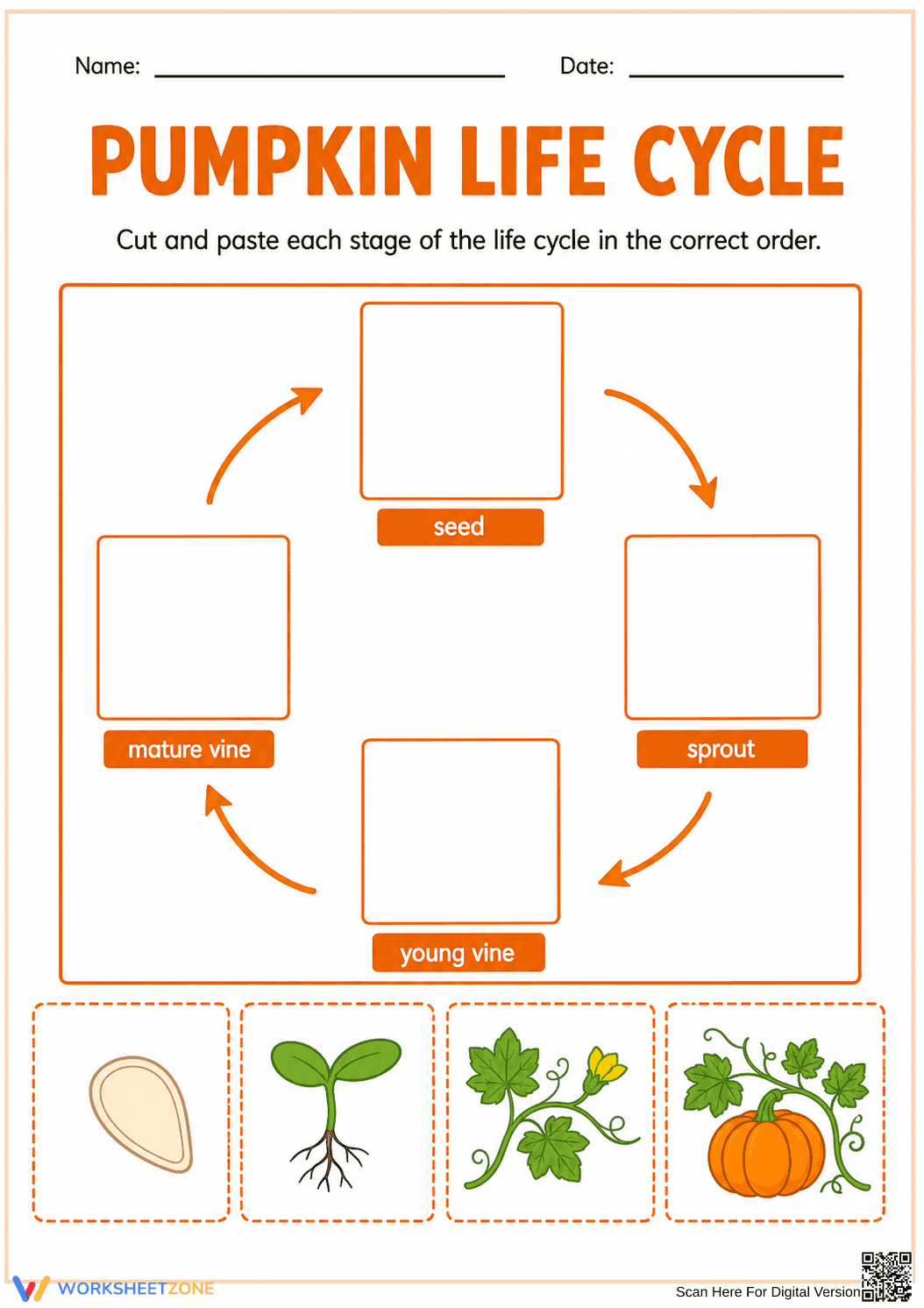
This Grade 2 pumpkin life cycle worksheet provides a hands-on approach to understanding plant biology. Students engage with the chronological stages of growth by organizing visual data into a logical sequence. By identifying the transition from seed to mature vine, learners develop a foundational understanding of biological cycles and the specific developmental milestones of flowering plants.
At a Glance
- Grade: 2 · Subject: Science
- Standard:
2-LS2-1— Observe and describe how plants change as they grow from seeds to maturity- Skill Focus: Chronological sequencing and life cycle identification
- Format: 1 page · 4 tasks · Answer key included · PDF
- Best For: Fall science units and seasonal centers
- Time: 15–20 minutes
This resource features a clean, circular diagram representing the continuous nature of life cycles. It includes four distinct labels—seed, sprout, young vine, and mature vine—paired with corresponding high-quality illustrations for cutting and pasting. The single-page PDF format ensures that all necessary components are contained in one place, minimizing the risk of lost pieces during the activity.
The zero-prep workflow for this activity is designed for maximum efficiency in busy classrooms. First, print the single-page PDF for each student, which takes less than 30 seconds for a standard class set. Second, distribute the sheets along with scissors and glue; the clear visual cues allow students to begin working with minimal verbal instruction. Finally, review the completed cycles as a group in under 5 minutes to verify accuracy and reinforce vocabulary. Total teacher preparation time is less than 2 minutes.
This worksheet aligns with 2-LS2-1, focusing on the observable growth patterns of plants. While the standard emphasizes the needs of plants, understanding the life cycle is a prerequisite for identifying how those needs change at different stages of development. It also supports CCSS.ELA-LITERACY.RI.2.3 by requiring students to describe the connection between a series of scientific ideas or steps. Both standard codes can be copied directly into lesson plans, IEP goals, or district curriculum mapping tools.
Use this worksheet as a formative assessment following a read-aloud about autumn harvests or plant biology. It serves as an excellent exit ticket to gauge student understanding of sequencing before moving to more complex botanical concepts. During the activity, observe if students can correctly identify the young vine versus the mature vine, as this distinction demonstrates a nuanced understanding of plant maturation. Expected completion time ranges from 15 to 20 minutes.
This activity is ideal for second-grade students, but it is also accessible for first-grade learners needing a challenge or third-grade students requiring a quick review. It pairs naturally with a physical pumpkin exploration lab or a classroom anchor chart detailing plant parts. The cut-and-paste format provides necessary fine-motor practice for developing learners while keeping them focused on the scientific content.
According to the RAND AIRS 2024 report on elementary science instruction, hands-on sequencing activities significantly improve long-term retention of biological concepts compared to passive observation. This pumpkin life cycle worksheet utilizes these proven pedagogical strategies by requiring students to physically manipulate the stages of growth, reinforcing the standard 2-LS2-1. Research indicates that integrating fine motor tasks with scientific inquiry helps bridge the gap between abstract cycles and concrete understanding for Grade 2 learners. By focusing on the four key stages—seed, sprout, young vine, and mature vine—this resource provides the structured practice necessary for mastery of plant biology fundamentals. Educational analysis from Fisher & Frey (2014) suggests that such scaffolded, visual-heavy tasks are essential for supporting English Language Learners and students with diverse learning needs in the general education science classroom, ensuring equitable access to core curriculum standards.


