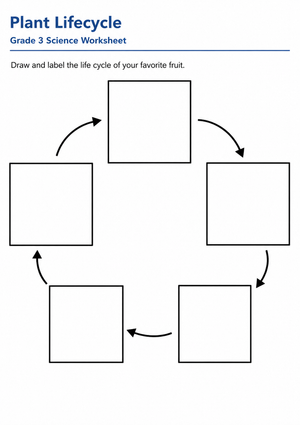
Fruit Life Cycle PDF Worksheets for 3rd Grade
These fruit life cycle pdf worksheets for 3rd grade help teachers cut through one of the most persistent misconceptions in elementary plant science: that a fruit is simply food, not a stage in a plant's reproductive sequence. Third graders arrive already knowing what apples and tomatoes look like — the challenge is getting them to see those objects as the end product of a flower, positioned late in the cycle rather than at its start. Each worksheet pairs labeled diagrams with sequencing and vocabulary tasks, keeping the content concrete enough for whole-group modeling while giving students enough independent work to reveal what they actually understand.
What's Inside the Set
The worksheets cover the full flowering plant cycle from seed through seed dispersal, with fruit as the anchor concept. Students work through several distinct skill formats across the set:
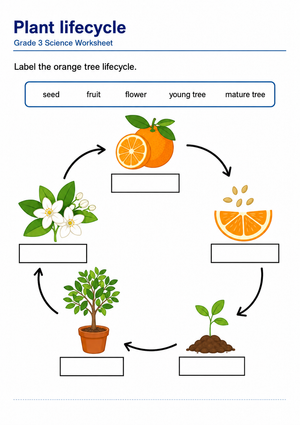
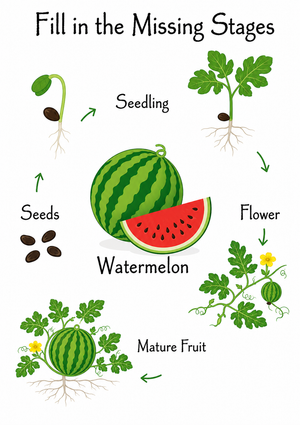
- Sequence ordering: Students number or cut and paste the stages — seed, germination, seedling, mature plant, flower, fruit, dispersal — into the correct order.
- Diagram labeling: Students connect word labels to parts of a drawn plant at different stages, including the relationship between the flower and the developing fruit.
- Vocabulary matching: Students pair terms like pollination, germination, and seed dispersal with simple definitions or illustrations.
- Short constructed response: Students write one to three sentences explaining a specific transition — most commonly how a flower becomes a fruit and why that fruit holds seeds.
- Comparison tasks: Students examine two familiar examples such as apples and tomatoes, noting differences in seed placement and shape while confirming both are fruits in the scientific sense.
The constructed response prompts are worth planning around deliberately. When a student writes "the flower turns into the fruit," that phrasing shows sequencing knowledge. When a student writes "the seeds are inside the fruit," they understand structure but have skipped the process entirely. Both responses contain some understanding, but only the first maps to what the standard actually asks — and sorting student work by that distinction makes a useful informal assessment mid-unit.
Common Misconceptions to Watch For and Correct
The most reliable error pattern in Grade 3 plant units is positional confusion about fruit: students know it comes from a plant, but they place it early in the sequence — sometimes directly after the seed stage — because in their daily experience, fruit is something you start with, not arrive at. You will see this in sequencing tasks where a student draws the apple or pumpkin right below the seed, skipping germination, growth, and flowering entirely.
A second recurring problem shows up in written explanations. Students frequently write that "the seed grows into fruit," cutting out the flower stage completely. This is not random — it reflects the fact that most students have never watched a flower transition into fruit in real time. Each sequencing worksheet in this set requires students to place the flower stage before they can label the fruit stage, which makes the order explicit rather than leaving students to infer a sequence that matches their prior knowledge instead of plant biology.
There is also the fruit-versus-vegetable conflict. Students who learn that tomatoes are botanically fruits sometimes over-apply the rule, calling everything with seeds a fruit — cucumbers, peppers, squash. That transfer error shows real thinking; it just needs a correction framed around origin from a flower, not simply the presence of seeds.
How to Work These Worksheets Into Your Week Without Losing Instructional Time
The most effective entry point for fruit life cycle pdf worksheets for 3rd grade is right after a whole-group anchor lesson where students have already sorted the earlier plant stages. Do not hand out the fruit worksheet cold. If students have already built a class chart showing seed, seedling, and mature plant, adding flower and fruit to that chart before distributing the worksheet gives students a visual reference that cuts repeated questions and keeps the lesson moving.
Some practical windows where this set fits cleanly:
- The first 12 to 15 minutes of a science block as students settle — a sequencing worksheet works especially well here because it requires focus but not extended writing.
- A rotating science center during a plant unit, with one group completing the labeling worksheet while another works on a seed observation task at the same time.
- A substitute folder during the last week of a plant unit — the vocabulary matching and short-answer worksheets run without any teacher setup beyond printing.
- A Monday review after a weekend break, when students need retrieval practice before a quiz later in the week.
One sequencing move worth building in explicitly: introduce the word fruit as a science term only after students have already mastered the earlier stages in order. When students have anchored seed, germination, seedling, and flower first, they are far more likely to slot fruit correctly as the stage that follows flowering. Teaching fruit first — because it is the most familiar word in the sequence — tends to cement exactly the positional error described above.
Standard Alignment
The primary NGSS alignment for this content is 3-LS1-1, which asks students to develop models describing that organisms have unique and diverse life cycles that all share birth, growth, reproduction, and death. In classroom terms, the fruit life cycle sequence maps directly onto that standard's model-building expectation: students are constructing a visual or written representation of how a flowering plant reproduces. The flower-to-fruit transition is the reproductive stage, which means it carries the most conceptual weight in the unit and is where student misconceptions cluster most reliably. Many states that have adopted NGSS or NGSS-aligned frameworks embed this content explicitly in Grade 3 life science, positioning the flowering plant as the primary organism for early life cycle study.
Adjusting Each Worksheet Across Ability Levels
For students who need more support, the sequencing worksheet works best when the stage labels come pre-printed on cut-apart cards rather than requiring students to generate the vocabulary independently. Adding directional arrows to diagrams also helps — students who struggle with spatial reasoning on circular layouts often do better when they can follow a clear left-to-right path through the stages. Oral rehearsal before writing matters too: having students say the sequence aloud to a partner before completing a constructed response reduces blank-page hesitation and word-retrieval errors in the final answer.
On-level students handle the full labeling worksheet plus a one-to-two sentence written explanation without modification. The comparison task — identifying what makes a tomato and an apple both fruits — is the right independent challenge at this level.
For students ready for added challenge, ask them to explain seed dispersal in relation to fruit: why does the plant produce sweet, colorful fruit in the first place? This moves the fruit life cycle pdf worksheets for 3rd grade content toward an adaptive function question — students who can articulate that animals eat fruit and carry seeds to new locations are demonstrating reasoning that goes well beyond labeling. That prompt also travels well as an enrichment journal entry or a verbal share at the close of class.
Frequently Asked Questions
Do these worksheets work if my students haven't done a full plant unit yet?
They work best as a mid-unit or late-unit resource, after students have seen the basic seed-to-plant sequence in direct instruction. Using them without any anchor lesson tends to produce guessing on sequencing tasks rather than genuine recall. A brief 10-minute introduction with a projected diagram — even just a class-built chart — gives students enough prior knowledge to engage with the written tasks rather than guess through them.
How do I handle the tomato question when students insist it's a vegetable?
Acknowledge both definitions directly. Tell students that in everyday cooking and grocery shopping, tomatoes are called vegetables — that is real and not wrong in that context. In science class, though, fruit has a specific meaning: the part of the plant that develops from the flower and holds seeds. Let students apply that definition to objects they already know. Most third graders find it satisfying to catch the distinction once they understand the rule is about plant structure, not taste or cooking use.
Can I use these worksheets as a quiz or formal assessment?
The labeling and constructed response formats hold up as formative tools without any changes. For a summative grade, the sequence ordering and short written explanation together give enough evidence of understanding. The fruit life cycle pdf worksheets for 3rd grade in this set are untimed, so if your school's assessment protocols require standardized conditions, pairing the worksheets with a separate rubric is a stronger approach than treating any single worksheet as the sole graded artifact.
What's the best hands-on activity to run alongside the worksheets?
Cut open a fruit in class — apples, tomatoes, and bell peppers all work well, and the bell pepper reliably surprises students who are certain it is a vegetable. Ask students to sketch what they see, count the seeds, and locate the remnant of the flower at the base of the fruit. That five-minute observation connects the diagram on each worksheet to a real object in a way that repeated reading cannot replicate. Students who complete this before doing the labeling worksheet almost always write more accurate answers than those who work through the worksheet first.
Clear All