Letter F beginning sound worksheets give you a low-prep way to target one of the earliest and most reliable phonemic awareness skills: isolating the /f/ sound at the start of a word. Before students can blend or segment full words, they need repeated practice hearing and naming individual sounds, and the /f/ sound is a strong starting point because it maps to the letter F almost every time in English, with very few exception words to confuse beginners.
Whether you are building a whole-group lesson, a small-group intervention station, or a quick progress check, worksheets that isolate this single sound let you control the practice tightly. Students are not asked to juggle multiple skills at once. They look at a picture, say its name, listen for the beginning sound, and mark or circle the letter F when they hear it.
How Letter F Fits Into a K-1 Phonics Scope and Sequence
Most systematic phonics sequences introduce single consonant sounds early, and F is a natural candidate because of its consistency and because it is visually and orally distinct from many other early letters. When you slot letter F beginning sound worksheets into your scope and sequence, pair them with the letters students already know so children practice discrimination, not just recognition of F in isolation.
- Introduce /f/ alongside a contrasting sound students already recognize, such as /m/ or /s/, so worksheets ask students to sort or choose rather than passively identify.
- Cycle back to /f/ two to three weeks after initial instruction with a mixed-review worksheet that includes previously taught sounds.
- Use worksheet data to decide whether the class moves on or needs another cycle of focused practice before the next target sound.
Classroom Implementation
Beginning-sound practice works best when it shows up in more than one format across the week, not as a single worksheet completed once and filed away.
- Picture-sorting station: Students sort picture cards into an F bin and a not-F bin, then complete a matching worksheet as a written follow-up.
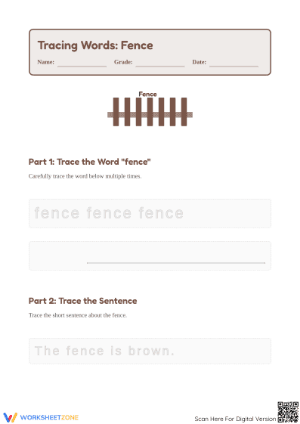
- Tracing and saying: Pair letter formation practice with saying the sound aloud each time a student traces the letter F, connecting motor memory to sound production.
- Independent practice bin: Rotate a stack of letter F worksheets into a literacy center so students who need extra repetition can revisit the skill without teacher-led time.
- Quick whole-group check: Open a lesson with a thirty-second oral warm-up naming pictures, then use a worksheet as the written record of who is ready to move forward.
Differentiating Letter F Practice for Pre-K Enrichment and Grade 1 Review
In pre-K, letter F beginning sound worksheets often serve as enrichment for students who already recognize some letters and are ready to connect letters to sounds rather than shapes alone. Keep pre-K tasks oral and picture-heavy, with minimal writing demand.
In grade 1, the same skill frequently appears as review for students who need to shore up a foundational gap before tackling blends and digraphs. For these students, add a short written component, such as writing the letter F next to each correctly identified picture, so the worksheet also reinforces letter formation alongside the sound skill.
Connecting Beginning Sounds to Broader Phonemic Awareness
Isolating the beginning sound in a word is an early rung on the phonemic awareness ladder, sitting below blending and segmenting full words and above simple rhyme recognition. Students who practice beginning-sound isolation consistently tend to move into blending tasks with less confusion because they already understand that words are made of separate, identifiable sounds.
When you introduce blending later in the year, referencing back to letter F practice gives students a familiar anchor: they already know how to isolate /f/, so asking them to blend it with a vowel sound is a smaller cognitive step than starting from scratch.
Frequently Asked Questions
1. What grade level is letter F beginning sound practice appropriate for?
This skill is typically taught in pre-K through grade 1, with pre-K and kindergarten as the primary instructional window and grade 1 often using it as a quick review or intervention target for students with gaps.
2. How do teachers know when a student has mastered beginning sound identification?
Mastery is usually defined as consistent, accurate identification across multiple exposures and formats, such as picture sorting, oral naming, and worksheet marking, rather than a single correct answer on one occasion.
3. What are common student confusions with the /f/ sound and how can worksheets address them?
Students often confuse /f/ with /v/ or /th/ because the sounds are produced with similar mouth positions. Worksheets that specifically contrast these sounds, rather than testing /f/ in isolation, help surface and correct this confusion early.
4. How should these worksheets be used in whole-group versus small-group instruction?
Whole-group use works well for initial introduction and quick formative checks, while small-group use is better suited to targeted intervention for students who show inconsistent mastery or specific sound confusions.
5. How many practice sessions are typically needed before moving to a new target sound?
This varies by student, but many classrooms plan for an initial instructional cycle followed by a review check two to three weeks later before considering the sound secure enough to move on.