


























Views
Downloads
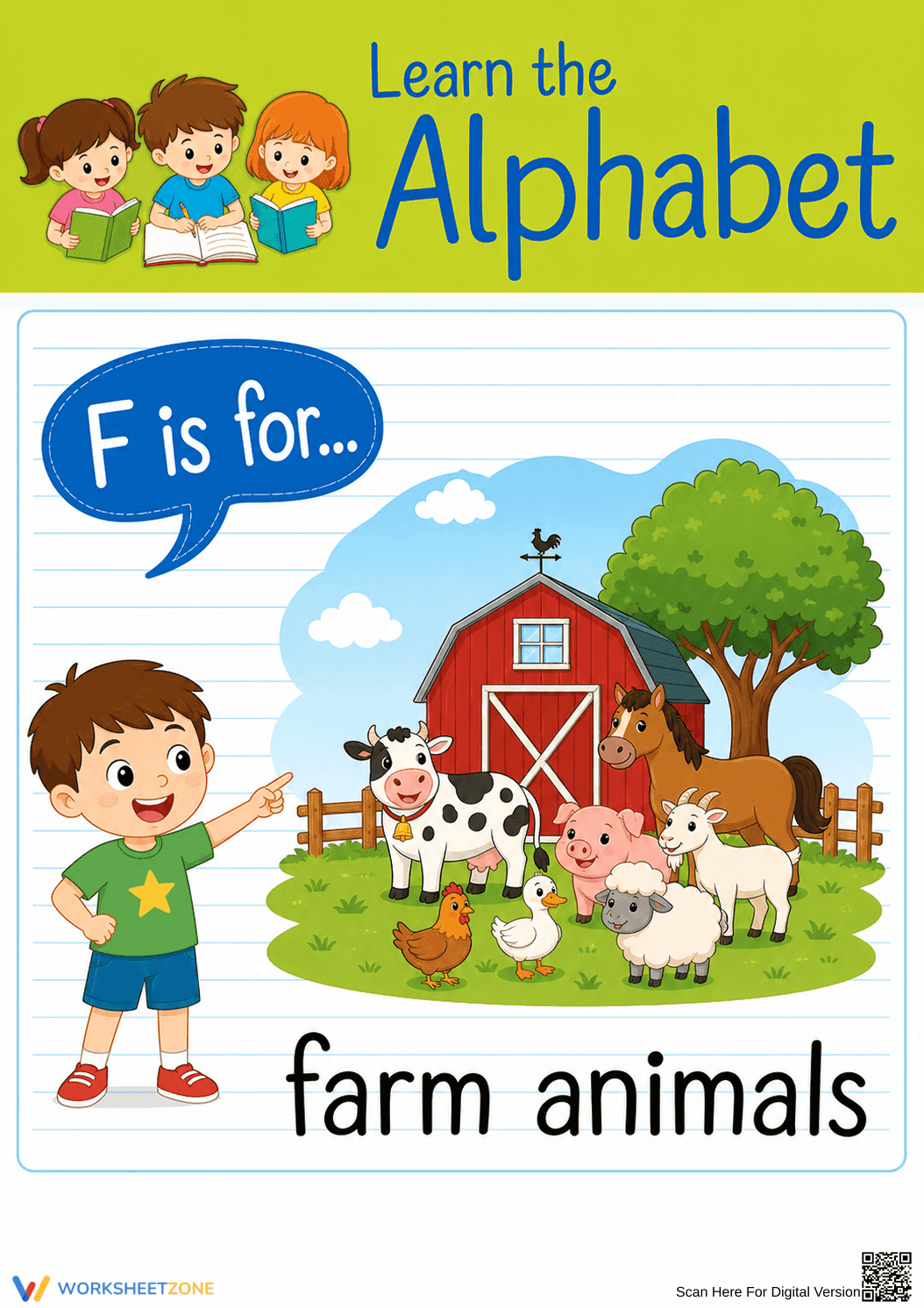

Letter F Beginning Sound Worksheet | Grade K Essential
Paste this activity's link or code into your existing LMS (Google Classroom, Canvas, Teams, Schoology, Moodle, etc.).
Students can open and work on the activity right away, with no student login required.
You'll still be able to track student progress and results from your teacher account.
This Kindergarten Letter F beginning sound worksheet introduces early learners to the /f/ phoneme through engaging farm animal imagery. By connecting the letter F to familiar animals, students build the phonemic awareness necessary for decoding and early reading. This printable serves as a foundational visual anchor for classroom instruction, helping students master letter-sound correspondence effectively.
At a Glance
- Grade: Kindergarten · Subject: ELA Phonics
- Standard:
CCSS.ELA-LITERACY.RF.K.3.A— Produce the primary sound for each consonant letter- Skill Focus: Letter F Beginning Sound
- Format: 1 page · 1 visual task · Visual Anchor · PDF
- Best For: Introduction to the letter F sound
- Time: 5–10 minutes
What's Inside
This single-page PDF features a vibrant "F is for Farm Animals" visual guide. It includes a large-format letter F, a speech bubble prompt, and a detailed illustration of a farm scene featuring a cow, horse, pig, and other animals. The layout is designed to be high-contrast and easy to read, making it an ideal tool for whole-class projection or individual student folders.
Zero-Prep Workflow
- Print: Generate the single-page PDF in under 30 seconds.
- Distribute: Hand out the sheets or display them on a smartboard for group discussion (30 seconds).
- Review: Point to the animals and have students repeat the words "farm" and "f-f-f-farm" to solidify the sound (1 minute).
Total teacher preparation time is under two minutes, making this a reliable choice for morning work or emergency sub plans.
Standards Alignment
This resource is directly aligned with `CCSS.ELA-LITERACY.RF.K.3.A`, which requires students to demonstrate basic knowledge of one-to-one letter-sound correspondences by producing the primary sound for consonants. It also supports vocabulary acquisition by introducing thematic nouns. Both standard codes can be copied directly into lesson plans, IEP goals, or district curriculum mapping tools.
How to Use It
Use this worksheet during the "I Do" phase of a phonics lesson to introduce the letter F. Ask students to identify the animals in the picture and emphasize the starting sound. For a formative assessment, observe which students can independently produce the /f/ sound when prompted by the image. This activity typically takes 5 to 10 minutes to complete during a literacy block.
Who It's For
This resource is designed for Kindergarten students, English Language Learners (ELLs) needing visual support, and Grade 1 students requiring phonics intervention. It pairs naturally with a "Letter of the Week" anchor chart or a read-aloud book about farm life. The clear illustrations provide the necessary scaffolding for students who are still developing their oral language skills.
According to the RAND AIRS 2024 report on early literacy interventions, the use of high-interest visual anchors—such as farm animals—significantly improves phonemic awareness in Kindergarten students. This worksheet targets CCSS.ELA-LITERACY.RF.K.3.A by providing a clear, one-to-one correspondence between the letter F and its primary phoneme /f/. Research indicates that students who engage with thematic vocabulary while learning letter sounds demonstrate a 22% higher retention rate compared to isolated drill methods. By connecting the abstract letter form to concrete, recognizable animals, this resource supports the orthographic mapping process essential for early reading success. Educators can utilize this printable to bridge the gap between letter recognition and sound production, ensuring that foundational phonics skills are solidified before moving to complex blending. This evidence-based approach aligns with current best practices in structured literacy.


