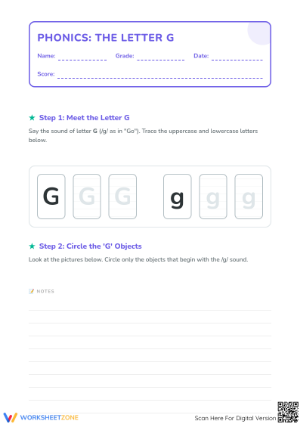
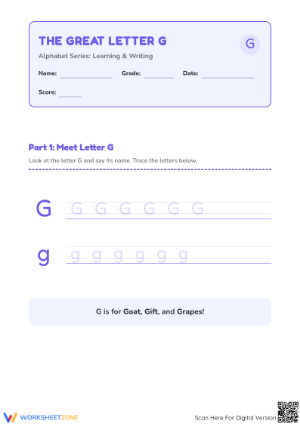
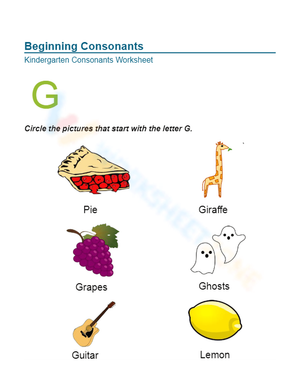
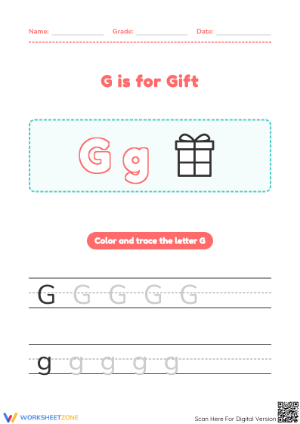
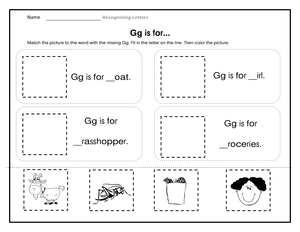
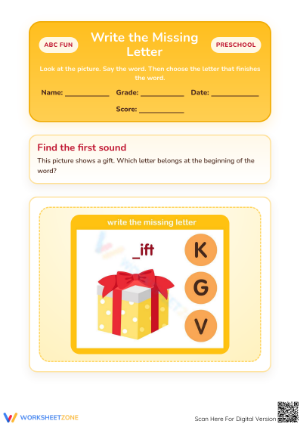
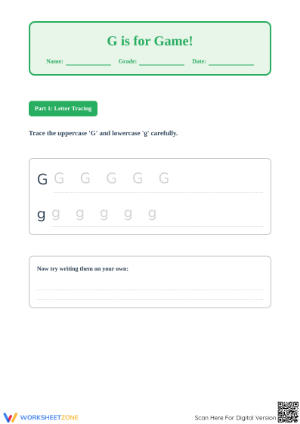
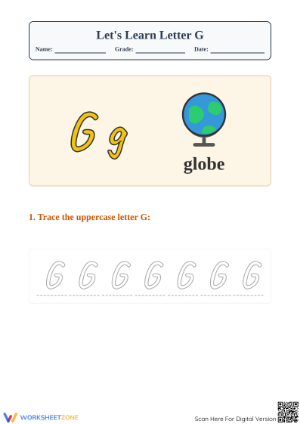
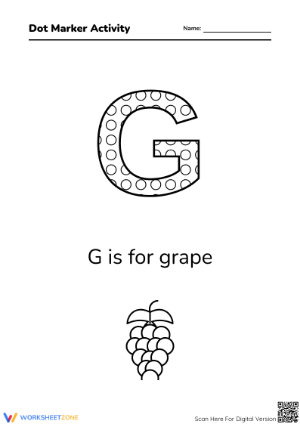
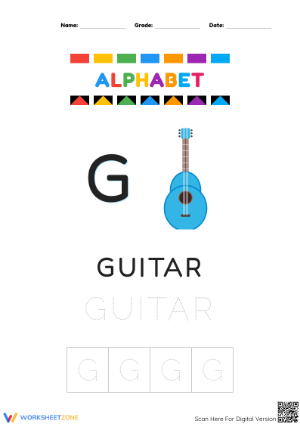
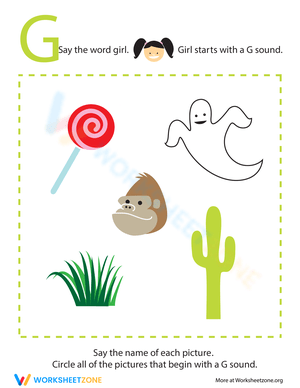
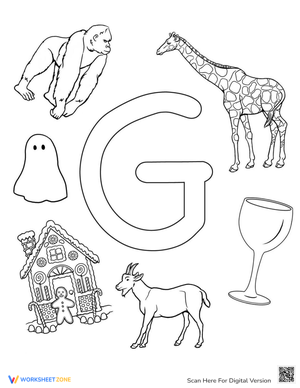
Kindergarten teachers often notice that the /g/ sound gives students more trouble than louder, more frequent consonants like /b/ or /m/. Letter g beginning sound worksheets give you a focused way to build that initial-sound recognition before students move into blending G into CVC words like gas or gum.
Where Letter G Fits in the Phonics Scope and Sequence
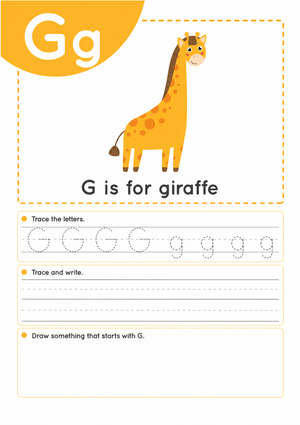
CCSS.ELA-LITERACY.RF.K.3.A asks kindergartners to produce the primary sound for each consonant, and G's primary sound is the hard /g/ heard in goat and garden. Save the soft G sound, as in giraffe, for a later unit once students have a stable base of one-to-one letter-sound correspondences. Introducing both sounds at once during initial instruction tends to slow down students who are still learning that G maps to any consistent sound at all.
Sequence a G lesson the way you would any new phoneme-grapheme pairing: whole-group introduction with a keyword picture and mouth-position modeling, guided practice in small groups, then independent worksheet practice for consolidation. Letter g beginning sound worksheets work best in that third slot, after students have already heard and produced the sound several times with you.
Pairing Worksheets With Multisensory Reinforcement
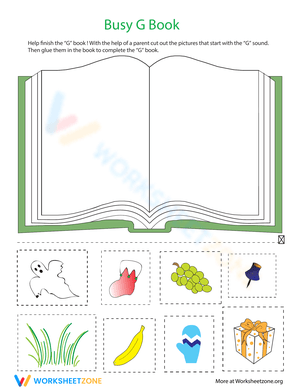
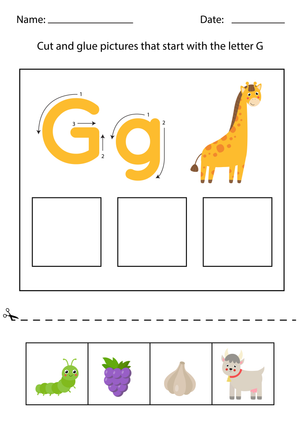
Letter g beginning sound worksheets hold up best when they are not the only activity in the lesson. Pair a worksheet with a cut-and-paste sort where students group G pictures separately from non-G pictures, or add a tactile step like tracing G in sand or shaving cream before the paper task. This multisensory layering helps students who need a kinesthetic anchor alongside the visual and auditory work the worksheet already provides.
Classroom Implementation
Plan a G-focused rotation across three to four days rather than a single session. Day one can center on oral isolation and a keyword picture; day two on a sorting worksheet; day three on a worksheet that pairs G with short vowels for early blending; and day four on a quick formative check. Keep worksheet time short, five to eight minutes per rotation, so it stays a supplement to direct instruction rather than a stand-alone lesson.
For intervention groups, pull the same beginning-sound-G worksheets used in the general classroom, but reduce the number of items per page and increase how often you return to the skill across the week. Students who missed the initial instruction window often need the same materials delivered with more repetition rather than entirely different content.
Avoiding the Hard vs. Soft G Mix-Up Early On
Introducing the soft G sound too early is a common source of confusion in beginning-sound work. Keep initial G worksheets limited to hard-G words like goat, gate, garden, and gum. Once students consistently isolate and produce the hard /g/ sound, you can introduce a short comparison unit that separates hard and soft G, ideally after students have moved past pure beginning-sound isolation and into more general phonics review.
Frequently Asked Questions
1. What is the best way to introduce the letter G beginning sound to kindergartners?
Start with a whole-group lesson using a consistent keyword picture, such as goat, and have students repeat the /g/ sound while watching your mouth position. Follow with guided small-group practice before assigning independent worksheet practice.
2. How do letter G beginning sound worksheets support CCSS RF.K.2 and RF.K.3?
Worksheets that require picture-to-sound matching build the phonemic isolation skill named in RF.K.2.D, while worksheets pairing the letter G with its primary sound support the letter-sound correspondence goal in RF.K.3.A.
3. When should teachers introduce the soft G sound relative to the hard G sound?
Hard G should be taught first as the primary sound. Soft G, as in giraffe, is best introduced later, once students reliably isolate and produce the hard /g/ sound in beginning position.
4. How can teachers assess whether a student has mastered the beginning G sound?
A short picture-sorting task, where students separate G-initial pictures from non-G pictures within a set time, gives a quick and reliable formative snapshot of mastery.
5. How often should beginning-sound worksheets be used in a phonics rotation?
Short daily or near-daily practice across three to four days works better than a single long session, since it gives students repeated, spaced exposure to a lower-frequency sound like G.