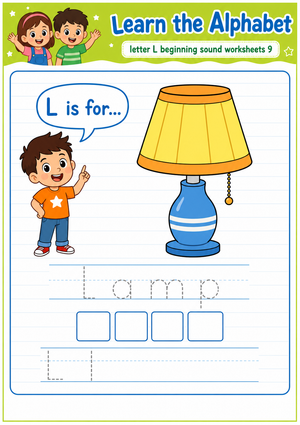
Why letter L beginning sound worksheets matter in early phonics
Letter l beginning sound worksheets give teachers a narrow, teachable target: can students hear and identify /l/ at the start of a spoken word? That single step matters because beginning-sound work sits inside phonological awareness and early phonics, where students are learning to connect what they hear with what they see in print. In PreK and kindergarten, that usually means listening first, then matching the sound to a letter, then practicing it across several picture cues.
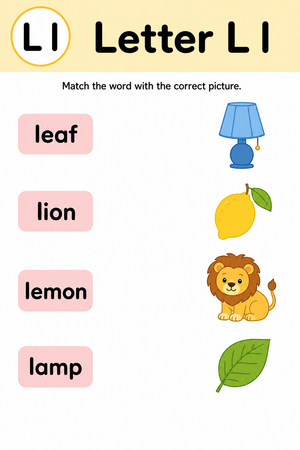
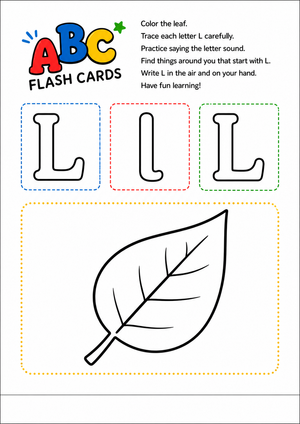
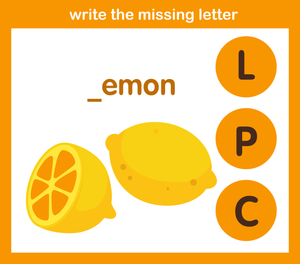
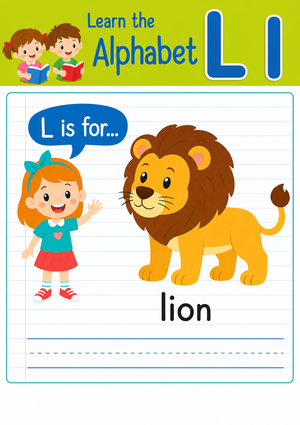
For classroom use, that focus is useful because it strips away extra demands. Students do not need to decode a full sentence or spell an entire word to show what they know. They can circle, sort, trace, or match images such as lamp, leaf, lion, and lemon. That makes these pages practical for literacy centers, morning work, intervention groups, and quick checks at the end of a phonics lesson.
What students should do on a strong letter L page
The best letter l beginning sound worksheets ask students to demonstrate sound recognition in simple, observable ways. A strong page usually starts with a visual task, because young learners can show understanding through pointing, circling, and matching before they are ready for independent writing. That keeps the lesson aligned to the actual goal: hearing /l/ at the beginning of words.
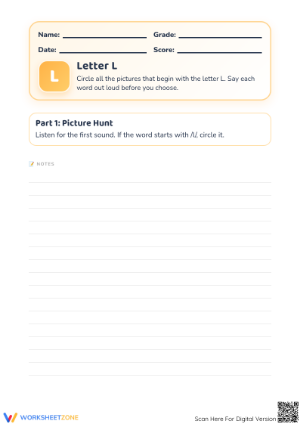
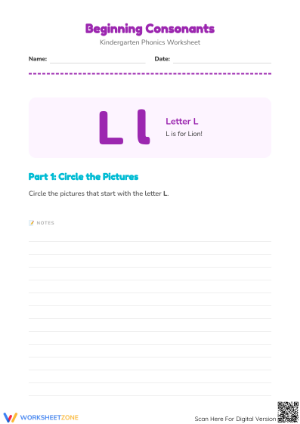
- Circle the picture that begins with /l/ from a small set of images.
- Match the uppercase or lowercase letter L to pictures that begin with the target sound.
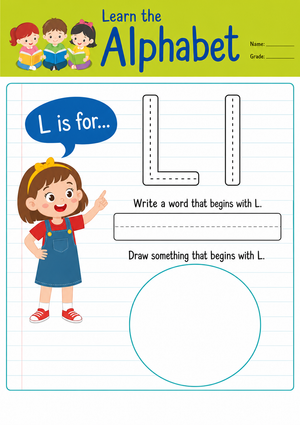
- Trace the letter while saying the sound aloud.
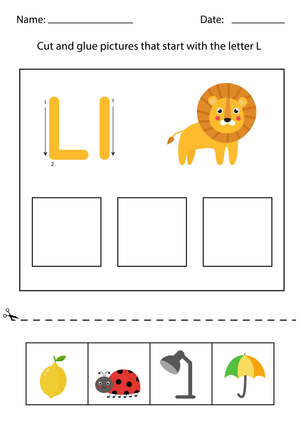
- Sort picture items into starts with /l/ and does not start with /l/.
- Connect a simple printed word to its matching picture when students are ready for light print support.
These formats are especially effective because they move from listening to recognition to light print application. Teachers can keep the modeling short: say the word, stretch the first sound, and ask students to repeat it. After that, the worksheet acts as guided practice rather than busy work. If students can explain why lion belongs in the /l/ group and sun does not, the page is doing its job.
Choose picture words that keep the focus on the initial /l/ sound
Vocabulary choice determines whether the worksheet helps or confuses. For beginning-sound practice, picture words should be familiar, visually clear, and easy to say. Words such as lion, leaf, lamp, lemon, and ladder are useful because the opening /l/ is noticeable and the images are usually easy for young learners to identify. Teachers should avoid cluttered or ambiguous pictures that force students to guess what the item is before they can think about the sound.
It also helps to pair the target word with contrast words that are clearly different. If a student is asked to choose between lamp, cat, and fish, the sound contrast is straightforward. If the distractors are too similar in appearance or language load, the task starts measuring vocabulary knowledge more than sound awareness. For intervention groups, that distinction matters.
Classroom Implementation
In a whole-group phonics lesson, these worksheets work best after a short oral warm-up. Start by saying a few familiar words and asking students whether they hear /l/ at the beginning. Model with gestures, mouth formation, and repetition, then move into the printed page once students have heard the sound several times. That sequence keeps the worksheet connected to listening rather than turning it into an isolated paper task.
In centers, keep the page paired with one simple routine. Students might name each picture softly, point to the first sound, then complete the task. In intervention, use fewer items and more teacher prompting. In grade 1 review, the same page can become a fast fluency check by asking students to identify the correct images and explain their choices in a full sentence.
Reading Rockets identifies phonological and phonemic awareness as foundational to early reading, and its Pre-K guidance emphasizes practicing sound noticing in brief, concrete routines. Across a PreK to grade 1 range, that supports using one-sound worksheets as short, repeated practice rather than long independent seatwork.
For formative assessment, collect completed sheets and sort them into three groups: secure, developing, and reteach. That gives teachers an immediate planning tool for the next day. A strong worksheet should help you decide who can move on, who needs another oral practice round, and who needs picture vocabulary clarified before sound work will be accurate.
Differentiate without turning the task into something else
Differentiation is useful only if it protects the original skill. With letter l beginning sound worksheets, the temptation is to add too much: extra handwriting, sentence writing, or full-word spelling. Those extensions can be appropriate later, but they should not replace the core check for hearing /l/ at the start of a word. If the main goal is beginning-sound recognition, the clearest adaptation is to change support level, not the skill itself.
- For emerging learners, reduce the number of answer choices and preview the picture names aloud.
- For students who need movement, turn the worksheet into a cut-and-sort task before asking them to record answers.
- For stronger students, ask them to generate one more /l/ word after finishing the page.
- For intervention groups, revisit the same image set over several days so students are practicing the sound, not relearning the task directions.
What the worksheet can tell teachers about student errors
Completed pages are useful because they show patterns quickly. If a student misses only one item, the issue may be attention or picture naming. If a student consistently selects images that do not begin with /l/, the problem is more likely tied to hearing or isolating the first sound. That difference should shape reteaching. One kind of error needs cleaner directions; the other needs more explicit oral practice.
A practical review routine is to check three things in order: did the student name the picture accurately, did the student say the first sound, and did the student connect that sound to letter L? That sequence helps teachers separate vocabulary confusion from phonological confusion, which makes small-group follow-up faster and more precise.
When several students make the same error on the same picture, the worksheet itself may need adjustment. That is one reason printable resources from Worksheetzone are most effective when teachers preview the image set before instruction. The worksheet should support decision-making, not add avoidable noise.
How Worksheetzone pages fit planning, review, and intervention
Teachers usually need printable phonics pages that can shift across different parts of the day. That is where letter l beginning sound worksheets are especially flexible. The same resource can support a mini-lesson follow-up, a center rotation, a sub plan, or a brief intervention block. Because the skill is narrow, teachers can plug the page into existing routines without redesigning the lesson.
Worksheetzone pages are also easy to combine with other short tasks. A teacher might begin with oral picture naming, move into the worksheet, and end with a quick exit response where students say one /l/ word aloud. That pacing keeps the page purposeful. Instead of standing alone, the worksheet becomes one part of a compact phonics cycle: hear it, identify it, record it, and explain it.
Frequently Asked Questions
1. What is a letter L beginning sound worksheet?
It is a phonics worksheet that asks students to identify words or pictures that start with the /l/ sound. Common tasks include circling the correct image, matching pictures to letter L, tracing the letter, or sorting items by beginning sound.
2. What age or grade is best for letter L beginning sound practice?
This skill is most appropriate for PreK and kindergarten, with useful review value in early grade 1. It also works well in reading intervention when students still need focused practice hearing and identifying initial sounds.
3. Which words work well for teaching the /l/ sound at the beginning of a word?
Clear, familiar picture words are best. Teachers often use lion, leaf, lamp, lemon, or ladder because the opening /l/ is easy to hear and the pictures are usually recognizable to young learners.
4. How can teachers use letter L sound worksheets in a phonics lesson?
Use them after a brief oral warm-up on the /l/ sound, then review responses to see who can identify the sound independently. They fit centers, morning work, small groups, intervention, and quick formative checks at the end of a lesson.