


























Views
Downloads

Printable Letter F Beginning Sound Worksheet | Grade K
Paste this activity's link or code into your existing LMS (Google Classroom, Canvas, Teams, Schoology, Moodle, etc.).
Students can open and work on the activity right away, with no student login required.
You'll still be able to track student progress and results from your teacher account.
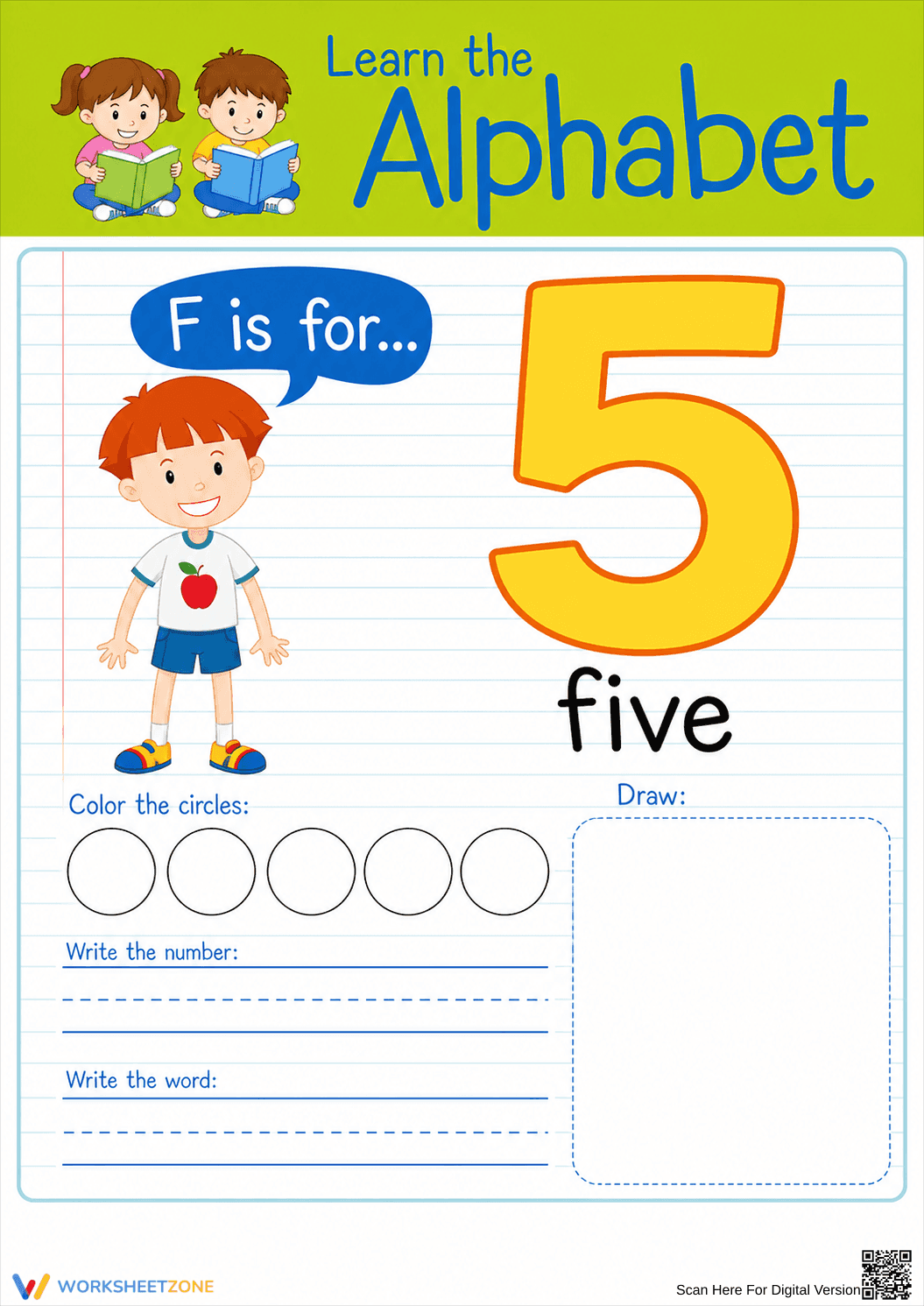
This printable Kindergarten worksheet helps early learners connect the letter F to its beginning sound using the number five. Students practice letter-sound correspondence, counting, and handwriting in one engaging activity. The clear layout ensures young students can build foundational literacy and math skills with minimal teacher guidance.
At a Glance
- Grade: K · Subject: ELA
- Standard:
CCSS.ELA-LITERACY.RF.K.3.A— Produce primary sounds for consonants- Skill Focus: Letter F beginning sound
- Format: 1 page · 4 problems · No answer key · PDF
- Best For: Independent practice centers
- Time: 10–15 minutes
Inside this single-page resource, educators will find four distinct task types designed to reinforce both phonics and basic numeracy. Students are prompted to color five circles, write the numeral five, write the word "five" on primary dashed lines, and complete a blank drawing box. The page features colorful, kid-friendly illustrations, including a boy speaking the phrase "F is for...", which provides a strong visual anchor for the target phonics skill.
This resource is designed for a highly efficient classroom workflow.
- Print (30 seconds): Generate copies directly from the PDF file for your entire class.
- Distribute (1 minute): Hand out the sheets along with crayons and pencils. The visual cues make instructions obvious.
- Review (3 minutes): Quickly check student work for correct letter formation and accurate counting.
Total teacher preparation time is under two minutes, making this an excellent option for emergency sub plans, morning work, or fast-finisher folders.
This activity aligns with primary standard CCSS.ELA-LITERACY.RF.K.3.A, requiring students to demonstrate basic knowledge of one-to-one letter-sound correspondences by producing the primary sound for consonants. It also supports cross-curricular math skills by having students represent a number of objects with a written numeral. Both standard codes can be copied directly into lesson plans, IEP goals, or district curriculum mapping tools.
Teachers can deploy this worksheet during morning arrival to establish a calm, productive routine while reinforcing the letter of the week. It also functions perfectly as an independent literacy center activity after direct instruction on the /f/ sound. As a formative assessment tip, observe students while they write the word "five" to check their pencil grip and adherence to the primary writing lines. Expect most Kindergarten students to complete the page within 10 to 15 minutes.
This resource is primarily designed for Kindergarten students mastering their initial consonant sounds and basic numbers up to five. It serves as a helpful intervention tool for first-grade students who need additional practice with letter-sound correspondence or fine motor handwriting skills. Pair this worksheet with a read-aloud book featuring heavy alliteration of the letter F or a classroom anchor chart displaying F-words to maximize the instructional impact.
Integrating phonics instruction with cross-curricular activities like counting and drawing significantly reinforces early childhood learning pathways. According to a RAND AIRS 2024 report on early literacy interventions, multimodal tasks that require students to simultaneously process visual symbols, motor skills, and phonetic sounds increase retention of foundational reading concepts. This worksheet targets CCSS.ELA-LITERACY.RF.K.3.A, asking students to produce primary sounds for consonants, specifically focusing on the letter F. By combining the auditory cue of the /f/ sound with the physical act of writing the word "five" and coloring corresponding circles, the activity builds robust neural connections. Providing young learners with structured, predictable formats reduces cognitive load, allowing them to focus entirely on the target skill rather than deciphering complex instructions.


