If you have reached the U-V-W-X-Y-Z stretch of your phonics scope and sequence, you already know the letter V presents a specific challenge. Students see fewer /v/ words in daily print than they do for letters like B, C, or S, so beginning-sound practice for V needs to be more deliberate. Letter V beginning sound worksheets give you a repeatable way to build that exposure while still meeting the demands of a structured phonics block.
Standards Alignment for Planning and Documentation
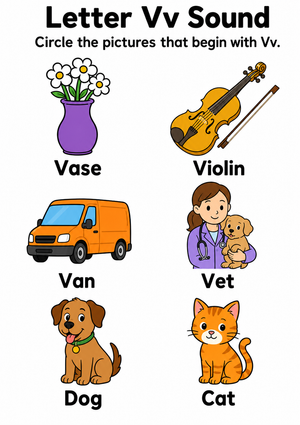
Letter V beginning sound worksheets map directly onto two Common Core reading foundational skills standards for kindergarten. The first is one-to-one letter-sound correspondence, which asks students to produce the primary sound for each consonant, including V. The second involves isolating and pronouncing initial, medial, and final phonemes in three-phoneme words, a skill that directly supports beginning-sound identification tasks like a letter V sort or circle-the-picture activity.
CCSS.ELA-LITERACY.RF.K.3.a requires students to demonstrate basic knowledge of one-to-one letter-sound correspondences by producing the primary sound for each consonant. CCSS.ELA-LITERACY.RF.K.2.d requires isolating and pronouncing initial, medial, and final phonemes in three-phoneme (CVC) words, according to the Common Core State Standards Initiative and Teach Starter's standards breakdowns. Citing both standards on your lesson plan gives you clean documentation for administrators or instructional coaches reviewing your phonics block.
Using Letter V Worksheets in Small-Group Intervention
For RTI or MTSS Tier 2 groups, letter V worksheets work best as a short, focused station rather than a whole-class activity. Pull students who are still confusing /v/ with /f/ or /b/ into a five-minute rotation where they sort pictures by beginning sound, then move to a worksheet that asks them to circle or write V under matching images. Keep the group small, four to six students, so you can watch mouth position and listen closely to each response.
Reading interventionists often find that letter V confusion clusters with a handful of predictable errors. Naming those errors ahead of time helps you plan which worksheet variations to pull for a given group.
Common Student Errors and How Worksheets Support Correction
Students frequently confuse /v/ with /f/ because both sounds are produced with a similar mouth shape, the difference being that /v/ is voiced and /f/ is not. Others substitute /b/ for /v/, or occasionally /w/, because the letter shapes look visually similar to a young reader still building letter recognition. A worksheet that pairs a clear picture with an isolated sound-matching task lets you catch these substitutions quickly, since the student's marked answer shows you exactly which sound they produced instead of V.
Repetition matters here. A single worksheet will not correct a persistent /v/-/f/ confusion, but three or four short sessions across a week, each asking students to isolate and produce the sound before marking an answer, tends to build the muscle memory needed for consistent recall.
Classroom Implementation
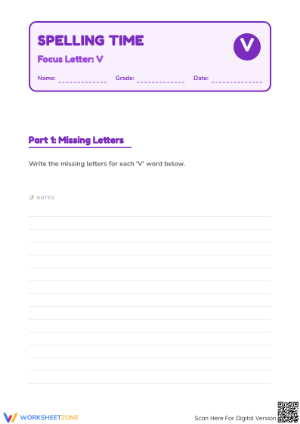
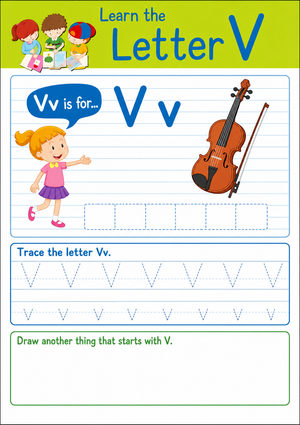
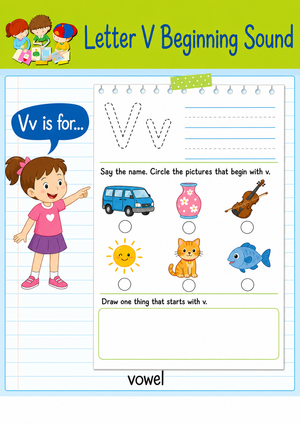
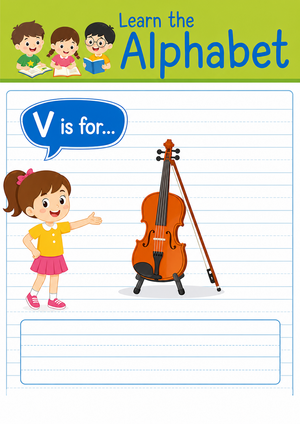
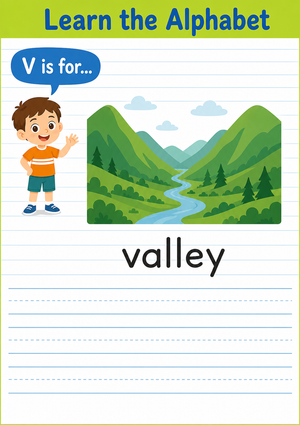
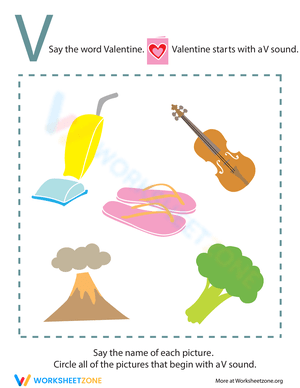
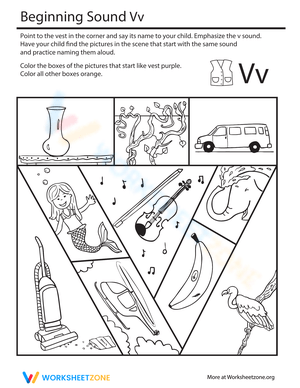
Build letter V practice into your existing phonics block rather than treating it as a stand-alone lesson. A simple weekly structure works well: introduce the sound with a picture sort on day one, follow with a worksheet that asks students to circle matching pictures on day two, add a writing or tracing worksheet on day three, and close the week with a quick formative check where students sort a mixed set of V, F, and B pictures independently. That final check tells you whether students are ready to move on or whether the group needs another week of targeted practice.
Keep an answer key or informal tracking sheet nearby during small-group work. Jotting down which students substitute /f/ or /b/ for /v/ gives you a quick reference for regrouping students in future intervention cycles without needing a formal reassessment.
Frequently Asked Questions
1. What grade level is letter V beginning sound practice appropriate for?
Letter V beginning sound worksheets are most commonly used in pre-K and kindergarten classrooms, since V typically appears in the later portion of a kindergarten phonics scope and sequence. First-grade teachers also use these worksheets for review or light intervention with students who need additional practice with less frequent consonant sounds.
2. How do letter V worksheets align with Common Core reading foundational skills standards?
They support CCSS.ELA-LITERACY.RF.K.3.a, which requires producing the primary sound for each consonant, and CCSS.ELA-LITERACY.RF.K.2.d, which requires isolating and pronouncing initial phonemes in three-phoneme words. Both standards are documented by the Common Core State Standards Initiative and explained further by Teach Starter's standards resources.
3. How can teachers use letter V worksheets in small-group or intervention settings?
Use them as a short, focused station within an RTI or MTSS Tier 2 rotation. Keep groups small so you can observe mouth position and listen to each student's response, and pair picture sorts with sound-isolation worksheets to reinforce the target sound before moving to CVC word tasks.
4. What are common mistakes students make with the /v/ sound and how can worksheets help address them?
Students often confuse /v/ with /f/ because the two sounds share a similar mouth shape, or substitute /b/ or /w/ due to visual similarity between the letters. Worksheets that require students to mark or write a response make these substitutions visible immediately, letting you correct them during the same session.
5. How often should beginning-sound worksheets be used in a weekly phonics routine?
A short cycle of three to four sessions per week tends to work well for building consistent recall, moving from picture-only matching early in the week to independent sorting or writing tasks by the end of the week as a formative check.