


























Views
Downloads
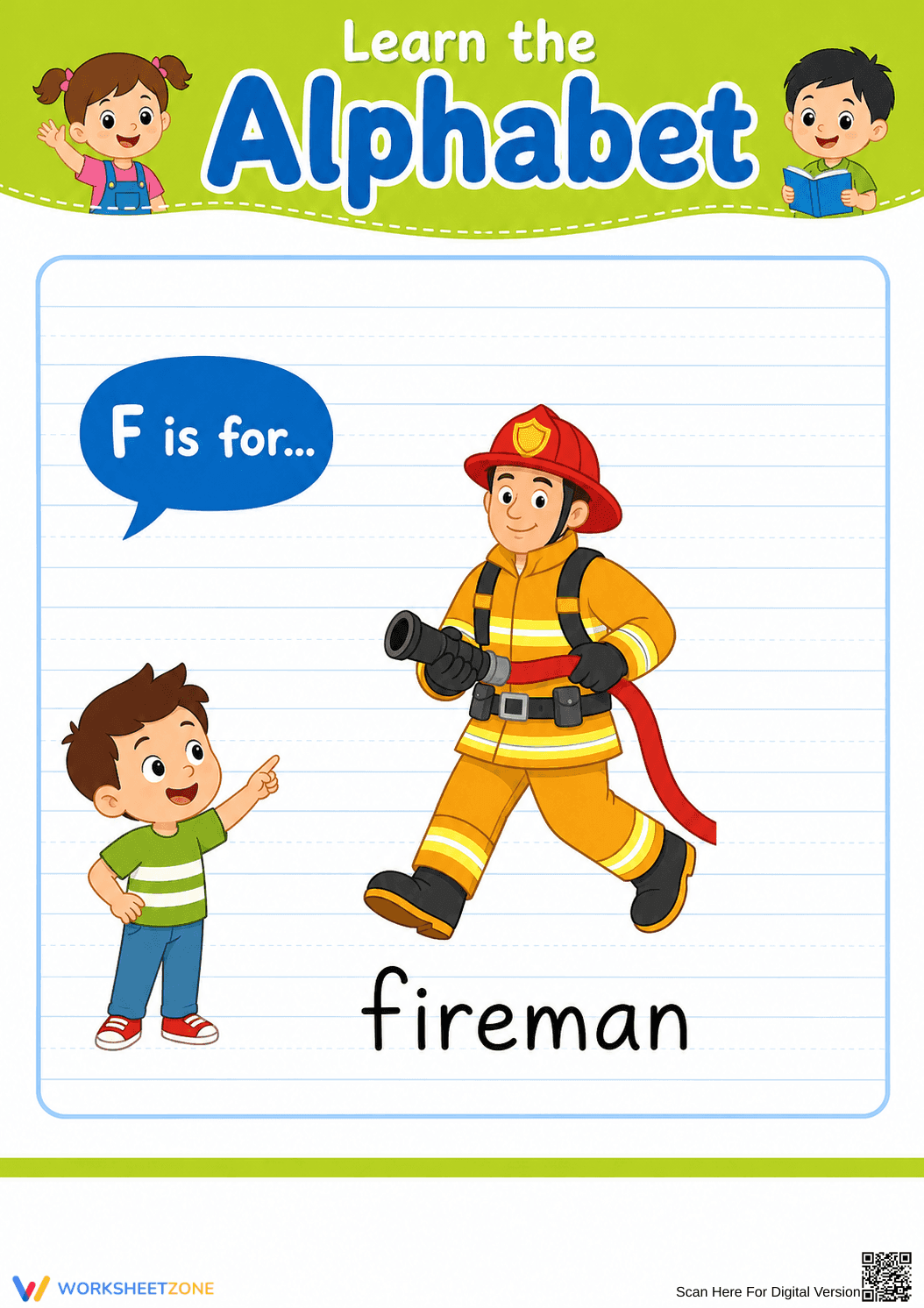

Printable Letter F Beginning Sound Worksheet | Grade K
Paste this activity's link or code into your existing LMS (Google Classroom, Canvas, Teams, Schoology, Moodle, etc.).
Students can open and work on the activity right away, with no student login required.
You'll still be able to track student progress and results from your teacher account.
This foundational phonics resource introduces early learners to the beginning sound of the letter F. Students connect the visual representation of a fireman to the initial consonant sound, building essential letter-sound correspondence skills. This clear, engaging visual support helps young readers confidently identify and produce the target phoneme.
At a Glance
- Grade: Kindergarten · Subject: ELA
- Standard:
CCSS.ELA-LITERACY.RF.K.3.A— Produce primary sounds for consonants- Skill Focus: Letter F beginning sound
- Format: 1 printable page · 1 visual identification task · No answer key needed · PDF
- Best For: Whole group phonics introduction and early literacy centers
- Time: 5–10 minutes
This single-page printable features a large, colorful illustration of a fireman alongside clear text stating "F is for... fireman." The layout is intentionally uncluttered, ensuring early readers focus entirely on the relationship between the letter F and its initial sound without distracting elements.
Zero-Prep Workflow
This resource is designed for immediate classroom implementation. The workflow is highly efficient:
- Print: Generate full-color or grayscale copies in under 30 seconds.
- Distribute: Hand out to students or display on a smartboard instantly (1 minute).
- Review: Guide students through choral reading of the text and sound production (3-5 minutes).
Total teacher prep time is under 2 minutes. It is an excellent addition to any emergency sub plan.
Standards Alignment
This resource aligns directly with CCSS.ELA-LITERACY.RF.K.3.A: Demonstrate basic knowledge of one-to-one letter-sound correspondences by producing the primary sound or many of the most frequent sounds for each consonant. It also supports early vocabulary acquisition by pairing the target letter with a familiar community helper. Both standard codes can be copied directly into lesson plans, IEP goals, or district curriculum mapping tools.
How to Use It
This visual aid serves perfectly as an anchor chart during whole-group instruction when introducing the letter F. Teachers can display the page and have students practice saying the /f/ sound together. Alternatively, it works well in small-group literacy centers. For a quick formative assessment, observe whether students can independently produce the correct sound. Expected completion time is 5 to 10 minutes.
Who It's For
This resource is primarily designed for Kindergarten students beginning their phonics journey, though it is also appropriate for Pre-K learners or first-grade students needing foundational review. The clear visual support makes it highly accessible for English Language Learners (ELLs) who are building both phonemic awareness and basic English vocabulary simultaneously. For differentiation, teachers can pair this page with a tactile activity, such as tracing the letter F in sand, or use it alongside a direct instruction lesson on community helpers to build cross-curricular connections.
Effective phonics instruction relies heavily on clear, unambiguous visual supports that connect abstract letters to concrete, familiar concepts in the classroom environment. According to a comprehensive review by EdReports 2024, foundational reading materials that explicitly pair target phonemes with highly recognizable images significantly improve early literacy outcomes for young learners. This resource directly supports CCSS.ELA-LITERACY.RF.K.3.A by helping students produce primary sounds for consonants through the specific context of the letter F beginning sound. By isolating the phoneme and providing a direct visual anchor—in this case, a fireman—educators can reduce cognitive load and facilitate faster phonetic mastery. Consistent exposure to these targeted visual-auditory pairings is a critical component of evidence-based literacy instruction, ensuring that young learners develop the automaticity required for fluent reading in later grades.


