




























Views
Downloads

Essential Letter F Phonics Worksheet | Grade K-1 Ready

Paste this activity's link or code into your existing LMS (Google Classroom, Canvas, Teams, Schoology, Moodle, etc.).
Students can open and work on the activity right away, with no student login required.
You'll still be able to track student progress and results from your teacher account.
This comprehensive Letter F worksheet helps early learners master alphabet recognition and handwriting through structured tracing and phonemic awareness tasks. Students develop fine motor control while connecting the letter shape to its corresponding initial sound. By the end of these two pages, learners will confidently identify and write both cases of the letter F.
At a Glance
- Grade: Kindergarten · Subject: ELA Phonics
- Standard:
CCSS.ELA-LITERACY.RF.K.1.D— Recognize and name all upper- and lowercase letters of the alphabet- Skill Focus: Letter formation and initial sounds
- Format: 2 pages · 56 tasks · Answer key included · PDF
- Best For: Morning work or phonics centers
- Time: 15–20 minutes
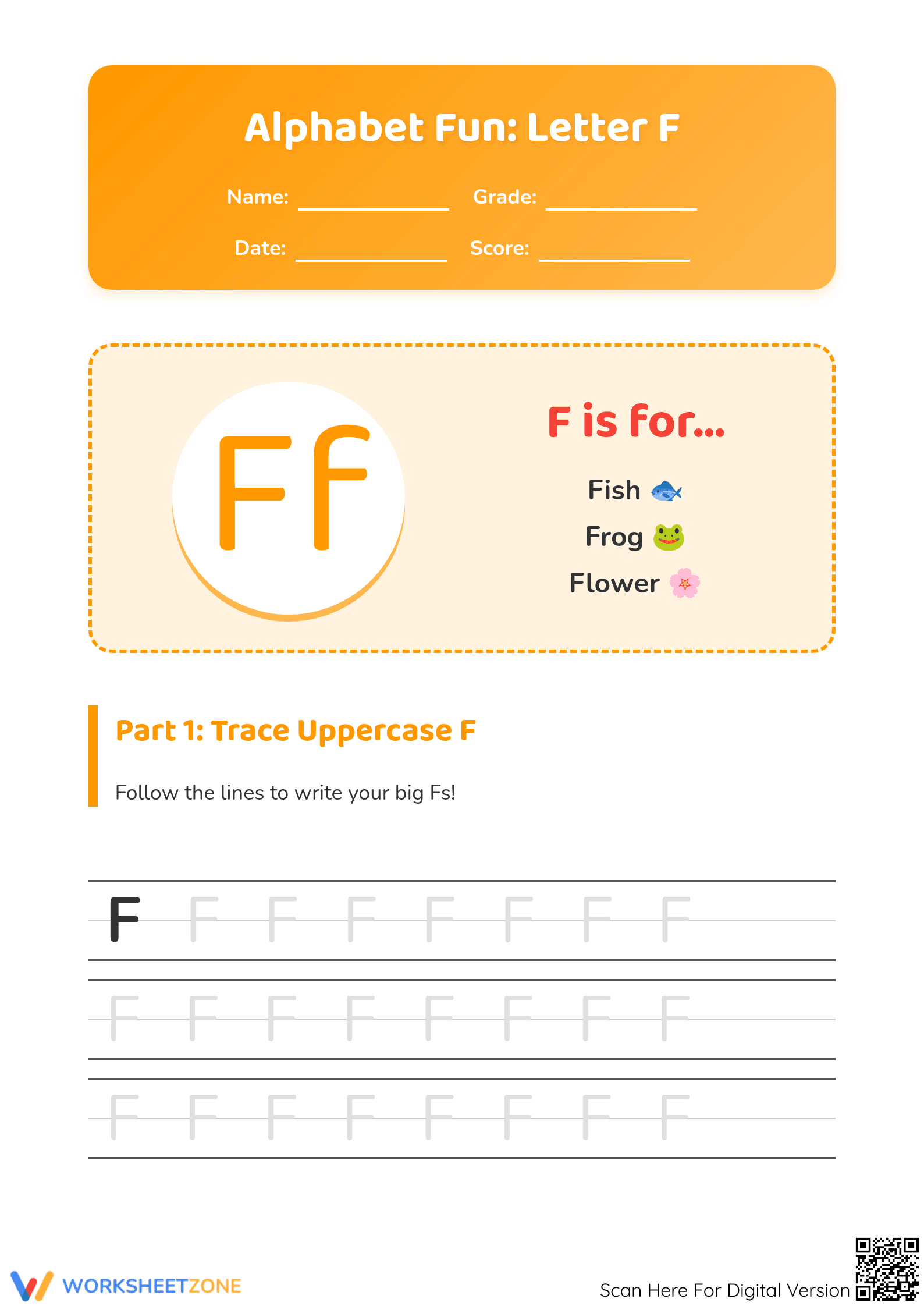
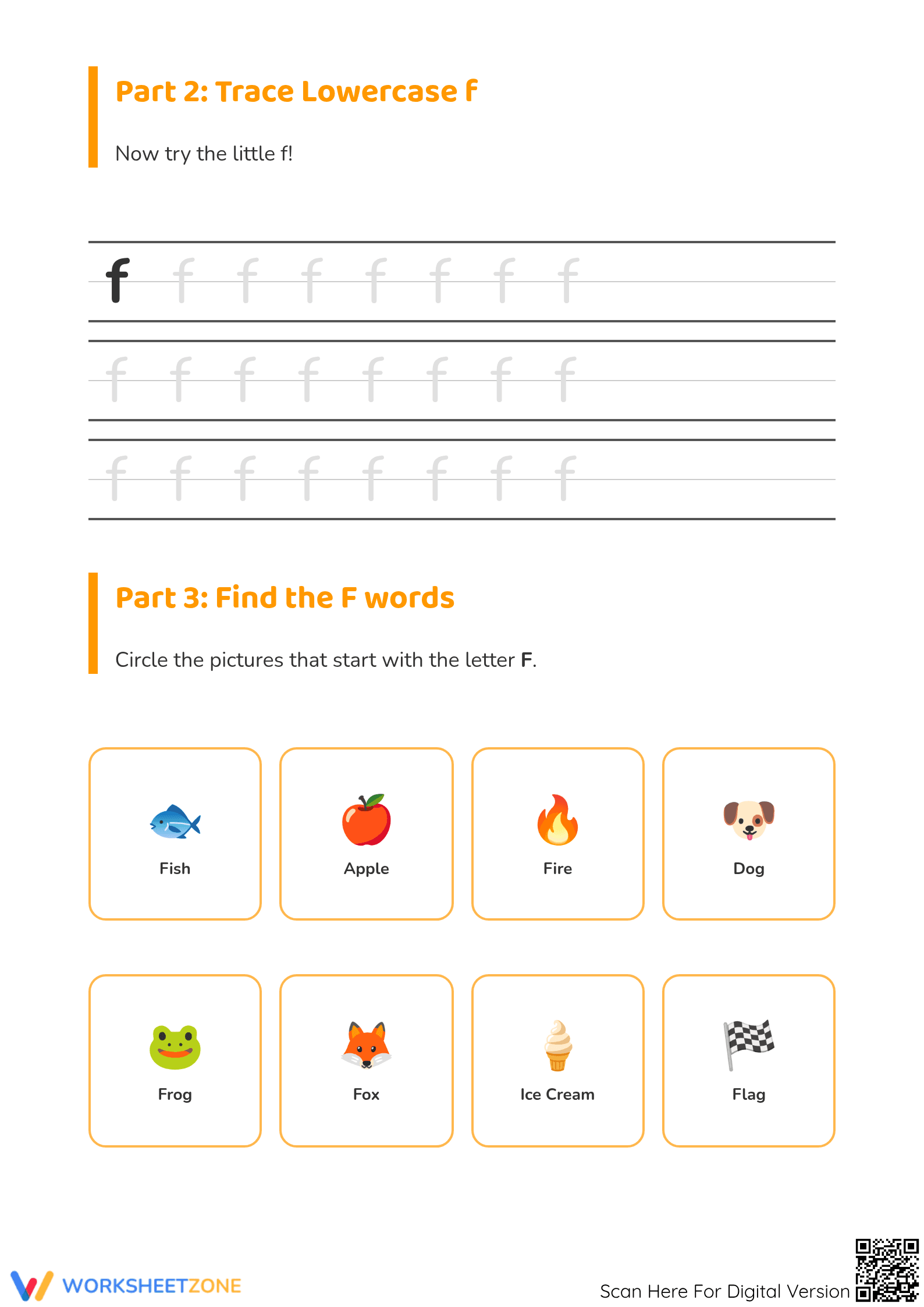
The packet contains two high-quality pages designed for immediate student engagement. Page one focuses on uppercase "F" with three rows of guided tracing and visual anchors like fish and frogs. Page two transitions to lowercase "f" tracing followed by a "Find the F words" activity featuring eight distinct illustrations to test phonemic discrimination and vocabulary.
This resource is designed for a zero-prep classroom environment. 1. Print: Select the two pages and hit print (30 seconds). 2. Distribute: Hand out to students with pencils and crayons (30 seconds). 3. Review: Use the visual identification section for a quick whole-class check (1 minute). Total teacher preparation time is under two minutes, making it an ideal choice for busy mornings or unexpected sub plans.
Primary alignment is to CCSS.ELA-LITERACY.RF.K.1.D, focusing on letter recognition and production. It also supports CCSS.ELA-LITERACY.RF.K.3.A by requiring students to associate the letter "F" with its primary phoneme through image sorting. Both standard codes can be copied directly into lesson plans, IEP goals, or district curriculum mapping tools.
Use this during the independent practice phase of a gradual release model after introducing the letter F on an anchor chart. It serves as an excellent formative assessment; observe students as they trace to identify those struggling with top-to-bottom stroke order or pencil grip. Expect students to complete both pages within a 20-minute instructional block.
This is ideal for Kindergarten students beginning their phonics journey, but also serves as a remedial tool for Grade 1 or 2 students needing handwriting intervention. It pairs naturally with a "Letter of the Week" curriculum or a specific read-aloud focusing on animals like foxes or frogs to reinforce the sound-symbol connection.
According to Fisher & Frey (2014), the gradual release of responsibility is most effective when students are provided with clear, scaffolded opportunities for independent practice. This worksheet embodies that principle by moving from guided tracing to independent sound identification. The inclusion of both uppercase and lowercase forms aligns with current research suggesting that simultaneous instruction of letter cases accelerates literacy acquisition in early childhood settings. By engaging in 56 specific tasks across two pages, students build the muscle memory required for fluent writing while reinforcing the phonemic connection between the grapheme "F" and its auditory counterpart. This dual-modality approach ensures that the standard CCSS.ELA-LITERACY.RF.K.1.D is not just introduced but practiced to the point of emerging mastery, providing a stable foundation for future reading fluency and spelling accuracy.


