




























Views
Downloads

Fire Hydrant Tracing Worksheet | Essential Grade K-1 Phonics

Paste this activity's link or code into your existing LMS (Google Classroom, Canvas, Teams, Schoology, Moodle, etc.).
Students can open and work on the activity right away, with no student login required.
You'll still be able to track student progress and results from your teacher account.
This Kindergarten and Grade 1 phonics worksheet helps students master the letter F and H through targeted tracing and visual identification. By focusing on the words 'fire' and 'hydrant,' learners develop fine motor control while reinforcing beginning sounds. This resource provides a structured way for early writers to practice letter formation.
At a Glance
- Grade: Kindergarten · Subject: ELA
- Standard:
CCSS.ELA-LITERACY.RF.K.1.D— Recognize and name all upper- and lowercase letters of the alphabet- Skill Focus: Letter F and H recognition and tracing
- Format: 2 pages · 4 tasks · No answer key needed · PDF
- Best For: Morning work or phonics centers
- Time: 10–15 minutes
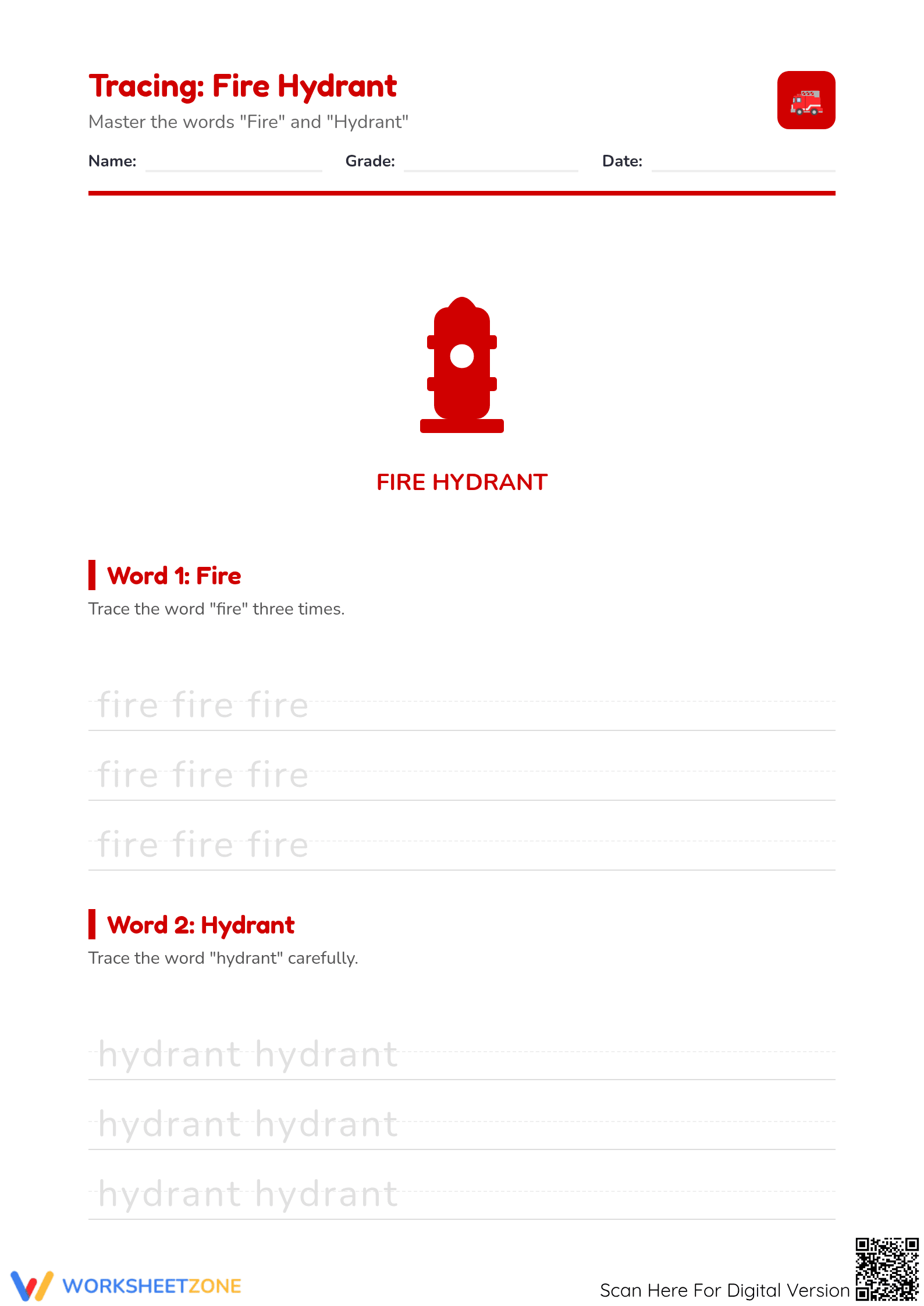
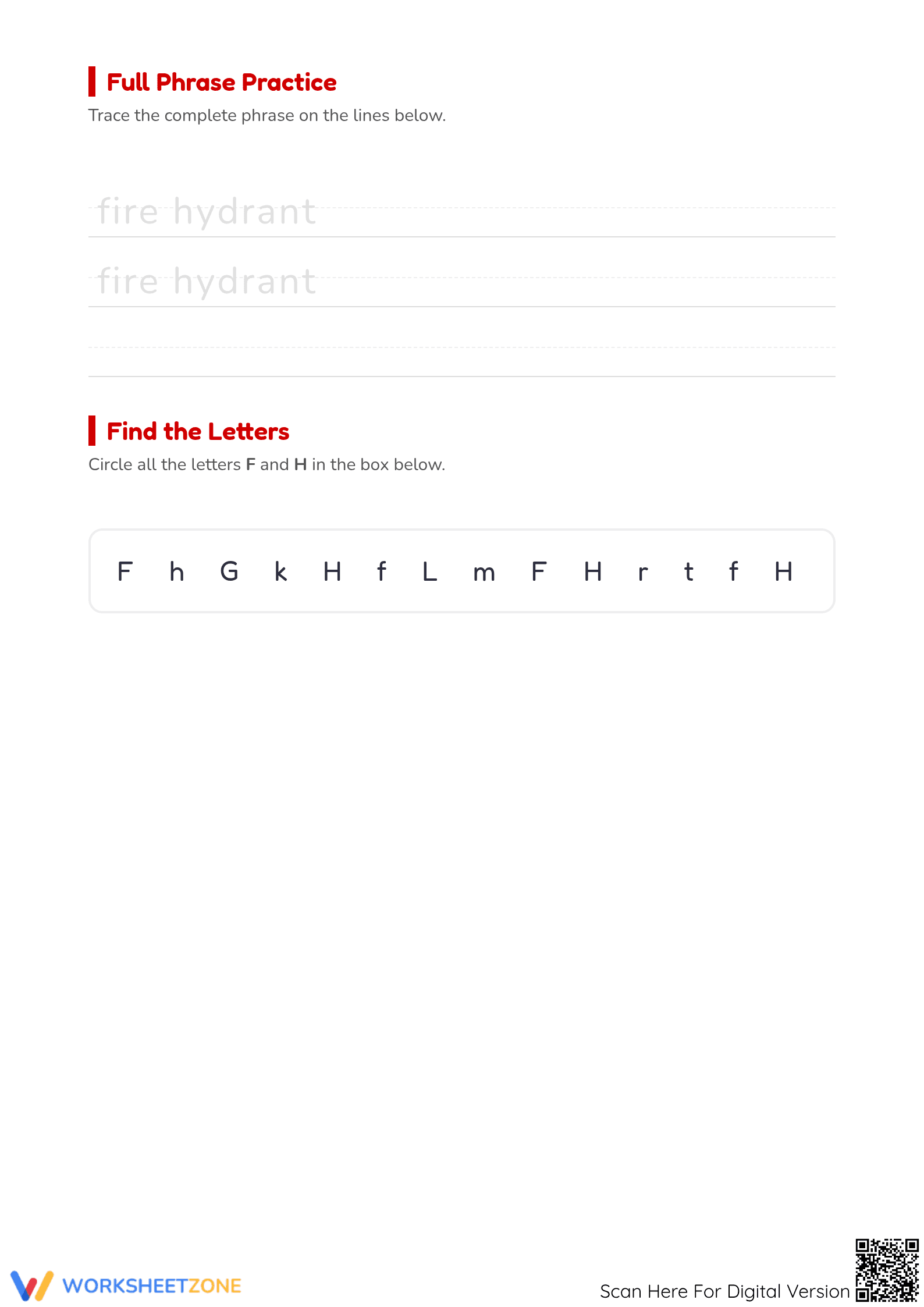
Inside this 2-page PDF, you will find four distinct practice zones. The first page features repetitive tracing for the words 'fire' and 'hydrant' to build muscle memory. The second page advances to full phrase practice, followed by a 'Find the Letters' discrimination task. The layout uses clear, dotted-line fonts and a clean visual style to prevent cognitive overload for young learners.
This resource is designed for a zero-prep classroom environment. Step 1: Print the 2-page PDF (30 seconds). Step 2: Distribute to students during morning work or a literacy center (1 minute). Step 3: Review the letter search box as a whole group to check for accuracy (2 minutes). Total teacher preparation time is under two minutes, making it an ideal solution for busy mornings or unexpected sub plans.
This worksheet is primarily aligned with CCSS.ELA-LITERACY.RF.K.1.D, which requires students to recognize and name all upper- and lowercase letters of the alphabet. It also supports CCSS.ELA-LITERACY.L.K.1.A by providing structured opportunities to print letters. Both standard codes can be copied directly into lesson plans, IEP goals, or district curriculum mapping tools.
Use this worksheet during your 'Letter of the Week' unit for the letter F. It works best after a direct instruction lesson on the /f/ sound. As a formative assessment, walk around while students complete the 'Find the Letters' section to observe which students confuse 'F' with 'L' or 'H' with 'h'. Completion typically takes 10 to 15 minutes.
This resource is perfect for Kindergarten students, first-grade RTI groups, or English Language Learners (ELLs) who need extra handwriting support. It pairs naturally with a fire safety thematic unit or a beginning sounds anchor chart. The simple instructions allow for independent work, freeing the teacher to lead small-group interventions.
According to Fisher & Frey (2014), the gradual release of responsibility begins with clear modeling of foundational skills like letter formation. This worksheet aligns with CCSS.ELA-LITERACY.RF.K.1.D by requiring students to identify and produce specific letter shapes within the context of high-interest vocabulary. Research from the NAEP suggests that early mastery of letter-sound correspondence and handwriting fluency are strong predictors of later reading success. By isolating the letters F and H through both tracing and visual discrimination tasks, this resource provides the repetitive practice necessary for cognitive mapping of graphemes. Multi-word phrases help students move beyond isolated characters to recognize meaningful units. This 2-page document serves as a reliable tool for educators seeking to bridge the gap between phonemic awareness and functional writing in early childhood settings, ensuring students meet kindergarten benchmarks for alphabet recognition and print concepts.


