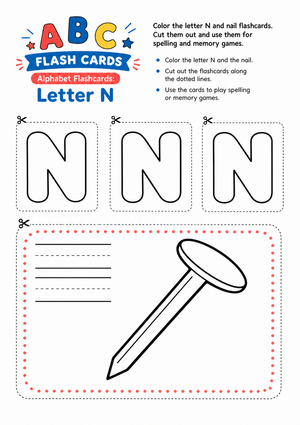
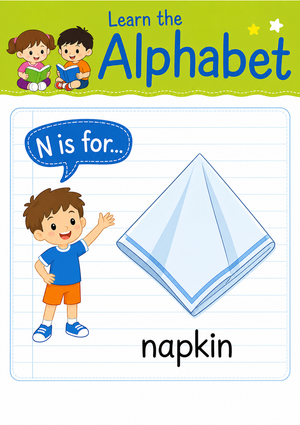
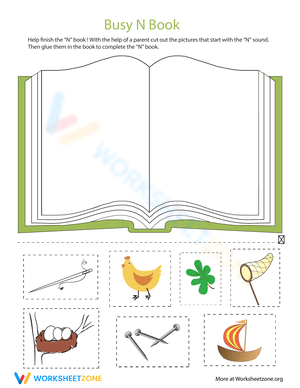
Kindergarten and pre-K teachers usually introduce the letter N after students have built confidence with a handful of easier initial sounds. It is not the flashiest letter, but it shows up constantly in early decodable text and in classroom vocabulary like name, number, and nap. Letter N beginning sound worksheets give you a low-prep way to isolate that /n/ phoneme before students move on to blending it into full CVC words.
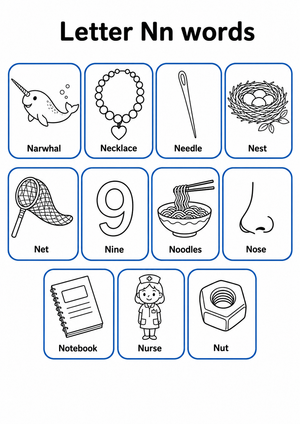
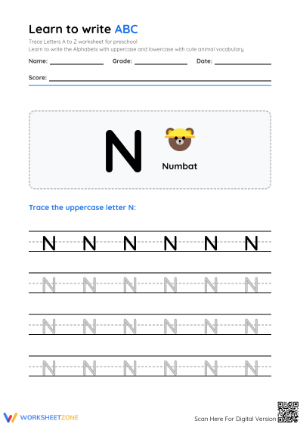
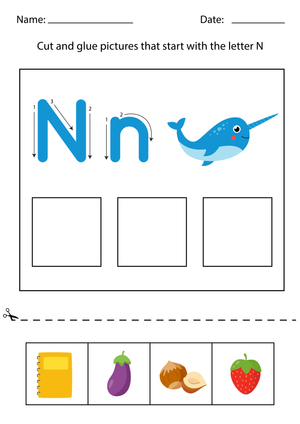
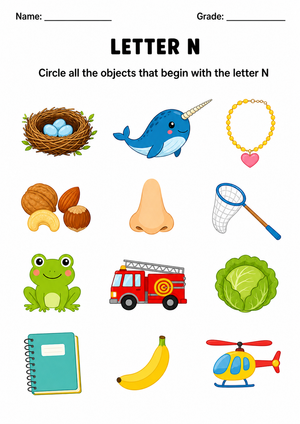
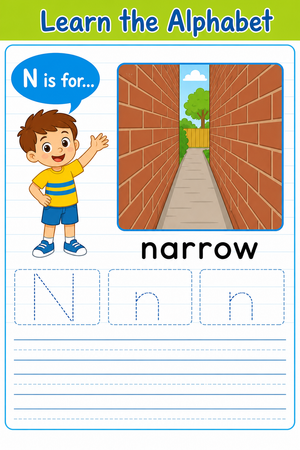
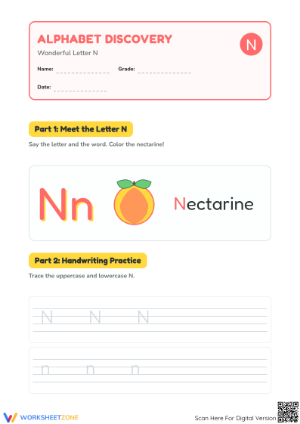
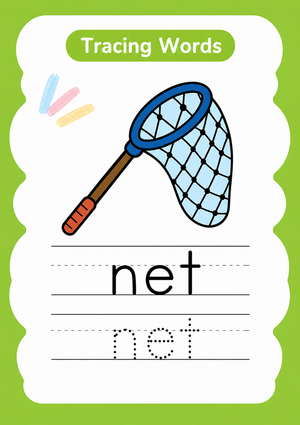
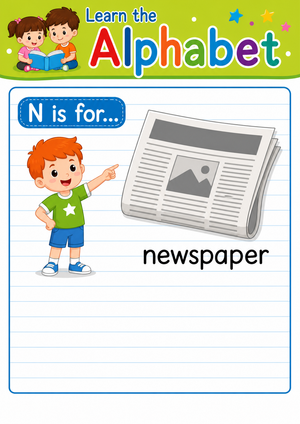
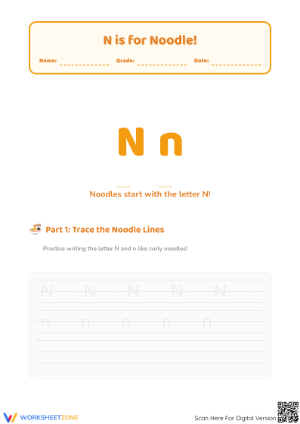
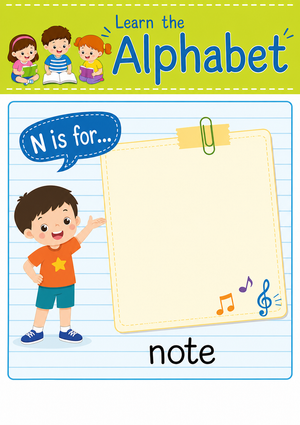
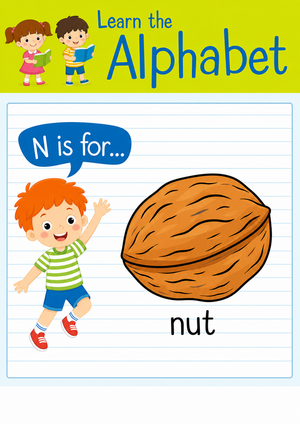
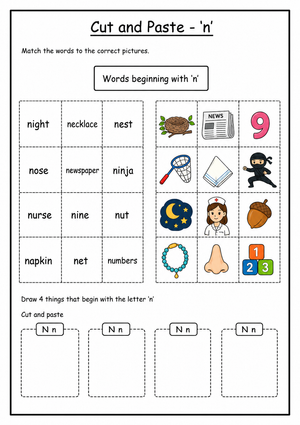
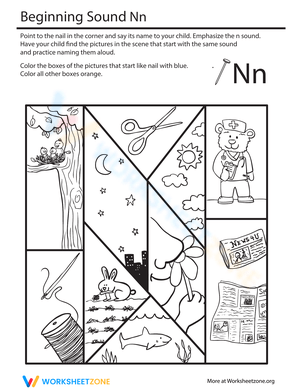
Most letter N beginning sound worksheets combine two skills on one page: uppercase and lowercase letter formation, and a picture-sound task where students circle, color, or sort images of words that start with /n/. Common example words include nuts, nurse, net, neck, needle, nest, note, and ninja. That mix of tracing plus listening keeps the practice multisensory instead of just a handwriting drill.
Pairing Picture Sorting with Letter Formation
A worksheet that only asks students to trace N repeatedly builds motor memory but skips the phonemic awareness piece entirely. The stronger format pairs a tracing row with a sorting or circling task on the same page, so students practice the visual symbol and the sound in the same sitting. Look for sheets that mix uppercase and lowercase N so students see both forms early, since many early readers encounter capital N in names and titles before they see it in body text.
For students who need extra scaffolding, cover the tracing rows with a blank sheet and let them focus purely on the sound-sorting section first. Once sound isolation feels automatic, reintroduce the tracing component. This sequencing respects the fact that phonemic awareness is an oral skill that does not require print at all, even though most classroom worksheets bundle the two together for convenience.
Formative Assessment with Beginning Sound Worksheets
A completed letter N worksheet can double as a quick formative check without adding a separate assessment to your week. Watch which pictures a student marks incorrectly, since patterns matter more than a single wrong answer. A student who consistently circles M-pictures on an N worksheet is showing a specific confusion you can address directly, while a student who misses one random item may simply need a rest or a repeated direction.
Keep a simple tally as you review a stack of worksheets: correct isolation, N/M confusion, or unrelated error. That three-category system takes less than a minute per student and gives you enough data to decide who needs to stay in a targeted small group the following week and who is ready to move to the next letter in your sequence.
Classroom Implementation
Letter N worksheets work in several classroom contexts beyond the initial teaching moment. Use them as a literacy center task during independent work time, as a homework review page sent home after the whole-group lesson, or as a warm-up at the start of a small-group intervention block. In each setting, keep the oral component alive by asking students to say each word aloud, even during independent center time, since a peer or paraprofessional can quietly check pronunciation without disrupting the room.
If your classroom uses a workshop model, place the N worksheet in a folder alongside a few letter cards or picture cards so students who finish early can extend the practice with a matching or sorting game instead of just waiting. For English language learners still building vocabulary for words like nest or needle, preview the picture set as a group before independent practice begins so unfamiliar vocabulary does not get in the way of the phonics skill you are actually assessing.
Connecting N Practice to Kindergarten Standards
Letter N beginning sound practice supports CCSS.ELA-LITERACY.RF.K.2.d, which asks kindergartners to isolate and pronounce the initial, medial, and final sounds in three-phoneme, or CVC, words. A worksheet that asks a student to identify /n/ at the start of nest or net is a direct, grade-appropriate application of that isolation skill, and it sits inside the broader RF.K.2 standard covering rhyming, syllable blending and segmenting, and onset-rime blending.
When you document lesson plans or intervention notes, it helps to name the specific sub-skill rather than just marking a general phonics box. Noting that a student practiced initial phoneme isolation with the letter N, tied to RF.K.2.d, gives you a clear record if a student later needs additional support documented for an intervention team or IEP review.
Frequently Asked Questions
1. What grade level are letter N beginning sound worksheets appropriate for?
These worksheets are designed primarily for pre-K and kindergarten classrooms, and they also fit well in reading intervention groups for older students who still need phoneme isolation practice.
2. How can teachers help students distinguish the letter N sound from the letter M sound?
Have students place a hand on their nose to feel the nasal vibration while producing each sound, then practice minimal pairs like nap and map side by side so the contrast becomes explicit rather than assumed.
3. What words are commonly used to teach the letter N beginning sound?
Frequent examples include nuts, nurse, net, neck, needle, nest, note, and ninja, chosen for their clear, single initial /n/ sound and easy picture representation.
4. How do letter N worksheets align with kindergarten phonemic awareness standards?
They support CCSS.ELA-LITERACY.RF.K.2.d, which requires kindergartners to isolate and pronounce initial, medial, and final sounds in three-phoneme words, with initial sound work like this being a foundational entry point.
5. How can these worksheets be used for small-group reading intervention?
Pull students who consistently confuse N and M into a small group, use the worksheet as an anchor task while requiring oral responses before marking answers, and track error patterns to decide when a student is ready to move on.