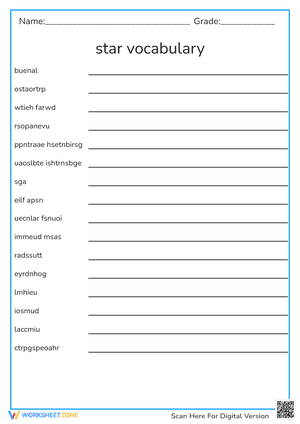
Space systems units move fast, and stellar evolution is one of the few topics where students have almost no prior schema to build on. Unlike weather or ecosystems, most sixth through eighth graders have never encountered terms like protostar or nebula outside a documentary. A sequencing worksheet gives you a low-prep way to surface misconceptions before you invest a full class period in a nuclear fusion mini-lesson.
These worksheets also work as a bridge between a single lecture on the suns life span and the broader disciplinary core idea that stars are the source of nearly every element heavier than hydrogen and helium. Teachers running a two-day astronomy unit often use one day for the mechanics of gravity and fusion, then a second day for life cycle sequencing and comparison, so the worksheet becomes the connective tissue between those two lessons.
The Five Stages Every Worksheet Should Cover
A complete life cycle of a star worksheet should walk students through five recognizable stages, whether it uses cards to sequence, a fill-in diagram, or short-answer prompts.
- Nebula: a cloud of gas and dust where gravity begins pulling matter together.
- Protostar: the collapsing cloud heats up as it contracts, but fusion has not started yet.
- Main sequence: nuclear fusion ignites in the core, and the star spends most of its life in this stable, hydrogen-burning phase.
- Red giant or supergiant: once core hydrogen runs low, the star expands and cools at its outer layers.
- Final stage: average stars like the sun end as a white dwarf inside a planetary nebula, while massive stars explode as a supernova and can leave behind a neutron star or black hole.
Framing the worksheet around these five stages keeps the vocabulary manageable and gives you a natural check for understanding: can a student correctly place cards or diagram labels in order, and can they explain what triggers the move from one stage to the next.
Mass is the single variable that decides both how long a star lives and how it dies, and the contrast is dramatic enough to anchor a whole lesson. A star like the sun spends roughly 10 billion years in the main sequence stage, while a star ten times more massive burns through its fuel in only about 20 million years. That means the most massive stars in a sequencing activity live roughly 500 times shorter lives than an average star, even though they contain far more fuel, because they fuse hydrogen at a much faster rate.
Using These Worksheets for Formative Assessment
Life cycle of a star worksheets work well as a formative check both before and after direct instruction. Before a fusion lesson, a quick sequencing task tells you whether students already have some background knowledge from prior grades or outside reading, which helps you decide how much time to spend on the basics. After the lesson, the same worksheet format becomes an exit ticket that flags which students need a small-group reteach on the difference between a protostar and a main sequence star.
Because the core vocabulary set is small, five stages plus a handful of key terms like nebula, protostar, and fusion, you can rotate between diagram-labeling, card-sequencing, and short-answer versions of the same worksheet across a week without students feeling like they are repeating identical work. That rotation also gives you three data points on the same content, which is useful when you are documenting intervention progress for a student who struggled with the initial assessment.
Diagram-Labeling Worksheets for Visual Learners
Not every student processes the life cycle of a star well through text-based sequencing alone. A diagram-labeling worksheet, where students match stage names to an illustrated timeline from nebula through to a white dwarf or supernova, gives visual learners another entry point into the same content. This version pairs especially well with small-group intervention, since you can talk through the diagram together and have students annotate it in real time rather than working silently from a card deck.
For students who need additional support, consider providing the diagram with stage names already filled in, then asking them to draw an arrow from each stage to a short description of what happens there. This flips the cognitive demand from recall to explanation, which is often more accessible for students who struggle with vocabulary retrieval but understand the underlying science.
Frequently Asked Questions
1. What grade level are life cycle of a star worksheets appropriate for?
These worksheets fit best in grades 6-8, where the standard focus is on the suns life span and the role of fusion in its core. Early high school classes can use the same worksheets with extended writing prompts for a deeper treatment of stellar evolution across different star masses.
2. How do these worksheets align with NGSS space science standards?
They support the middle school expectation to model the suns life span and the role of nuclear fusion in its core, and connect to the broader disciplinary core idea that stars produce elements over their life cycle. High school classes extend into a more detailed treatment of stellar evolution.
3. What are the main stages of a stars life cycle covered in classroom worksheets?
Most classroom worksheets cover five stages: nebula, protostar, main sequence, red giant or supergiant, and a final stage that differs by mass, either a white dwarf or a supernova leading to a neutron star or black hole.
4. How can teachers use these worksheets for review or formative assessment?
Use a sequencing or diagram-labeling version before a fusion lesson to check prior knowledge, then repeat a similar format afterward as an exit ticket or pre-test review to confirm students can explain each transition, not just recall stage names.
5. Why does a stars mass affect how long it lives?
Mass determines how fast a star fuses hydrogen in its core. A star roughly ten times more massive than the sun burns through its fuel in about 20 million years, compared to the suns roughly 10 billion year main sequence lifetime, because higher mass drives a much faster fusion rate.















 Interactive Worksheet Maker
 Quiz Maker
 Word Search Maker
 Crossword Puzzle Maker
 Word Scramble Generator
 Sentence Scramble Generator
 Handwriting Worksheet Generator
 Name Tracing Generator
 Fill In The Blank Generator