




























Views
Downloads

Essential Life Cycle of a Star Worksheet | Grade 8 Science

Paste this activity's link or code into your existing LMS (Google Classroom, Canvas, Teams, Schoology, Moodle, etc.).
Students can open and work on the activity right away, with no student login required.
You'll still be able to track student progress and results from your teacher account.
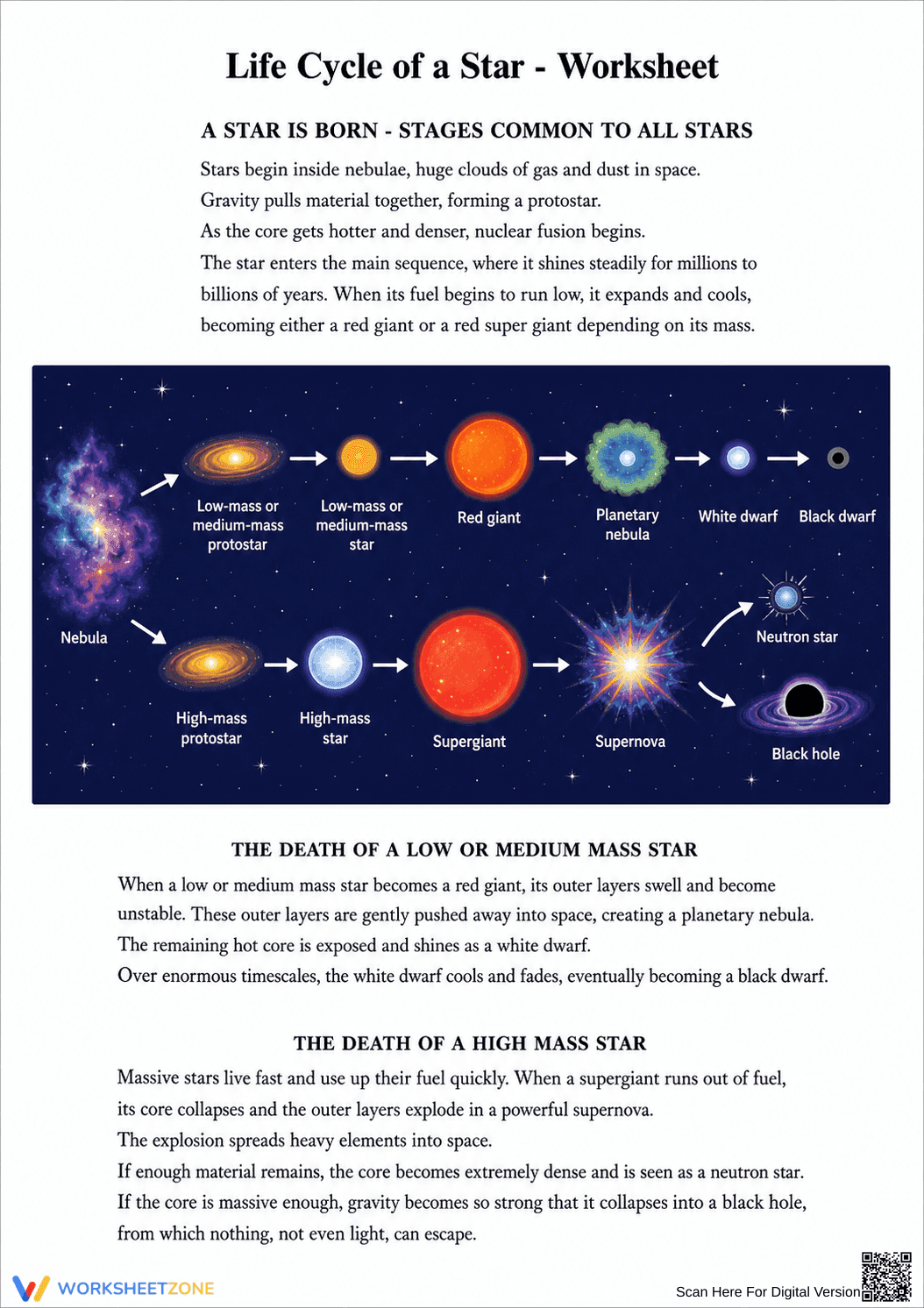
This comprehensive science packet guides students through the complex stages of stellar evolution, from nebular birth to black hole or white dwarf endings. By analyzing the role of mass in determining a star's fate, learners develop a deep conceptual understanding of astronomical life cycles and the physical laws governing the universe.
At a Glance
- Grade: 8 · Subject: Science
- Standard:
MS-ESS1-2— Explain the role of gravity in the life cycle of stars- Skill Focus: Stellar evolution and mass-dependent outcomes
- Format: 4 pages · 30 problems · Answer key included · PDF
- Best For: Middle school astronomy units and review
- Time: 45–60 minutes
What's Inside
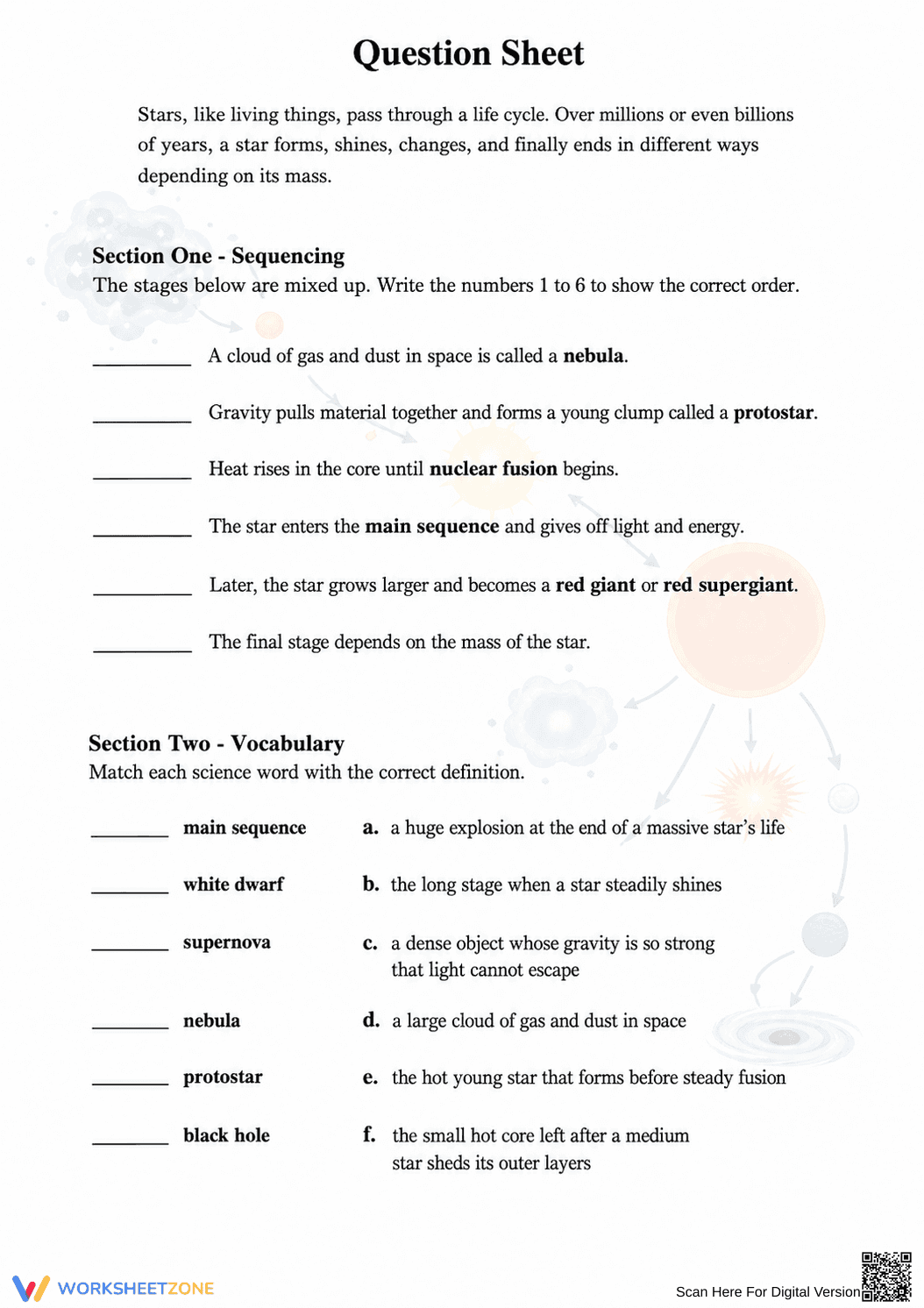
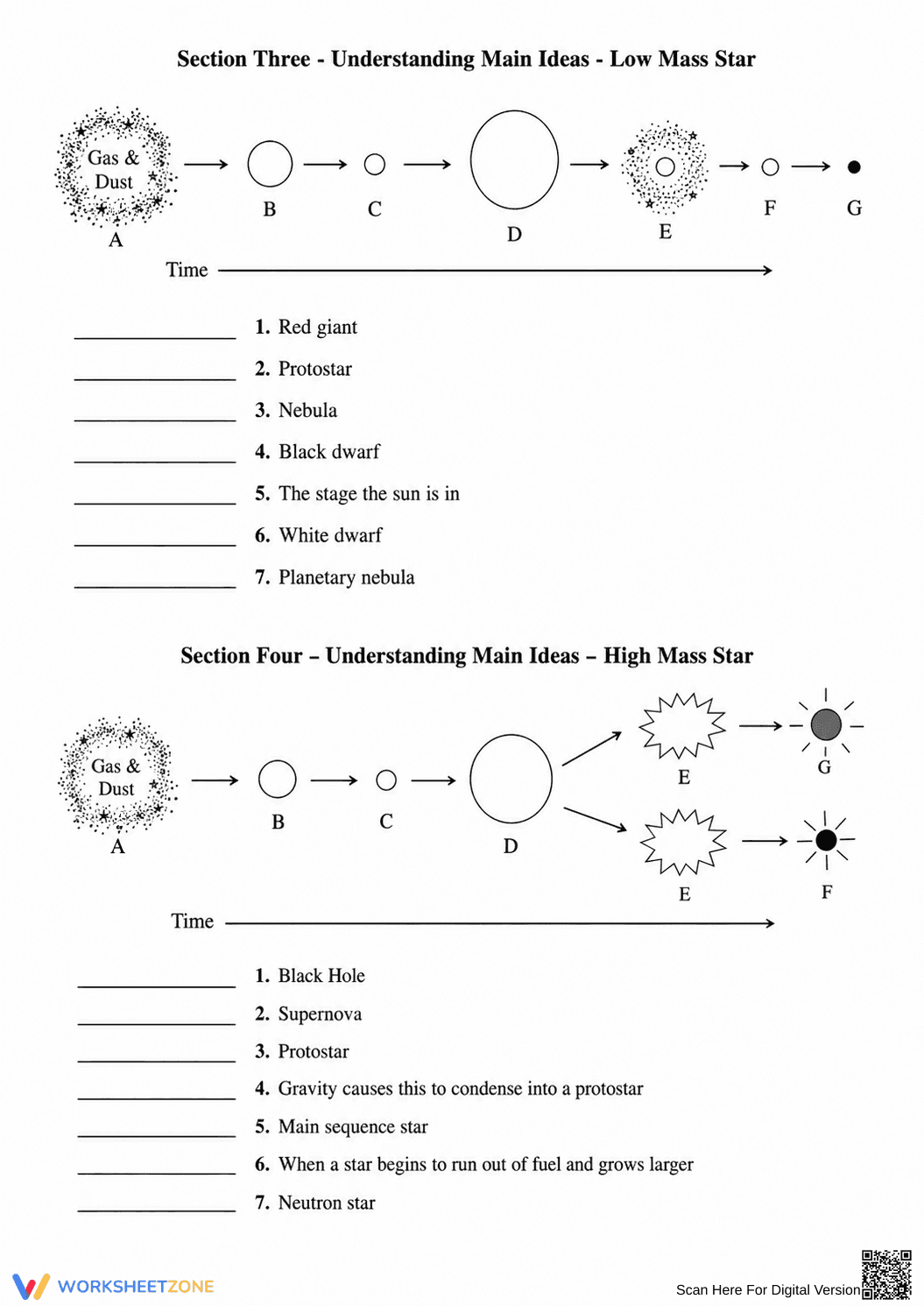
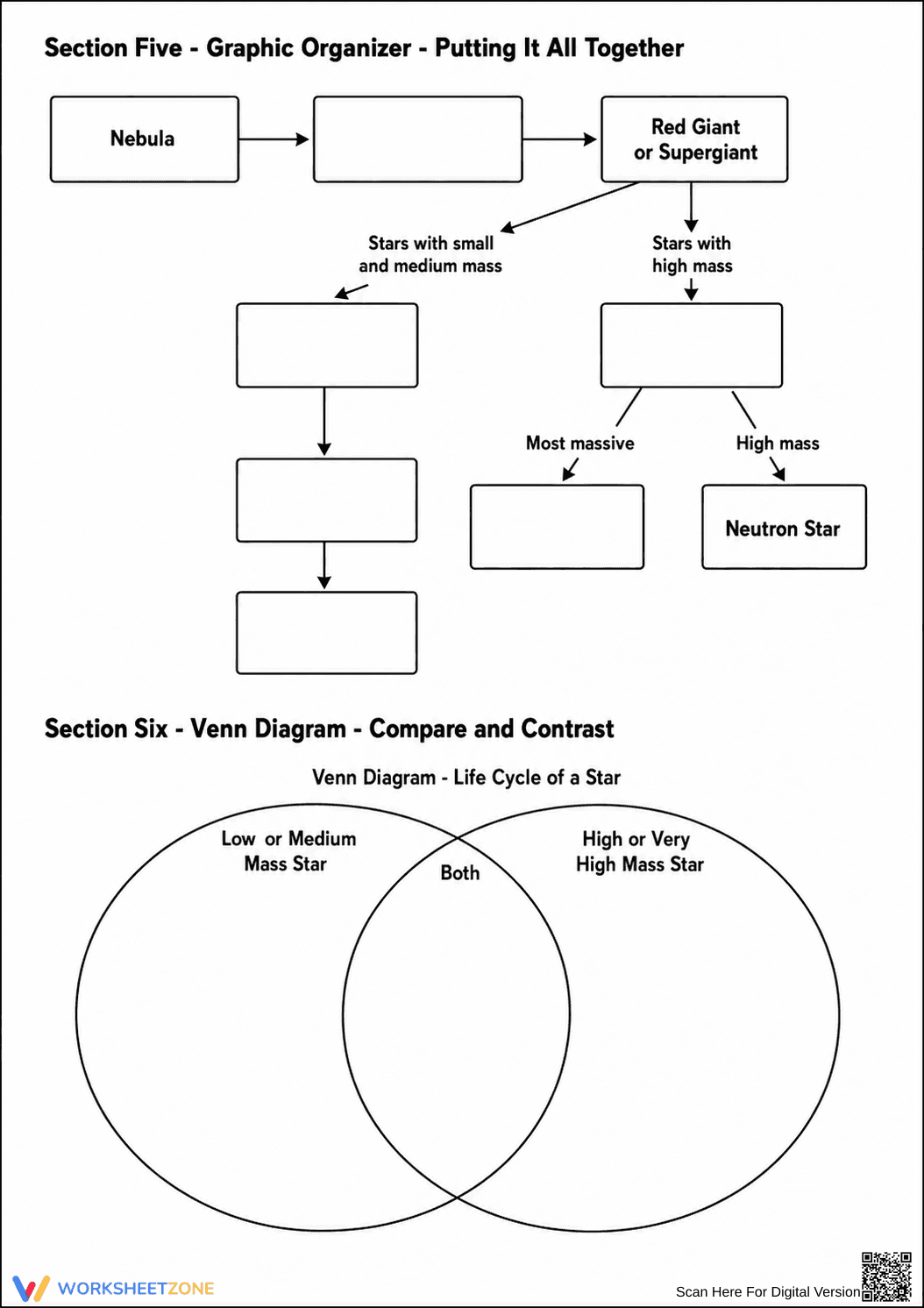
This 4-page instructional packet features a detailed reading passage paired with a full-color evolutionary diagram. Students engage with 30 distinct tasks, including a 6-step sequencing exercise, a scientific vocabulary matching section, and two diagram-labeling activities for low-mass and high-mass stars. The final page provides a graphic organizer and a Venn diagram to synthesize learning.
Zero-Prep Workflow
- Print: Generate the 4-page PDF in under 1 minute for your entire class.
- Distribute: Hand out the packets for a 45-minute independent or partner session.
- Review: Use the included answer key to provide immediate feedback or grade efficiently.
This structured workflow makes it an ideal resource for emergency sub plans or as a primary instructional tool during astronomy units.
Standards Alignment
This resource is aligned to `MS-ESS1-2`, focusing on how gravity and nuclear fusion drive the development of stars. It also supports MS-ESS1-3 by examining the scale and properties of celestial objects. Both standard codes can be copied directly into lesson plans, IEP goals, or district curriculum mapping tools.
How to Use It
Use this packet as a summative review after a lecture on the Hertzsprung-Russell diagram to reinforce the relationship between mass and luminosity. Alternatively, assign it as a guided inquiry activity where students extract evidence from the text to complete the Venn diagram. Monitor student progress during the sequencing section to identify misconceptions about the protostar phase.
Who It's For
This material is designed for middle school science students, particularly those in Grade 8, but is adaptable for high school introductory earth science. It provides excellent support for visual learners through its heavy use of diagrams and flowcharts. Pair this with a digital planetarium simulation or a physical model of a nebula for a multi-sensory experience.
According to Fisher & Frey (2014), the use of graphic organizers and scaffolded sequencing tasks, as seen in this `MS-ESS1-2` resource, significantly improves student retention of complex scientific processes. By breaking down the life cycle of a star into discrete, mass-dependent pathways, the worksheet reduces cognitive load while building technical vocabulary. Research indicates that visual-textual integration helps middle school learners bridge the gap between abstract astronomical concepts and observable physical phenomena. This packet provides the structured repetition necessary for mastery of stellar evolution, ensuring students can accurately predict the end-state of a star based on its initial mass. The inclusion of both low-mass and high-mass pathways aligns with current pedagogical best practices for comprehensive science instruction, making it a reliable tool for achieving state and national science proficiency standards in astronomy.


