




























Views
Downloads

Grade 8 Star Life Cycle — Printable No-Prep Worksheet

Paste this activity's link or code into your existing LMS (Google Classroom, Canvas, Teams, Schoology, Moodle, etc.).
Students can open and work on the activity right away, with no student login required.
You'll still be able to track student progress and results from your teacher account.
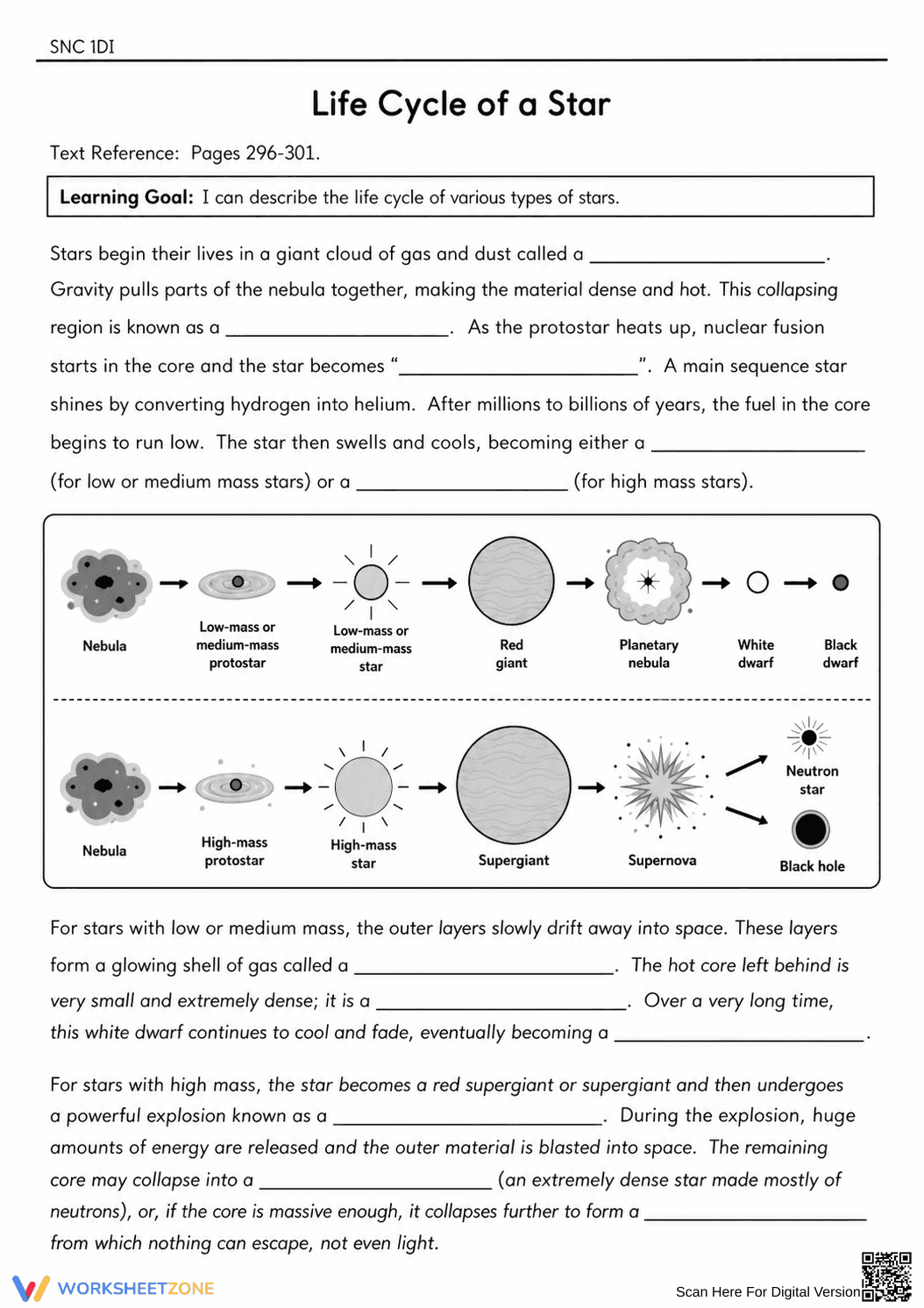
This Grade 8 science worksheet helps students master the life cycle of a star by tracing stellar evolution from nebula to black hole. By completing guided fill-in-the-blank notes and analyzing a detailed diagram, students will confidently describe how mass determines a star's final stage.
At a Glance
- Grade: 8 · Subject: Science
- Standard:
HS-ESS1-1— Illustrate the life span of stars and nuclear fusion- Skill Focus: Describing stellar evolution
- Format: 2 pages · 22 problems · Answer key included · PDF
- Best For: Independent review or guided notes
- Time: 20–30 minutes
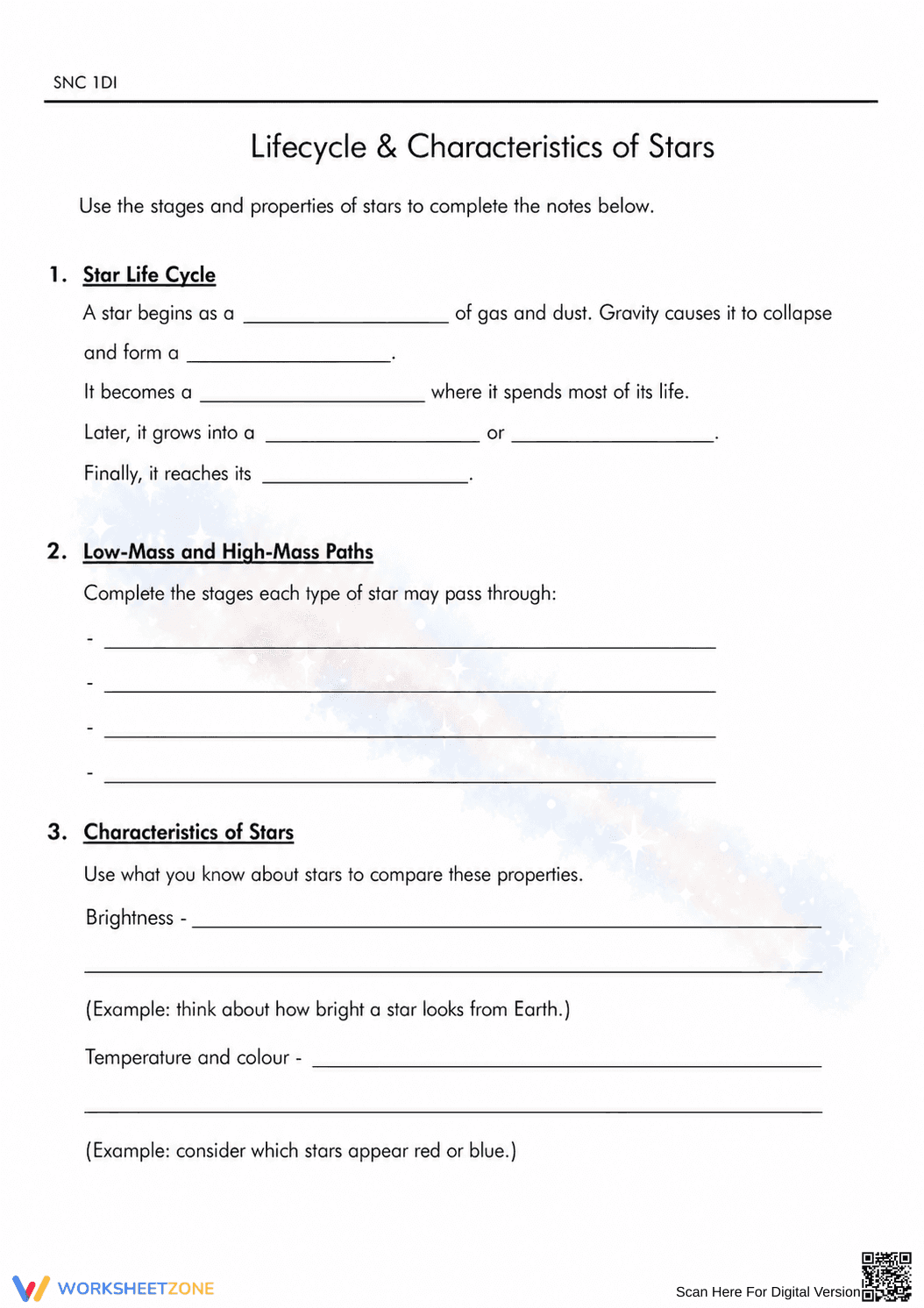
This two-page resource features a comprehensive reading passage with embedded fill-in-the-blank tasks, a clear visual diagram comparing low-mass and high-mass star paths, and a structured notes section for summarizing characteristics like brightness and temperature. A complete answer key is included to make grading effortless.
Zero-Prep Workflow
- Print (1 min): Simply print the two-page PDF for each student. No special materials or complex setup required.
- Distribute (1 min): Hand out the worksheets as a standalone assignment or alongside your astronomy textbook.
- Review (5 mins): Use the included answer key to quickly check student comprehension or guide a whole-class review. Total teacher prep time is under two minutes, making this an excellent emergency sub plan.
Standards Alignment
Aligned to HS-ESS1-1: Develop a model based on evidence to illustrate the life span of the sun and the role of nuclear fusion in the sun's core to release energy. It also supports middle school space science objectives regarding gravity and solar system formation. Both standard codes can be copied directly into lesson plans, IEP goals, or district curriculum mapping tools.
How to Use It
Use this worksheet during direct instruction as guided notes, allowing students to fill in key vocabulary as you discuss stellar evolution. Alternatively, assign it as an independent post-lesson review activity to solidify concepts. As a formative assessment tip, check students' responses in the "Characteristics of Stars" section to ensure they understand the relationship between a star's temperature and its color. Expected completion time is 20 to 30 minutes.
Who It's For
This resource is designed for middle and early high school students studying astronomy or space science. The visual diagram provides excellent scaffolding for visual learners and students needing extra support with complex scientific vocabulary. It pairs perfectly with a direct instruction lesson on the universe and galaxies.
Integrating structured notes with visual diagrams significantly enhances student retention of complex scientific processes, particularly in astronomy where concepts operate on an unimaginable scale. According to Fisher & Frey (2014), providing guided instructional frameworks helps students transition smoothly from acquiring new knowledge to independent application and critical thinking. This worksheet applies that exact pedagogical principle by having students actively map out stellar evolution rather than passively reading about it. Aligned with HS-ESS1-1, it ensures learners can accurately illustrate the life span of stars and nuclear fusion while building essential academic vocabulary. By combining text-based recall with clear visual models of low-mass and high-mass star paths, educators can effectively support diverse learning needs in the science classroom. This dual-coding approach not only reinforces immediate comprehension but also builds the foundational knowledge required for more advanced physics and earth science coursework.


