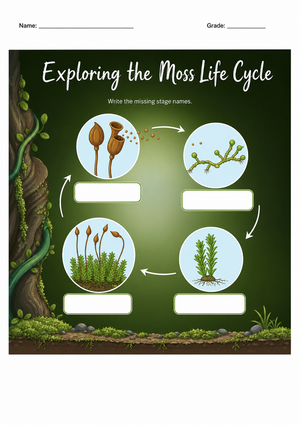
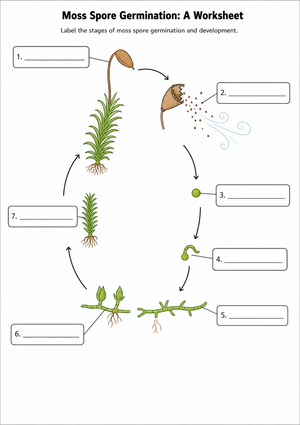
When students sort living things into vascular and non-vascular plants, moss is the example that makes the distinction click. Unlike ferns or flowering plants, moss has no true roots, stems, or vascular tissue to move water internally. That single fact opens the door to a richer conversation about how plants evolved different strategies for reproduction and survival, and it gives you a natural entry point for moss life cycle worksheets in a life science or botany unit.
Moss worksheets work well because the moss life cycle is visual, sequential, and genuinely different from the flowering plant life cycles most students already know. Instead of memorizing a linear cycle, students trace a two-stage process where the plant literally alternates forms. That structure supports labeling, sequencing, and vocabulary practice all in one lesson.
The Two Stages: Gametophyte and Sporophyte
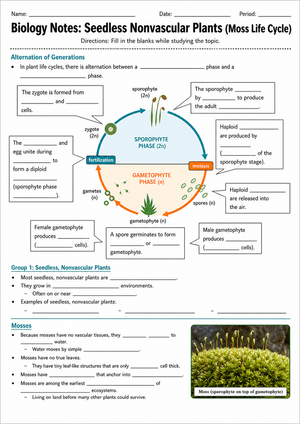
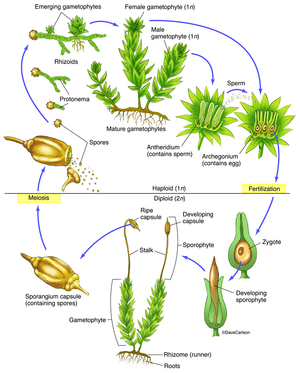
Moss reproduction follows a pattern called alternation of generations, which means the plant switches between two distinct forms across its life cycle: a haploid gametophyte stage and a diploid sporophyte stage. The leafy green moss most students picture when they hear the word moss is actually the gametophyte, and it is the dominant, longer-lived stage in the cycle.
The sporophyte, by contrast, is the thin stalk with a capsule on top that grows directly out of the gametophyte. It depends entirely on the gametophyte for nutrients and cannot survive independently. Worksheets that ask students to label a gametophyte versus a sporophyte on a single diagram help cement this dependency relationship, which is the trickiest part of the concept for most learners.
How Fertilization Happens: The Role of Water
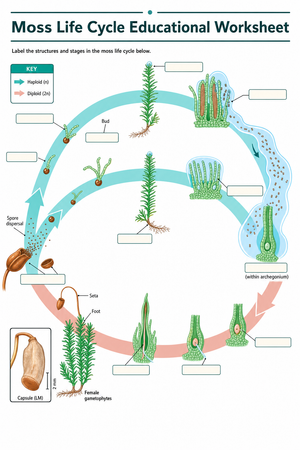
Mosses reproduce sexually using specialized structures called antheridia, which produce male gametes, and archegonia, which produce female gametes. The catch is that moss sperm must physically swim through a thin film of water to reach the egg inside the archegonium, which means fertilization can only occur when moss tissue is wet, a constraint that explains why mosses thrive in shaded, moist habitats and why classroom terrariums need consistent misting rather than a single watering.
This water dependency is a great discussion starter for questions about plant adaptation. Ask students why a fern or a flowering plant does not need standing water to reproduce, and use moss as the counterexample. It reinforces the idea that non-vascular plants like mosses are restricted to damp environments precisely because of how their gametes travel.
From Zygote to Spores: Completing the Cycle
Once fertilization occurs, the diploid zygote develops into the sporophyte, growing a stalk topped by a capsule known as a sporangium. Inside that capsule, the sporophyte undergoes meiosis to produce haploid spores. When the capsule matures and releases those spores, each one can germinate into a brand-new gametophyte plant, restarting the entire cycle.
According to Biology LibreTexts, the moss life cycle is a textbook example of alternation of generations, where the gametophyte and sporophyte are structurally distinct, genetically different in chromosome number, and dependent on each other at different points, a relationship that makes moss one of the clearest classroom models for teaching how plant generations can differ in form, function, and independence (16.3B: Moss Life Cycle, Biology LibreTexts).
Building Worksheets Around Sequencing and Labeling
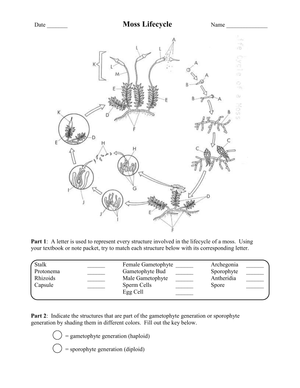
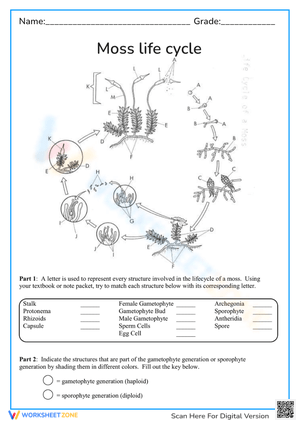
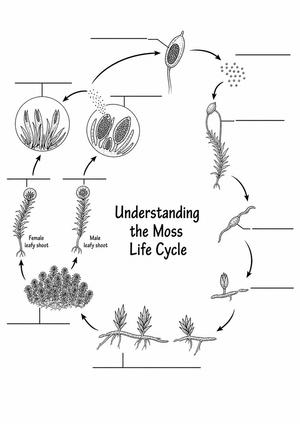
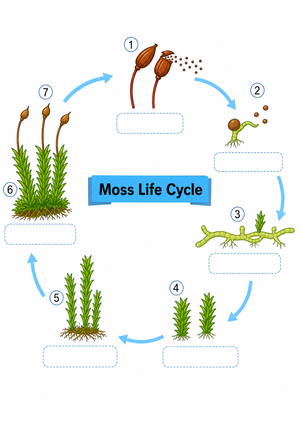
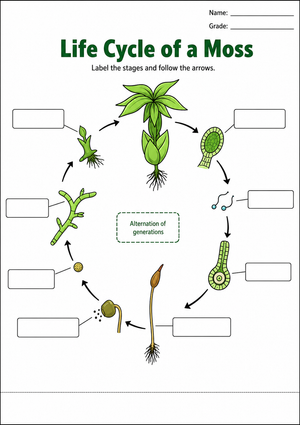
Moss life cycle worksheets are most effective when they combine a visual diagram with an active task rather than asking students to passively read a description. Effective worksheet formats include a labeling diagram with blanks for gametophyte, sporophyte, antheridia, archegonia, spores, and capsule, a cut-and-sequence activity where students order the stages from spore germination through fertilization to spore release, and a vocabulary matching section pairing key terms with their function in the cycle.
For younger learners in elementary grades, keep the diagram simple and focus on just two labels: the leafy gametophyte and the stalked sporophyte. For upper elementary and middle school students, add the haploid and diploid distinction, since that vocabulary connects directly to genetics concepts they will encounter later.
Connecting to Broader Plant Reproduction Standards
Moss life cycle content supports life science instruction around plant reproduction and life cycles that spans multiple grade bands, since most K-8 science scopes include at least one unit on how different plant groups reproduce and survive. Using moss alongside ferns and flowering plants in the same classification unit helps students build a comparative framework instead of memorizing each plant type in isolation.
The Science Notes moss life cycle diagram is a useful reference for building your own simplified classroom version, since it lays out the gametophyte and sporophyte stages with clear visual separation that translates well into a worksheet format (Moss Life Cycle - Diagram and Reproduction, Science Notes).
Frequently Asked Questions
1. What are the main stages of the moss life cycle?
The moss life cycle has two main stages: the gametophyte, which is the familiar leafy green moss, and the sporophyte, a stalked structure with a spore capsule that grows out of the gametophyte. The cycle moves from spore germination to gametophyte growth, fertilization, sporophyte development, and spore release.
2. What is the difference between the gametophyte and sporophyte in moss?
The gametophyte is haploid, dominant, and photosynthetic, forming the green moss patches students recognize. The sporophyte is diploid, shorter-lived, and cannot photosynthesize independently, relying on the gametophyte for nutrients while it produces spores through meiosis.
3. Why do mosses need water to reproduce?
Moss sperm produced in the antheridia must swim through a film of water to reach the egg in the archegonium. Without at least a thin layer of moisture on the moss tissue, fertilization cannot occur, which is why mosses are typically found in damp, shaded environments.
4. What grade level is appropriate for teaching the moss life cycle?
Moss life cycle content works across K-8 with adjustments. Elementary students can focus on basic labeling of the gametophyte and sporophyte, while middle school students can handle the full vocabulary of alternation of generations, including haploid, diploid, and meiosis.
5. How does the moss life cycle compare to the life cycle of ferns or flowering plants?
Ferns also undergo alternation of generations, but their sporophyte stage is dominant, opposite of moss where the gametophyte dominates. Flowering plants have a highly reduced gametophyte stage and rely on seeds rather than spores, making moss, ferns, and flowering plants a useful three-way comparison for plant classification lessons.












 Interactive Worksheet Maker
 Quiz Maker
 Word Search Maker
 Crossword Puzzle Maker
 Word Scramble Generator
 Sentence Scramble Generator
 Handwriting Worksheet Generator
 Name Tracing Generator
 Fill In The Blank Generator