


























Views
Downloads

Star Life Cycle Notes Worksheet | Grade 6 Science Printable
Paste this activity's link or code into your existing LMS (Google Classroom, Canvas, Teams, Schoology, Moodle, etc.).
Students can open and work on the activity right away, with no student login required.
You'll still be able to track student progress and results from your teacher account.
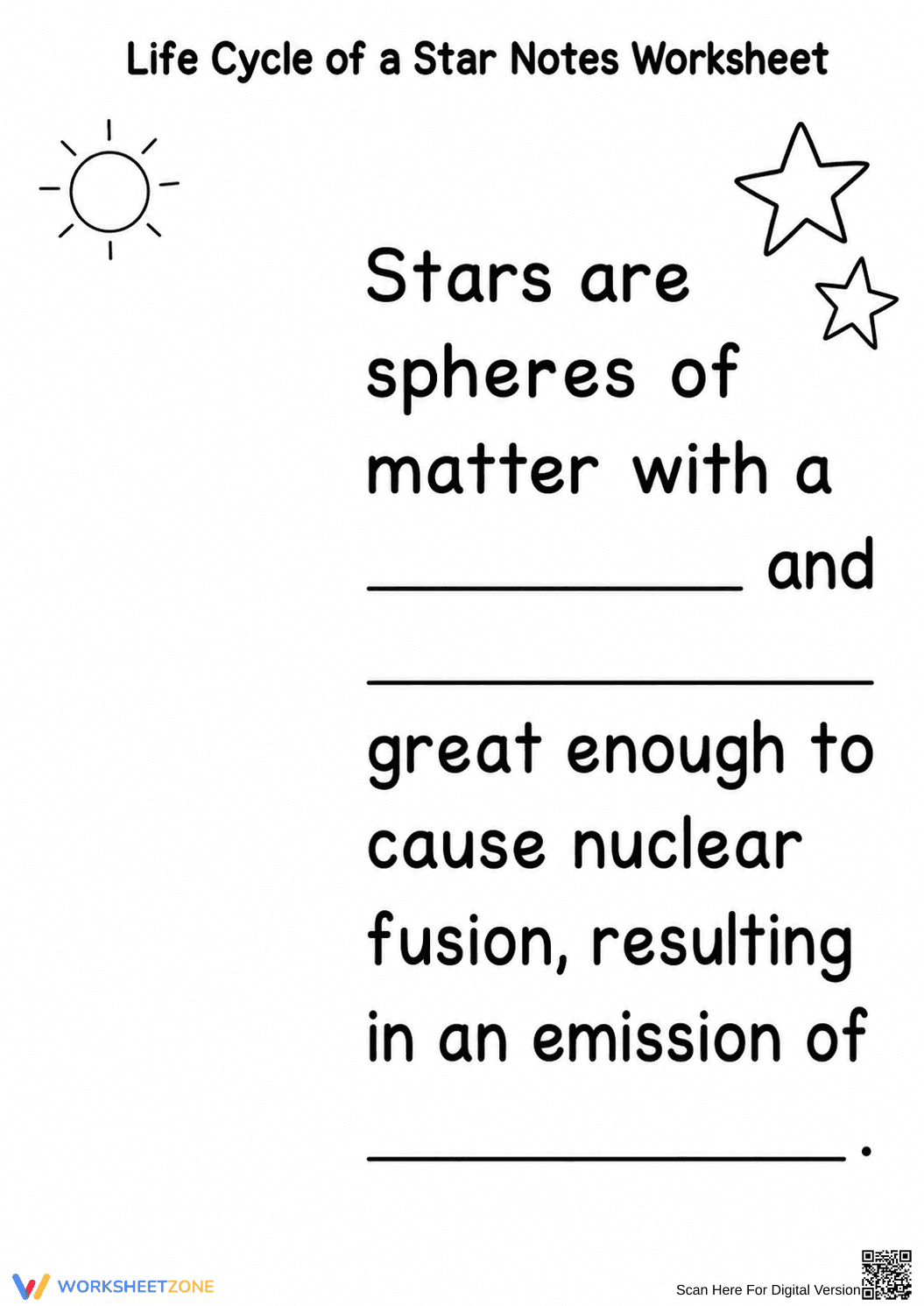
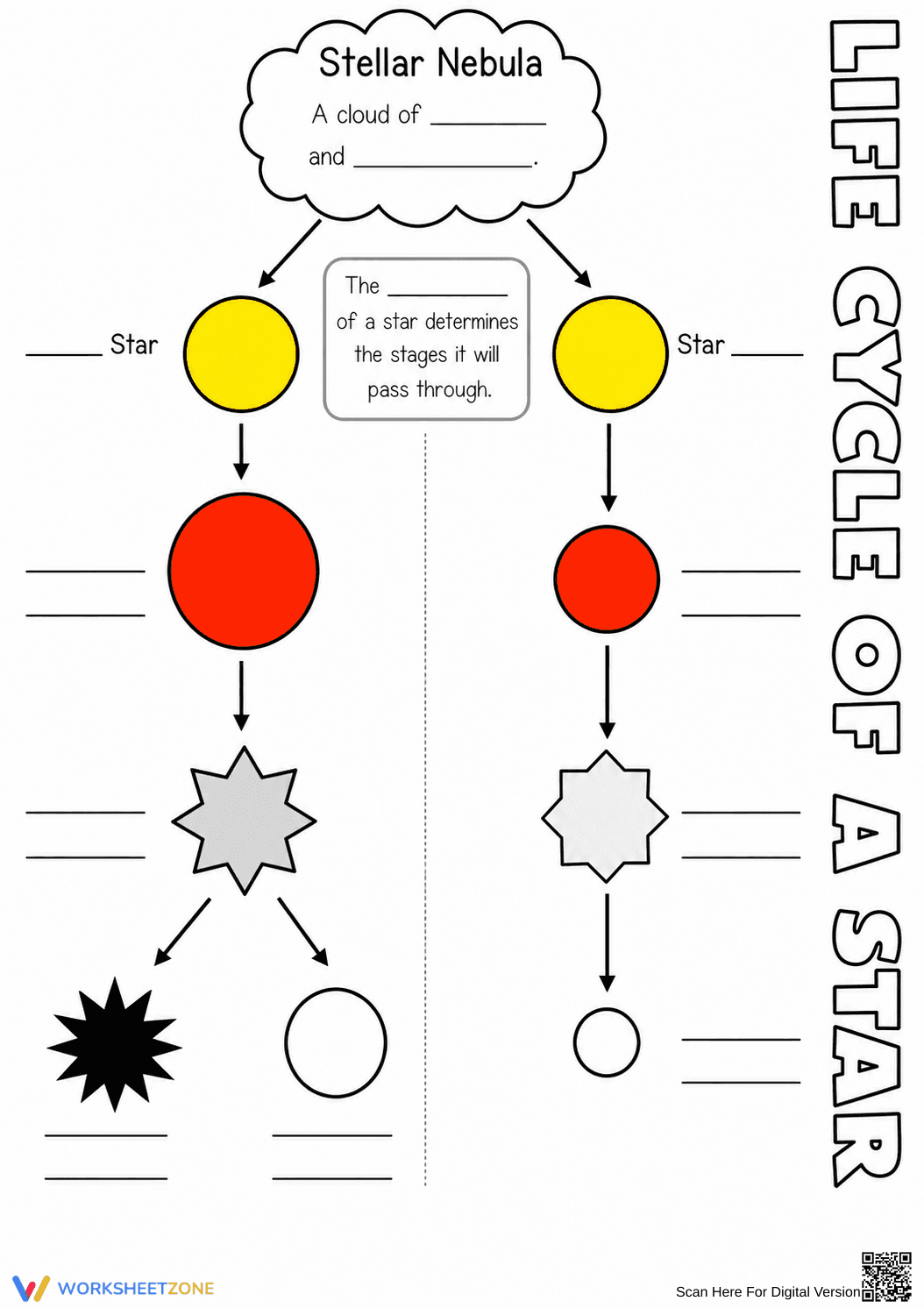
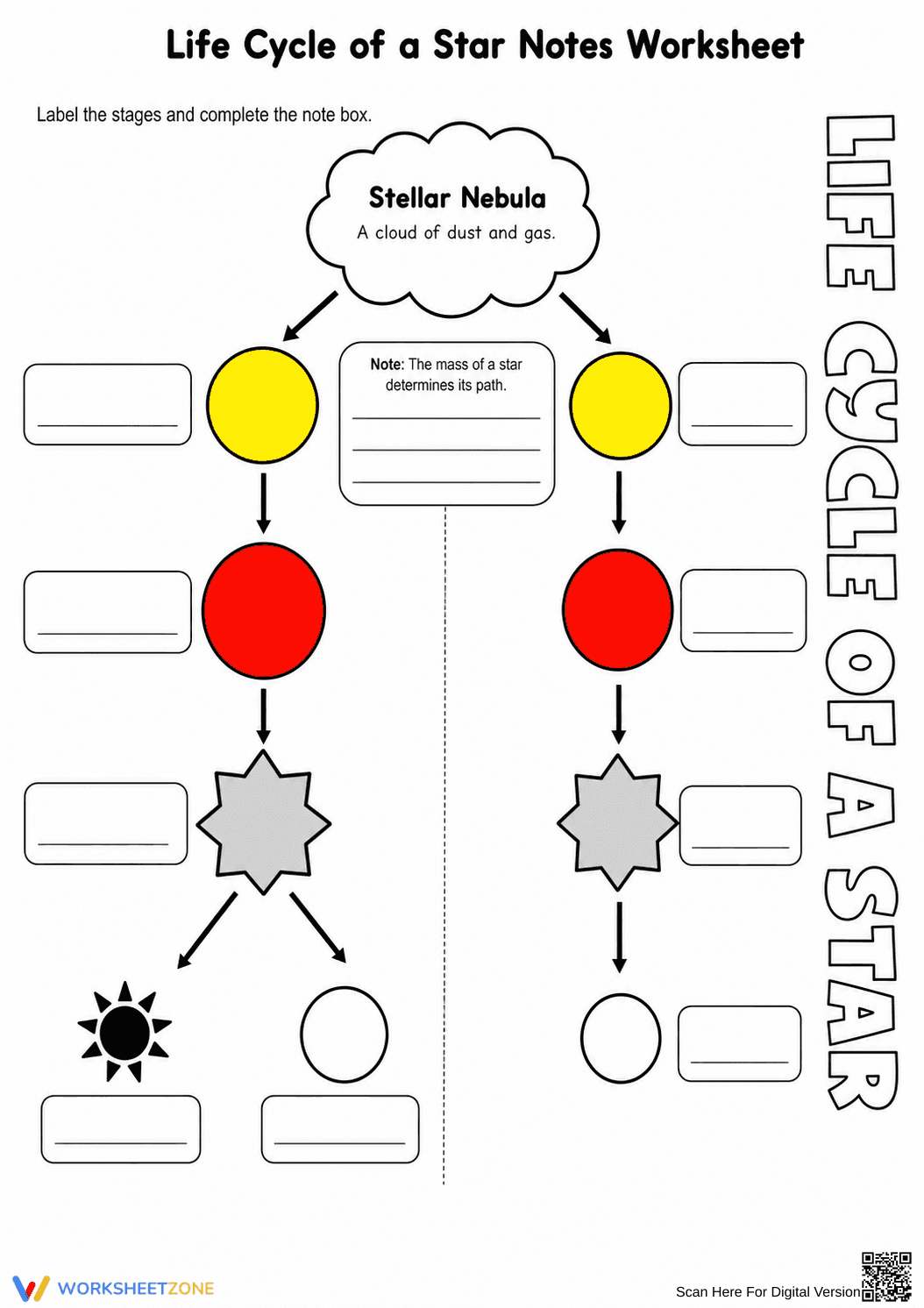
This star life cycle notes worksheet helps students master the stages of stellar evolution by completing a structured flowchart and definition guide. By filling in the blanks, learners will identify key concepts like nuclear fusion, mass, and gravity, resulting in a clear, comprehensive reference sheet for their science folders.
At a Glance
- Grade: 6 · Subject: Science
- Standard:
MS-ESS1-2— Describe the role of gravity in the universe- Skill Focus: Identifying star life cycle stages
- Format: 4 pages · 12 problems · Answer key included · PDF
- Best For: Independent practice and note-taking
- Time: 15–20 minutes
Inside this four-page PDF, educators will find a two-part activity to solidify astronomy concepts. The first section features a fill-in-the-blank definition focusing on the physical properties of stars. The second section provides a visual flowchart where students label the evolutionary paths of average and massive stars, from stellar nebulas to black holes. A complete answer key is included for easy review.
Enjoy a smooth, zero-prep classroom experience:
- Print (1 minute): Simply print the double-sided notes and flowchart pages for each student. No special materials are required.
- Distribute (1 minute): Hand out the worksheets at the beginning of your astronomy unit or as a structured review activity.
- Review (3 minutes): Use the included answer key to quickly check student responses or project it on the board for self-correction.
With under two minutes of total teacher prep time, this activity is highly effective for busy educators and makes an excellent, self-explanatory sub plan.
This activity is aligned to MS-ESS1-2, requiring students to develop and use a model to describe the role of gravity in the motions within galaxies and the solar system. By mapping out how mass and gravity dictate a star's life path, learners connect observable phenomena to fundamental physical forces. Both standard codes can be copied directly into lesson plans, IEP goals, or district curriculum mapping tools.
Use this versatile worksheet during direct instruction as a guided note-taking tool, allowing students to fill in the flowchart as you present stellar evolution. Alternatively, assign it as an independent review task. As a formative assessment tip, observe whether students correctly differentiate the final stages of average versus massive stars; confusion here indicates a need to review how initial mass determines a star's fate. Expected completion time is 15 to 20 minutes.
This resource is ideal for middle school science students in grades 5 through 7 who are exploring space systems and astronomy. The structured fill-in-the-blank format provides built-in scaffolding, making it accessible for diverse learners, including those who benefit from guided notes. It pairs perfectly with a visual slide deck or an anchor chart detailing the differences between red giants and supergiants.
Integrating structured visual models like flowcharts into middle school science instruction significantly improves students' ability to comprehend complex, unobservable phenomena. According to a recent ScienceDirect TpT Analysis, providing guided note-taking frameworks helps reduce cognitive load, allowing learners to focus on the relationships between scientific concepts rather than rote memorization. This worksheet directly supports that pedagogical approach by requiring students to actively map out the stages of stellar evolution. Aligned with the MS-ESS1-2 standard, the activity asks learners to describe the role of gravity in the universe, specifically focusing on how a star's initial mass and gravitational forces dictate its entire life cycle. By completing these targeted tasks, students build a highly reliable reference tool that reinforces their understanding of nuclear fusion and stellar pathways, ensuring long-term retention of essential astronomy concepts.


