




























Views
Downloads

Complete Star Life Cycle Worksheet | Grade 8 Science

Paste this activity's link or code into your existing LMS (Google Classroom, Canvas, Teams, Schoology, Moodle, etc.).
Students can open and work on the activity right away, with no student login required.
You'll still be able to track student progress and results from your teacher account.
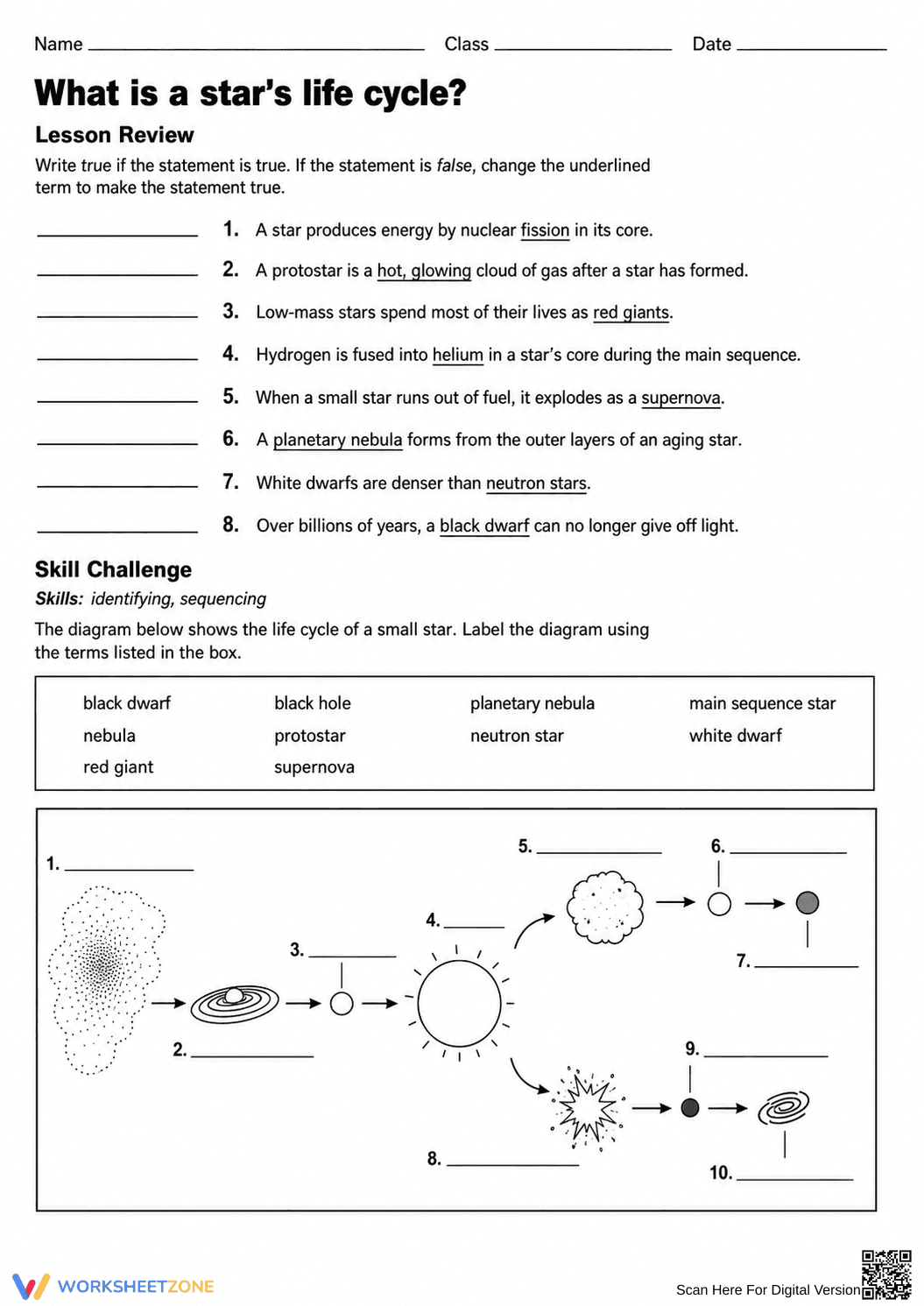
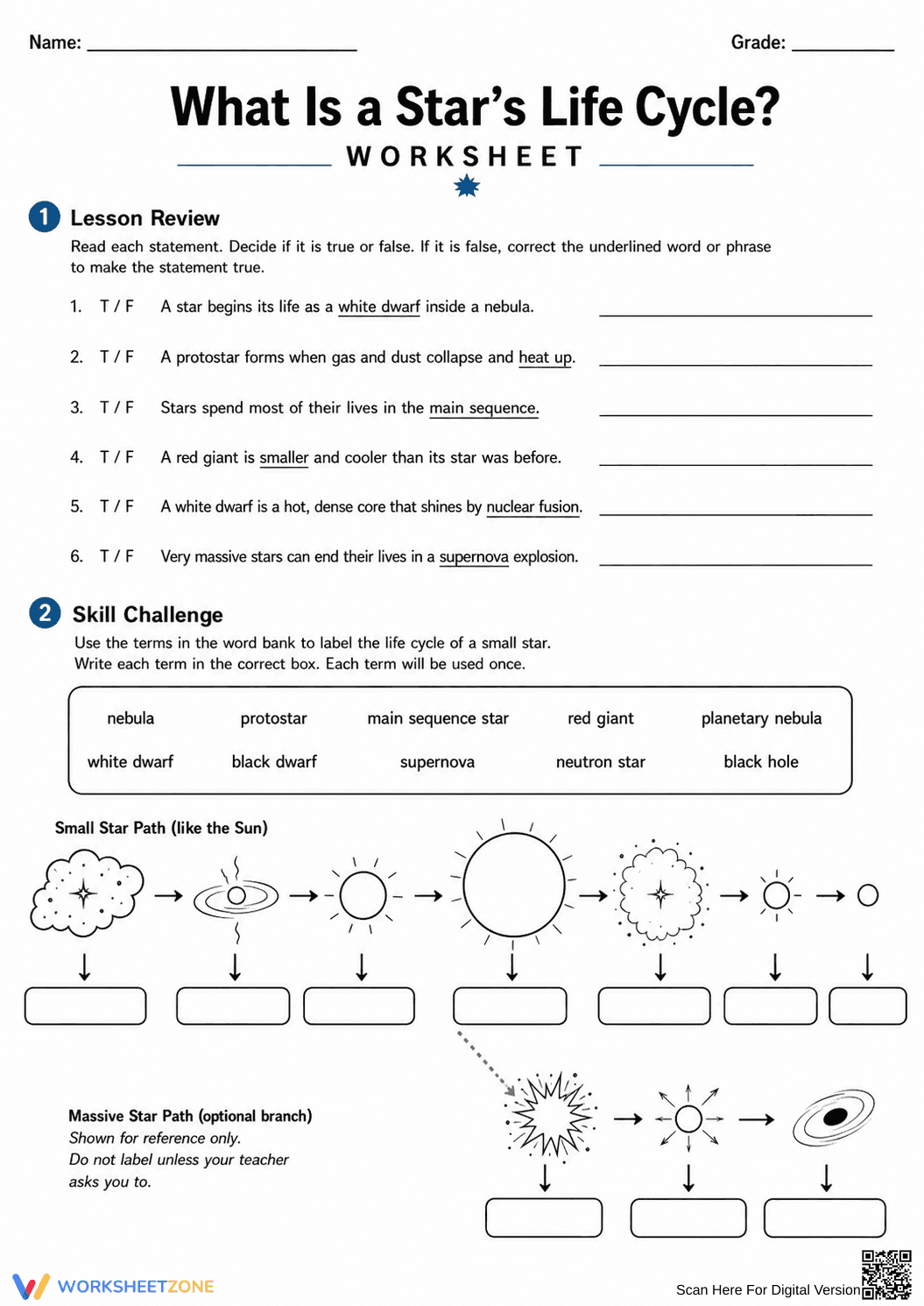
This Grade 8 science worksheet helps students identify and sequence the stages of stellar evolution. By evaluating true/false statements and labeling a detailed diagram, learners solidify their understanding of how stars are born, mature, and eventually die based on their mass.
At a Glance
- Grade: 8 · Subject: Science
- Standard:
HS-ESS1-1— Illustrate the life span of stars and nuclear fusion- Skill Focus: Sequencing stellar evolution
- Format: 2 pages · 18 problems · Answer key included · PDF
- Best For: Independent practice and review
- Time: 15–20 minutes
This resource features two distinct sections to assess student comprehension. The first part is a lesson review containing true or false questions where students must correct inaccurate underlined terms. The second part is a skill challenge requiring students to use a provided word bank to accurately label a diagram showing the evolutionary paths of stars, from nebulas to black holes.
Zero-Prep Workflow
This worksheet is designed for immediate classroom implementation with under two minutes of teacher prep time.
- Print (1 minute): Generate copies of the two-page PDF for your class roster.
- Distribute (1 minute): Hand out the assignment as a warm-up or post-instruction activity.
- Review (5 minutes): Use the included answer key to quickly grade or facilitate a whole-class review session.
Because the instructions are completely self-explanatory and a word bank is provided, this resource makes an excellent addition to any substitute teacher plan.
Standards Alignment
This practice aligns with HS-ESS1-1: Develop a model based on evidence to illustrate the life span of the sun and the role of nuclear fusion in the sun's core to release energy. It also supports foundational middle school space science concepts regarding gravity and the solar system. Both standard codes can be copied directly into lesson plans, IEP goals, or district curriculum mapping tools.
How to Use It
Assign this worksheet immediately after direct instruction on stellar evolution to reinforce new vocabulary. It works perfectly as a 20-minute independent practice activity. Alternatively, use it as a formative assessment at the end of your astronomy unit. While students complete the diagram labeling, circulate the room and observe whether they correctly differentiate between the end stages of low-mass versus high-mass stars. This quick observation helps identify who might need a brief reteach before a summative exam.
Who It's For
This material is designed for middle school and early high school science students learning about astronomy. The built-in word bank provides necessary scaffolding for English language learners and students needing vocabulary support. Pair this worksheet with a visual anchor chart of the universe or a short video clip demonstrating a supernova to give students a multimedia learning experience.
Understanding the sequence of stellar evolution is a core component of astronomical literacy for secondary students. Aligning directly with HS-ESS1-1, this resource requires students to accurately illustrate the life span of stars and nuclear fusion through detailed diagram labeling and targeted fact correction. According to a recent ScienceDirect TpT Analysis, integrating visual models with active vocabulary reinforcement significantly improves long-term retention of complex scientific processes in the classroom. By requiring learners to actively correct false statements rather than simply guessing true or false, the worksheet promotes deeper cognitive engagement and prevents passive guessing. This dual approach of visual sequencing and critical reading ensures students build a robust mental model of how initial mass determines a star's ultimate fate. Mastering these concepts lays essential groundwork for advanced physics and earth science coursework, ensuring learners are fully prepared for subsequent scientific inquiry.


