


























Views
Downloads

Grade 9 Star Life Cycle — Printable No-Prep Worksheet
Paste this activity's link or code into your existing LMS (Google Classroom, Canvas, Teams, Schoology, Moodle, etc.).
Students can open and work on the activity right away, with no student login required.
You'll still be able to track student progress and results from your teacher account.
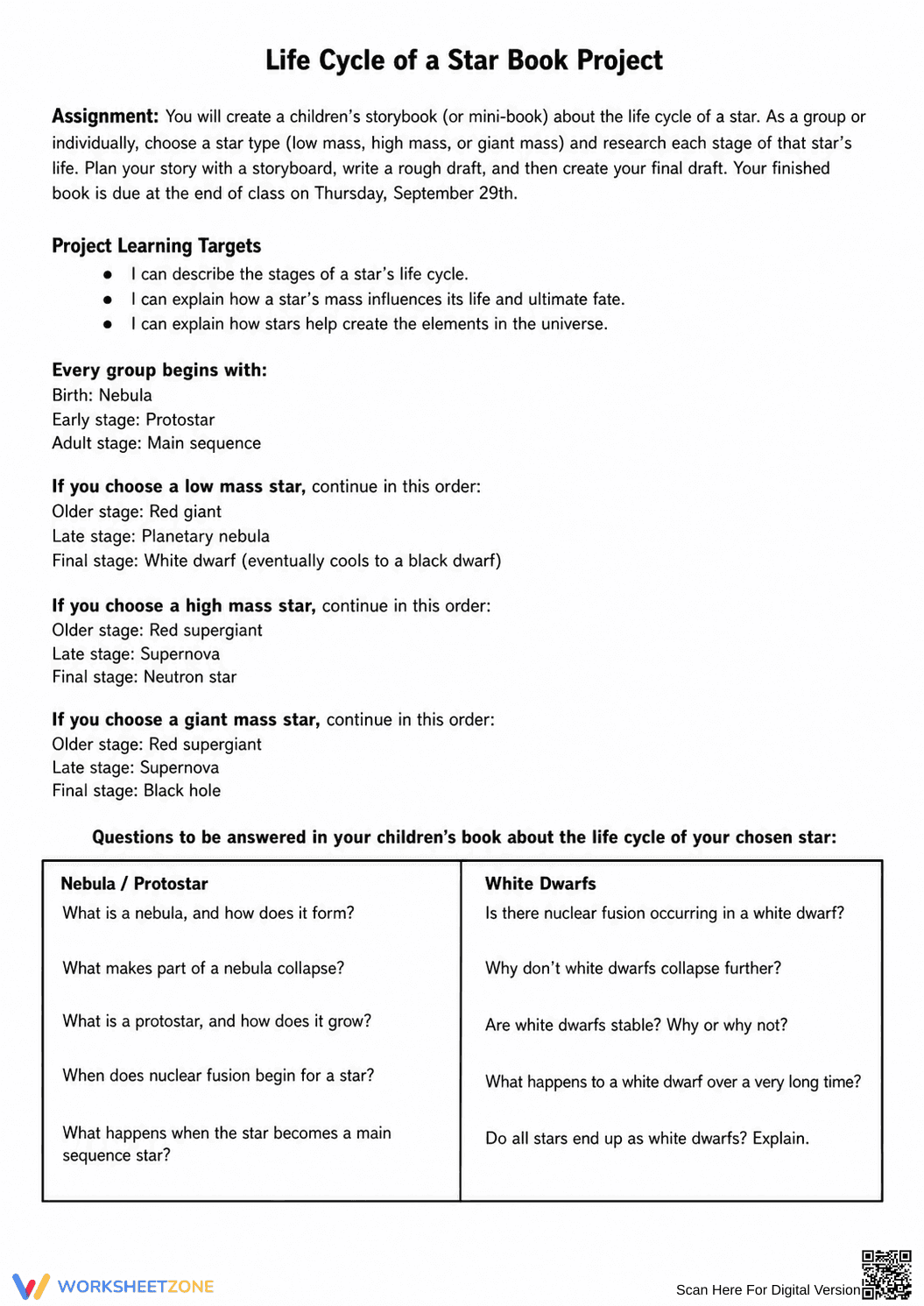
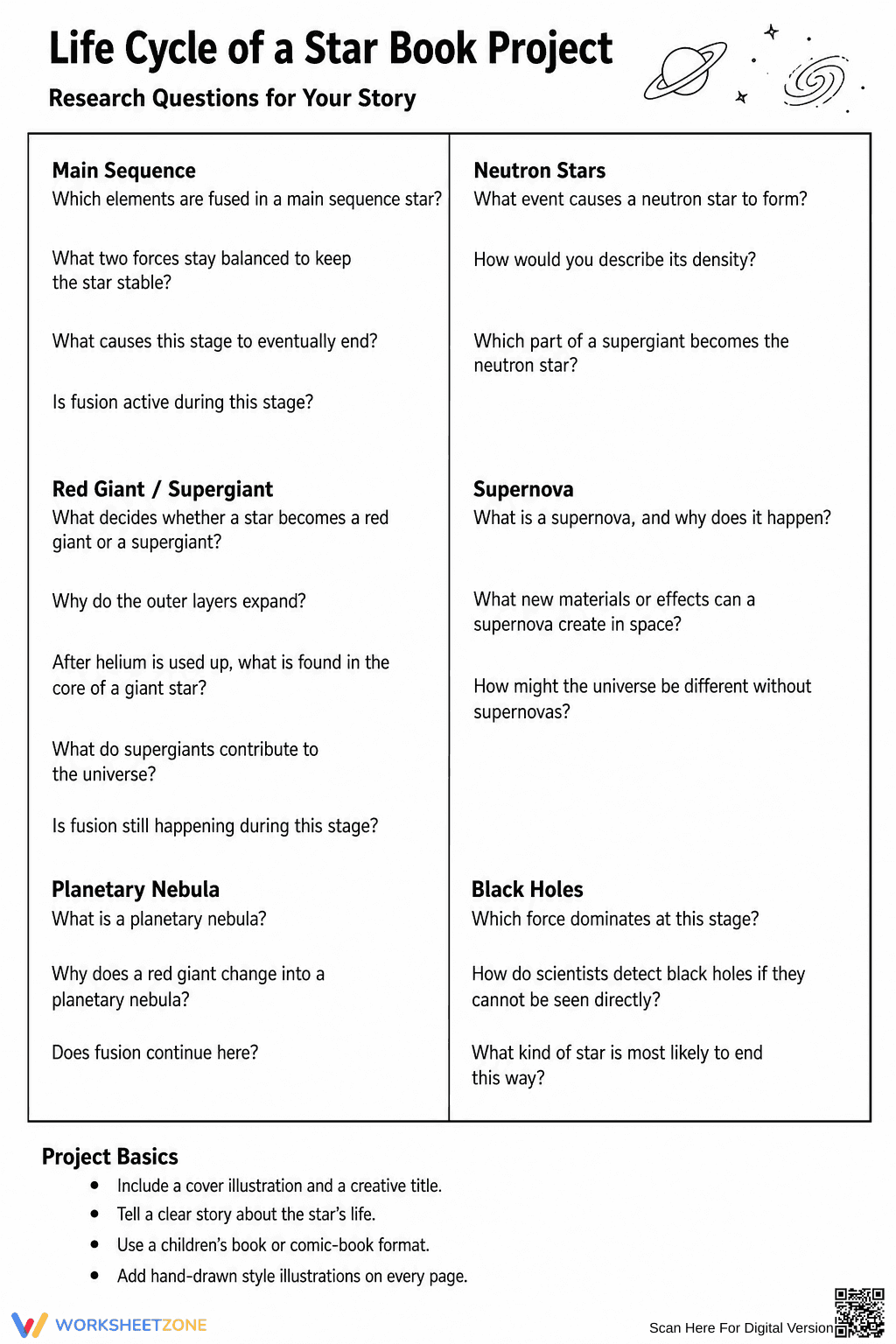
This Grade 9 science project worksheet guides students through researching and illustrating the life cycle of a star. By answering targeted questions and creating a children's book, students synthesize complex astronomical concepts into accessible narratives, demonstrating their understanding of stellar evolution and element formation.
At a Glance
- Grade: 9 · Subject: Science
- Standard:
HS-ESS1-3— Communicate scientific ideas about how stars produce elements.- Skill Focus: Stellar Evolution & Element Formation
- Format: 2 pages · 25 problems · No answer key · PDF
- Best For: End-of-unit project
- Time: 120–180 minutes
This two-page project guide provides a comprehensive framework for a creative astronomy assignment. It includes clear learning targets, a breakdown of evolutionary stages for low, high, and giant mass stars, and 25 specific research questions. The structured prompts cover everything from nebulae and main sequence stars to supernovae and black holes, ensuring students gather all necessary facts before drafting their storybooks.
- Print (1 minute): Download the PDF and print double-sided copies for each student or group.
- Distribute (1 minute): Hand out the project guidelines and briefly review the learning targets and book format requirements.
- Review (Ongoing): Monitor students as they research their chosen star mass and draft their storyboards.
With under two minutes of teacher setup required, this resource is perfect for immediate classroom use or as an extended substitute teacher plan.
Aligned to HS-ESS1-3, this project requires students to communicate scientific ideas about the way stars, over their life cycle, produce elements. It also supports broader physical science goals regarding nuclear fusion and gravity. Both standard codes can be copied directly into lesson plans, IEP goals, or district curriculum mapping tools.
Assign this project after direct instruction on stellar evolution to serve as a summative assessment. Students can work individually or in small groups over 2 to 3 class periods (120–180 minutes) to research, draft, and illustrate their books. As a formative assessment tip, check their answers to the 25 research questions before allowing them to begin illustrating, ensuring their scientific foundation is accurate.
Designed for Grade 9 through 12 students in Earth and Space Science or Astronomy courses. The creative format naturally differentiates for various learning styles, allowing artistic students to shine while maintaining rigorous scientific standards. Pair this project with a visual anchor chart of the Hertzsprung-Russell diagram for optimal results.
Integrating creative writing into STEM education significantly enhances student retention of complex physical phenomena. When students communicate scientific ideas about how stars produce elements (aligned with HS-ESS1-3), they move beyond rote memorization into active cognitive processing. According to a 2024 report by EdReports, project-based learning tasks that require students to translate high-level scientific data into accessible formats increase engagement and deepen conceptual mastery. This star life cycle project leverages that pedagogical strategy by breaking down stellar evolution into manageable research questions. By requiring students to explain the balance of forces in a main sequence star or the aftermath of a supernova in plain language, educators can accurately assess both content knowledge and science communication skills.


