




























Views
Downloads

Life Cycle of a Star Review Worksheet | Essential Grade 8-11

Paste this activity's link or code into your existing LMS (Google Classroom, Canvas, Teams, Schoology, Moodle, etc.).
Students can open and work on the activity right away, with no student login required.
You'll still be able to track student progress and results from your teacher account.
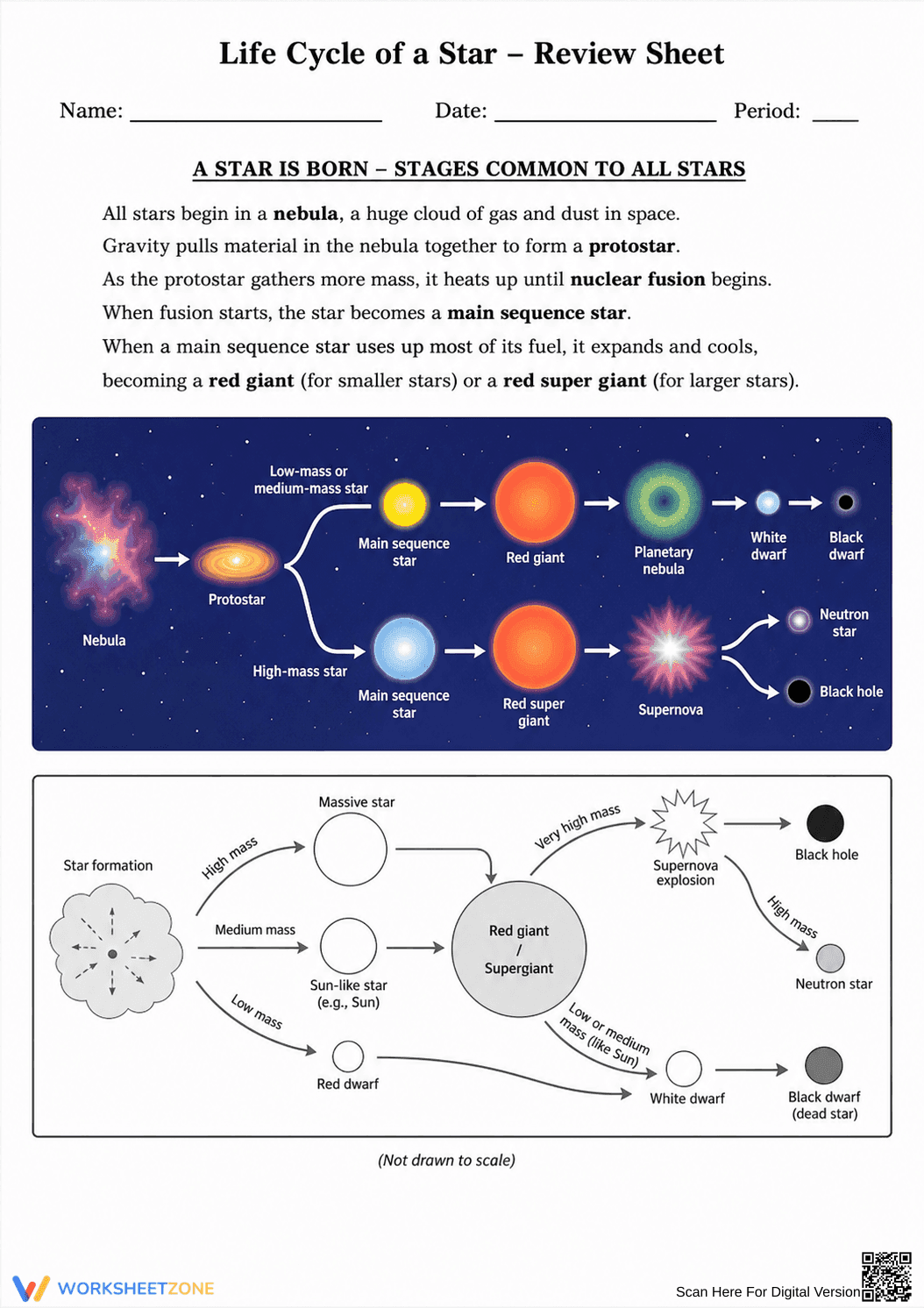
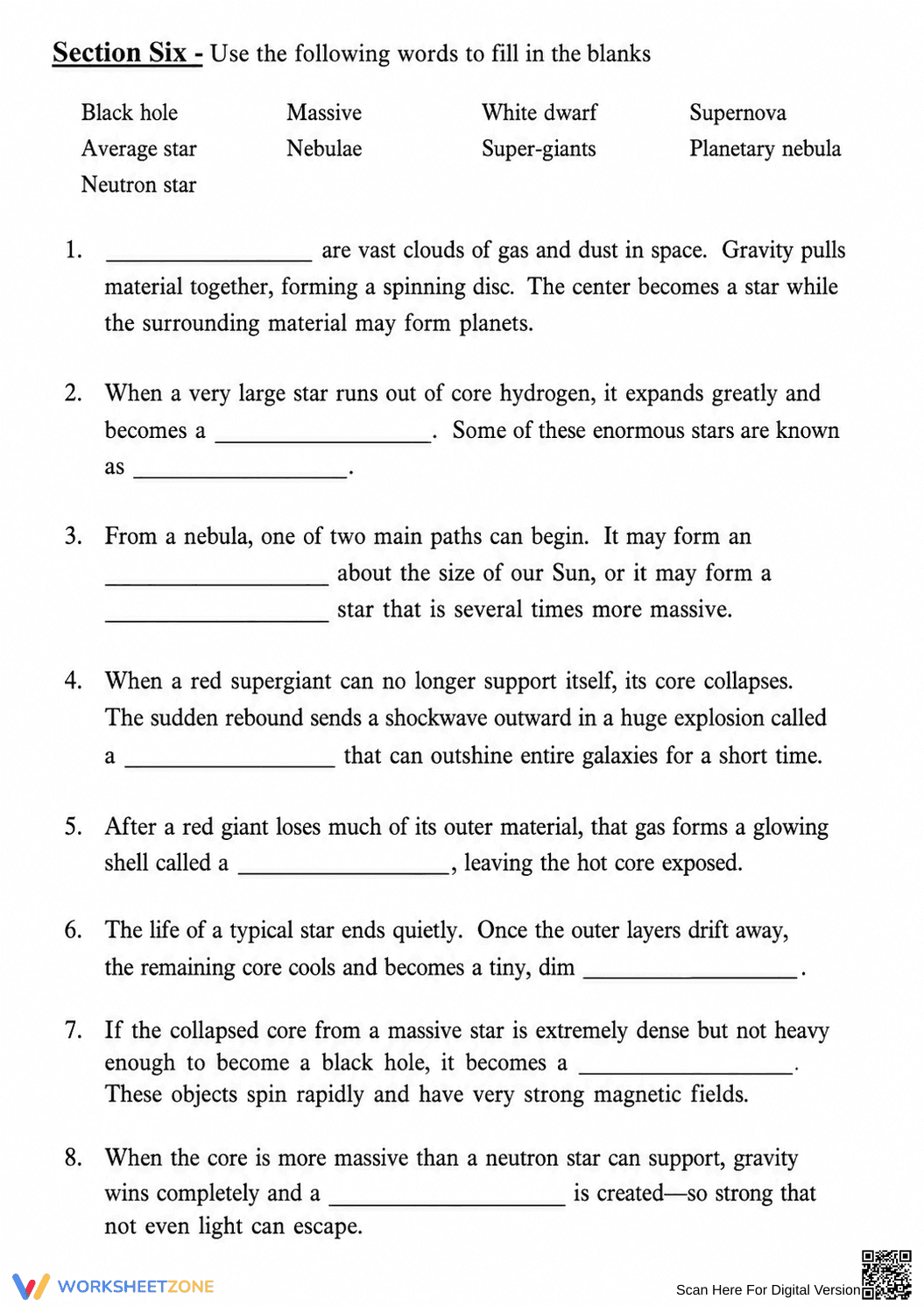
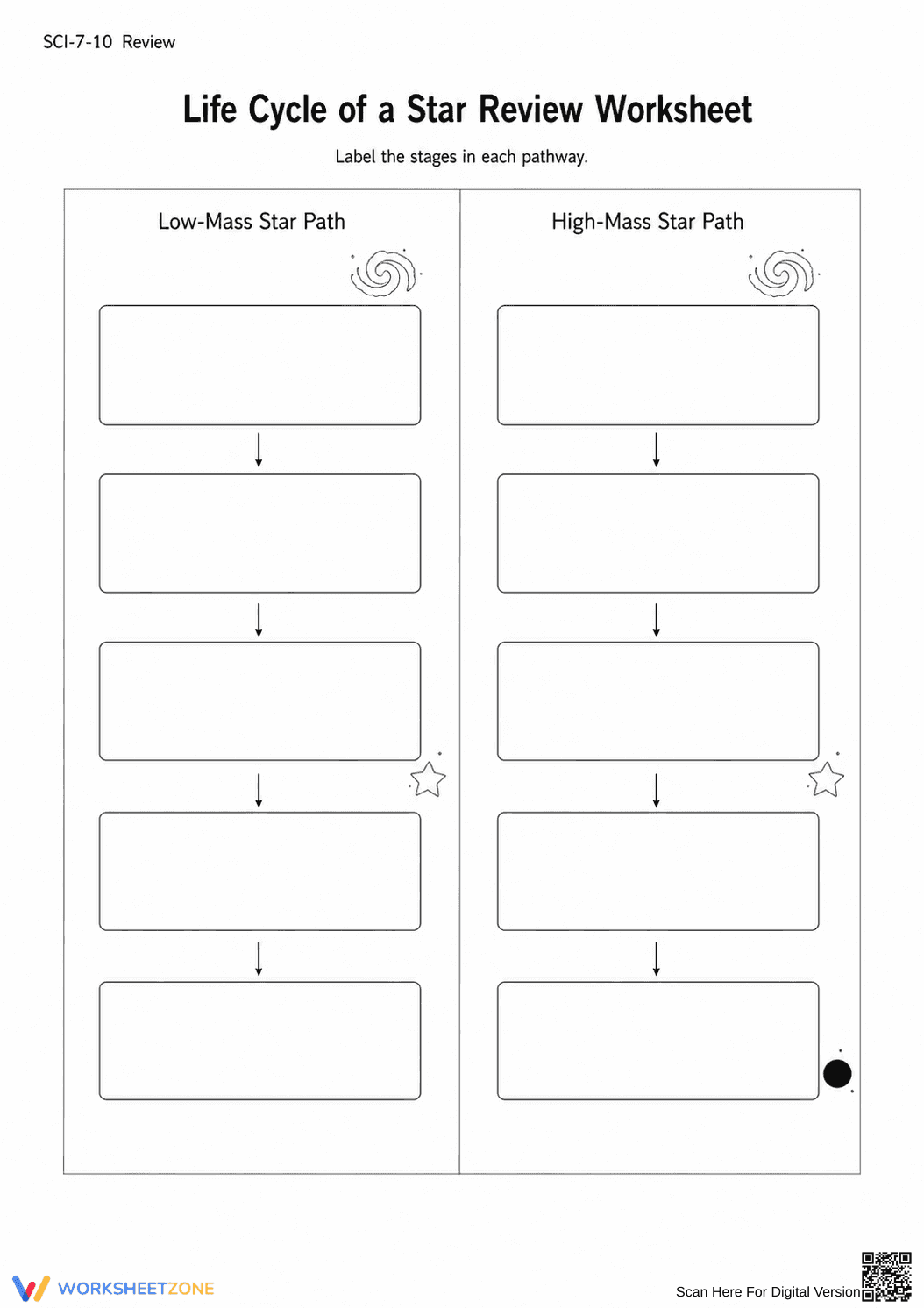
This comprehensive stellar evolution review worksheet guides students through the complex stages of a star's life, from nebula to black hole. By analyzing diagrams and completing structured tasks, learners master how mass dictates a star's ultimate fate. It provides a clear framework for understanding nuclear fusion and gravitational collapse in the cosmos.
At a Glance
- Grade: 8-11 · Subject: Earth & Space Science
- Standard:
HS-ESS1-3— Communicate how stars produce elements and change over their life cycles- Skill Focus: Stellar Evolution Pathways
- Format: 6 pages · 35+ problems · Answer key included · PDF
- Best For: Unit review or emergency sub plans
- Time: 45–60 minutes
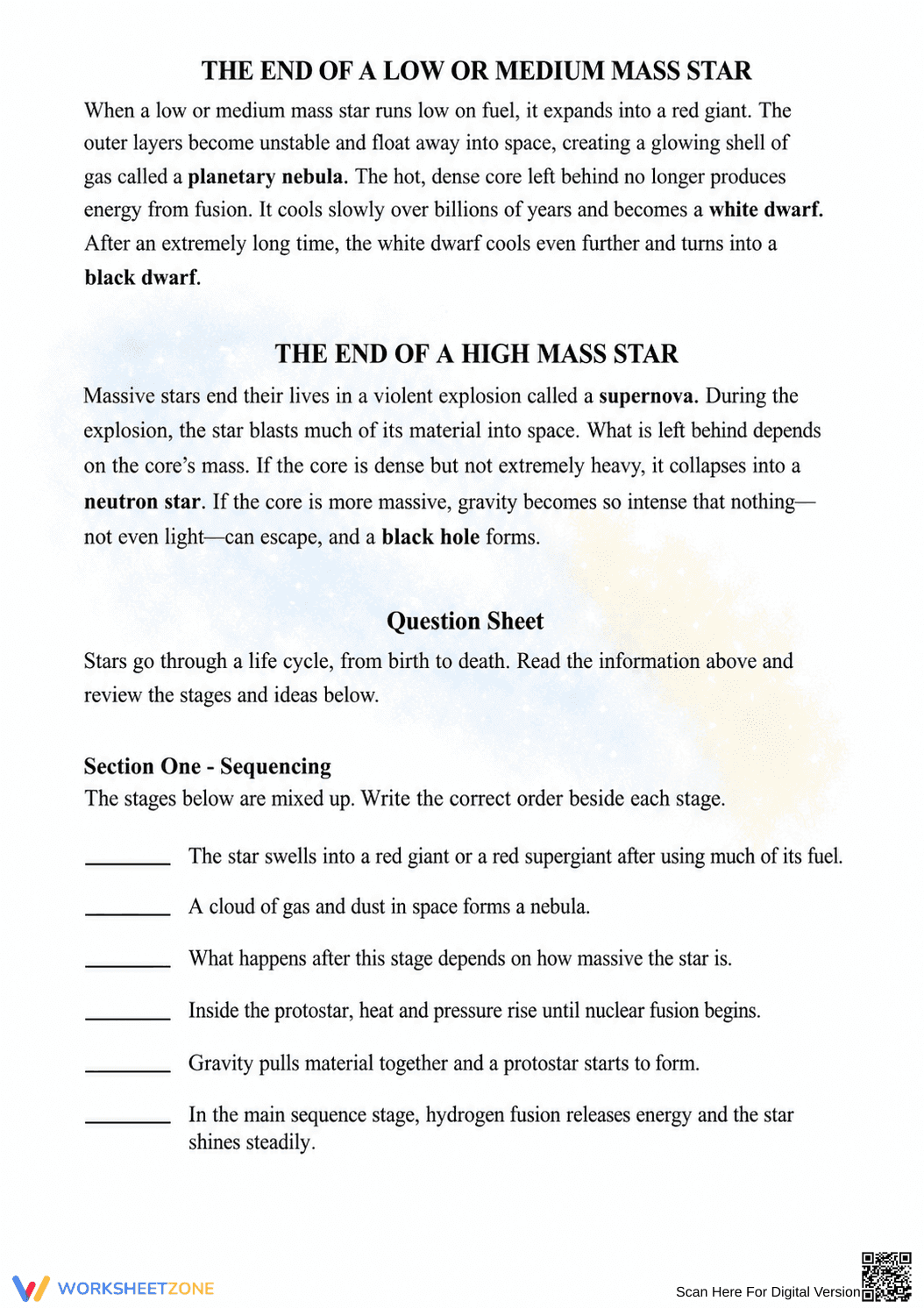
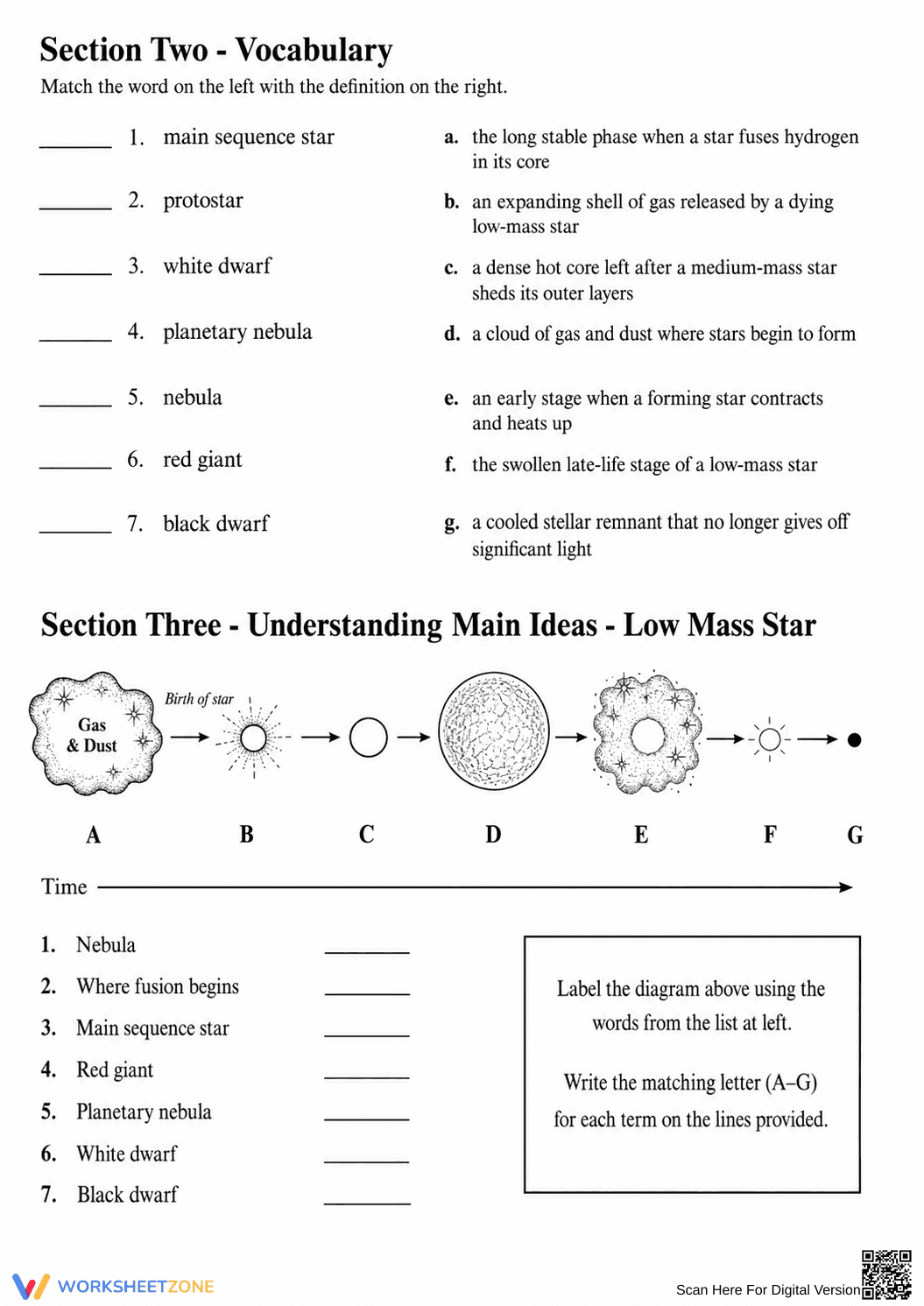
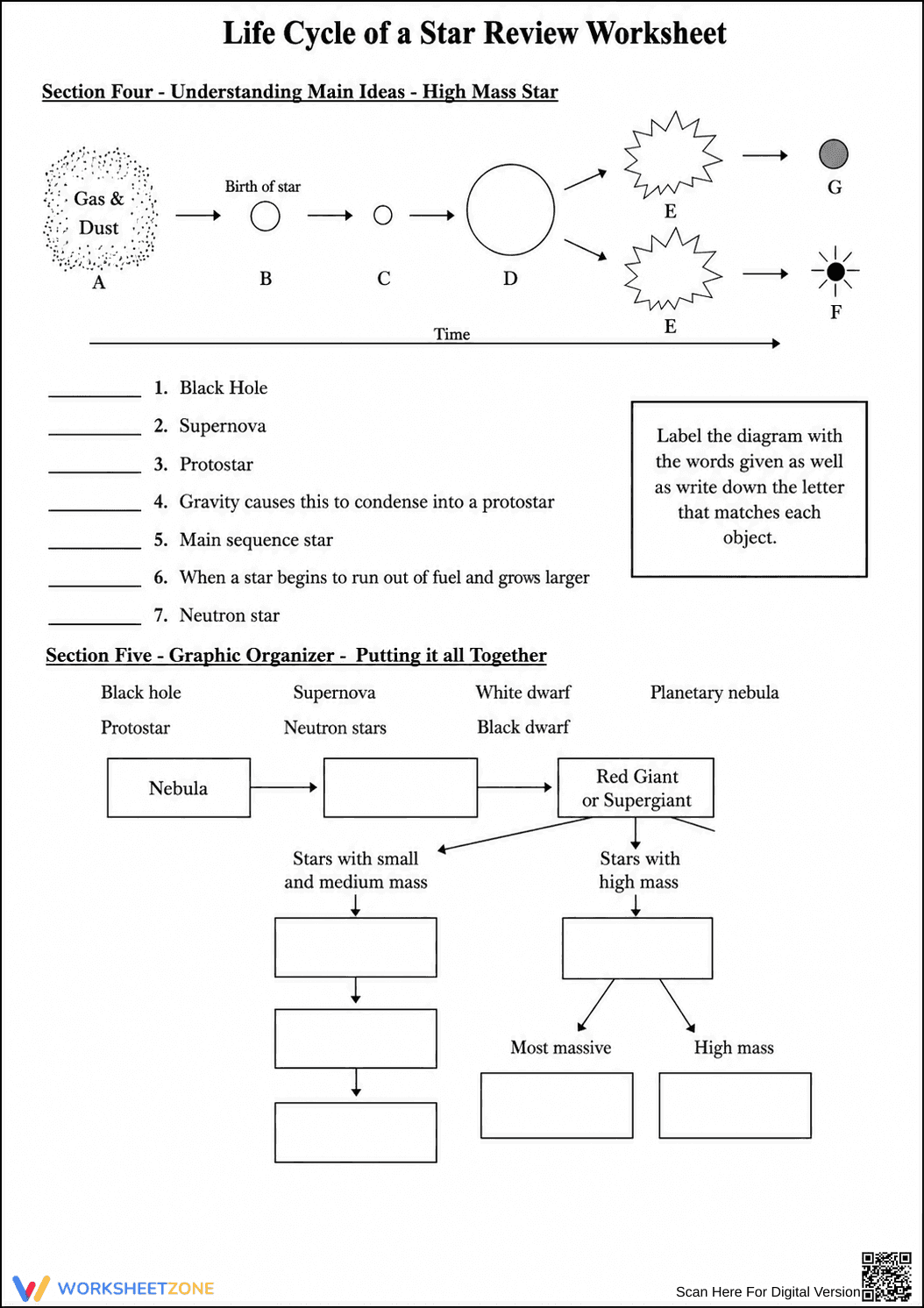
What's Inside: This 6-page packet features a detailed informational text followed by six distinct activity sections. Students engage with sequencing exercises, vocabulary matching for 7 key terms, and dual-pathway diagrams for low-mass and high-mass stars. The resource includes a comprehensive graphic organizer and a fill-in-the-blank summary to ensure all 35 concepts are reinforced through multiple modalities.
The zero-prep workflow is designed for maximum efficiency. First, print the 6-page PDF (30 seconds). Next, distribute the packets to students for independent or partner work (1 minute). Finally, review the completed diagrams and graphic organizers using the included answer key to identify misconceptions (5 minutes). This structure makes it an ideal resource for unexpected teacher absences.
Standards Alignment: This resource aligns with HS-ESS1-3, requiring students to communicate scientific ideas about the way stars change over their life cycle. It also supports MS-ESS1-2 by illustrating the role of gravity in star formation. Both standard codes can be copied directly into lesson plans, IEP goals, or district curriculum mapping tools.
How to Use It: Use this as a summative review after direct instruction on the Hertzsprung-Russell diagram or stellar nucleosynthesis. During the activity, circulate to observe if students correctly differentiate between the "Red Giant" and "Red Supergiant" branches. Completion typically takes 45 to 60 minutes depending on prior knowledge.
Who It's For: Designed for middle and high school astronomy or earth science students, this worksheet supports diverse learners through visual models and scaffolded text. It pairs naturally with a stellar evolution anchor chart or a digital simulation of supernova events.
According to the RAND AIRS 2024 report on secondary science literacy, structured graphic organizers and multi-modal diagrams significantly improve the retention of complex astronomical sequences among Grade 8-11 learners. This worksheet utilizes these proven strategies by requiring students to map the life cycle of a star across 6 distinct sections, including vocabulary matching and pathway sequencing. By aligning with the HS-ESS1-3 standard, the resource ensures that students move beyond rote memorization to understand the causal relationship between a star's initial mass and its eventual remnants, such as white dwarfs or black holes. Research from Fisher & Frey (2014) suggests that this type of scaffolded review, which transitions from informational text to independent modeling, is essential for mastering high-level science concepts. Educators can use this 6-page tool to provide the rigorous practice necessary for state assessment readiness while maintaining a low-prep classroom environment.


