




























Views
Downloads

Essential Life Cycle of a Star Worksheet | Grades 6-9

Paste this activity's link or code into your existing LMS (Google Classroom, Canvas, Teams, Schoology, Moodle, etc.).
Students can open and work on the activity right away, with no student login required.
You'll still be able to track student progress and results from your teacher account.
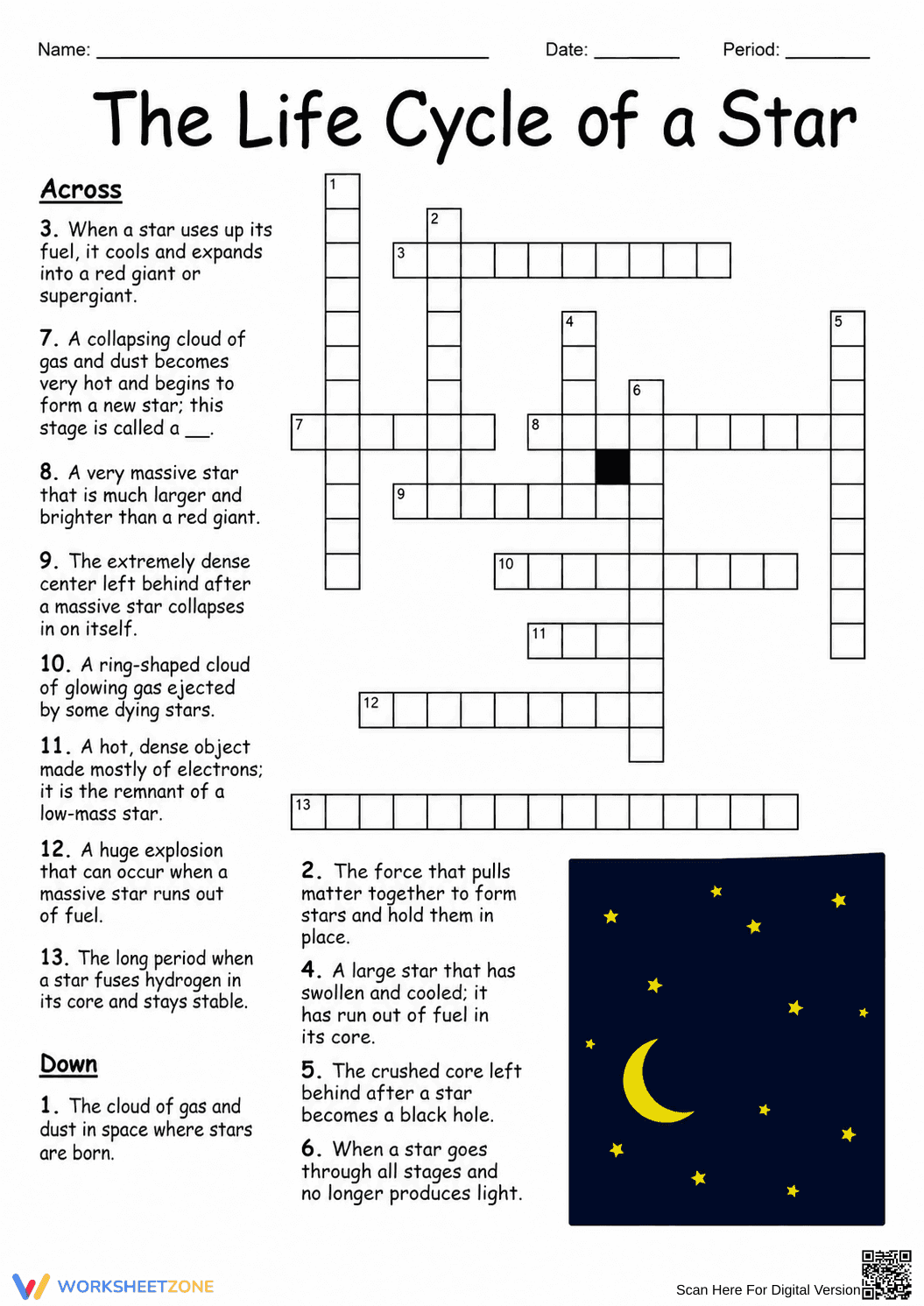
This Grade 6-9 science worksheet provides a comprehensive review of stellar evolution through an engaging crossword format. Students identify key stages and celestial objects, from nebulae to black holes, ensuring they master the complex vocabulary of astronomy. It serves as an ideal formative assessment or vocabulary reinforcement tool for middle school space science units.
At a Glance
- Grade: 6-9 · Subject: Science
- Standard:
MS-ESS1-2— Explain the role of gravity in the motions within galaxies and the solar system- Skill Focus: Stellar evolution vocabulary
- Format: 1 page · 13 problems · Answer key included · PDF
- Best For: Vocabulary review and formative assessment
- Time: 15–25 minutes
The resource features a single-page crossword puzzle containing 13 distinct clues (8 across and 5 down). The clues are meticulously crafted to describe specific astronomical phenomena such as red giants, supernovae, and planetary nebulas. The layout includes a clear grid and a thematic space illustration, accompanied by a full answer key for rapid grading or student self-correction.
This worksheet is designed for immediate classroom implementation with a total teacher prep time of under 2 minutes. Simply print the PDF (30 seconds), distribute it to students as a bell-ringer or exit ticket (30 seconds), and use the provided answer key for a quick whole-class review (1 minute). Its self-contained nature makes it an excellent choice for emergency sub plans.
Primary alignment: MS-ESS1-2. This standard requires students to understand the role of gravity and the life cycles of celestial bodies within the universe. By identifying the forces that pull matter together to form stars, students demonstrate mastery of gravitational interactions. This standard code can be copied directly into lesson plans, IEP goals, or district curriculum mapping tools.
Use this worksheet during the "Explain" or "Evaluate" phase of a 5E lesson cycle. It works best after students have been introduced to the H-R diagram or stellar life cycles. As a formative assessment tip, observe which students struggle with the "Down" clues versus "Across" clues to identify specific gaps in conceptual understanding of star death versus star birth. Completion typically takes 15 to 25 minutes.
This resource is tailored for middle and early high school students (Grades 6-9) studying Earth and Space Science. It is particularly effective for visual learners and students who benefit from gamified vocabulary practice. Pair this worksheet with a stellar evolution anchor chart or a short video clip of a supernova for a multi-modal learning experience.
According to the RAND AIRS 2024 report, structured vocabulary reinforcement in science significantly improves long-term retention of complex astronomical concepts. This worksheet aligns with MS-ESS1-2 by requiring students to define the specific stages of stellar evolution, such as the transition from a nebula to a main sequence star. By engaging with 13 targeted clues, students build the academic language necessary for higher-level astrophysics. Research from Fisher & Frey (2014) emphasizes that "word-solving" activities like crosswords provide the cognitive scaffolding needed for students to internalize domain-specific terminology. This printable resource ensures that Grade 6-9 learners can accurately describe the life cycle of a star, from its birth in a collapsing cloud of gas to its eventual end as a white dwarf or black hole, meeting core NGSS requirements for space science literacy.


