




























Views
Downloads

MS-ESS1-2 Worksheet: Star Life Cycles — Grade 6-9 Aligned

Paste this activity's link or code into your existing LMS (Google Classroom, Canvas, Teams, Schoology, Moodle, etc.).
Students can open and work on the activity right away, with no student login required.
You'll still be able to track student progress and results from your teacher account.
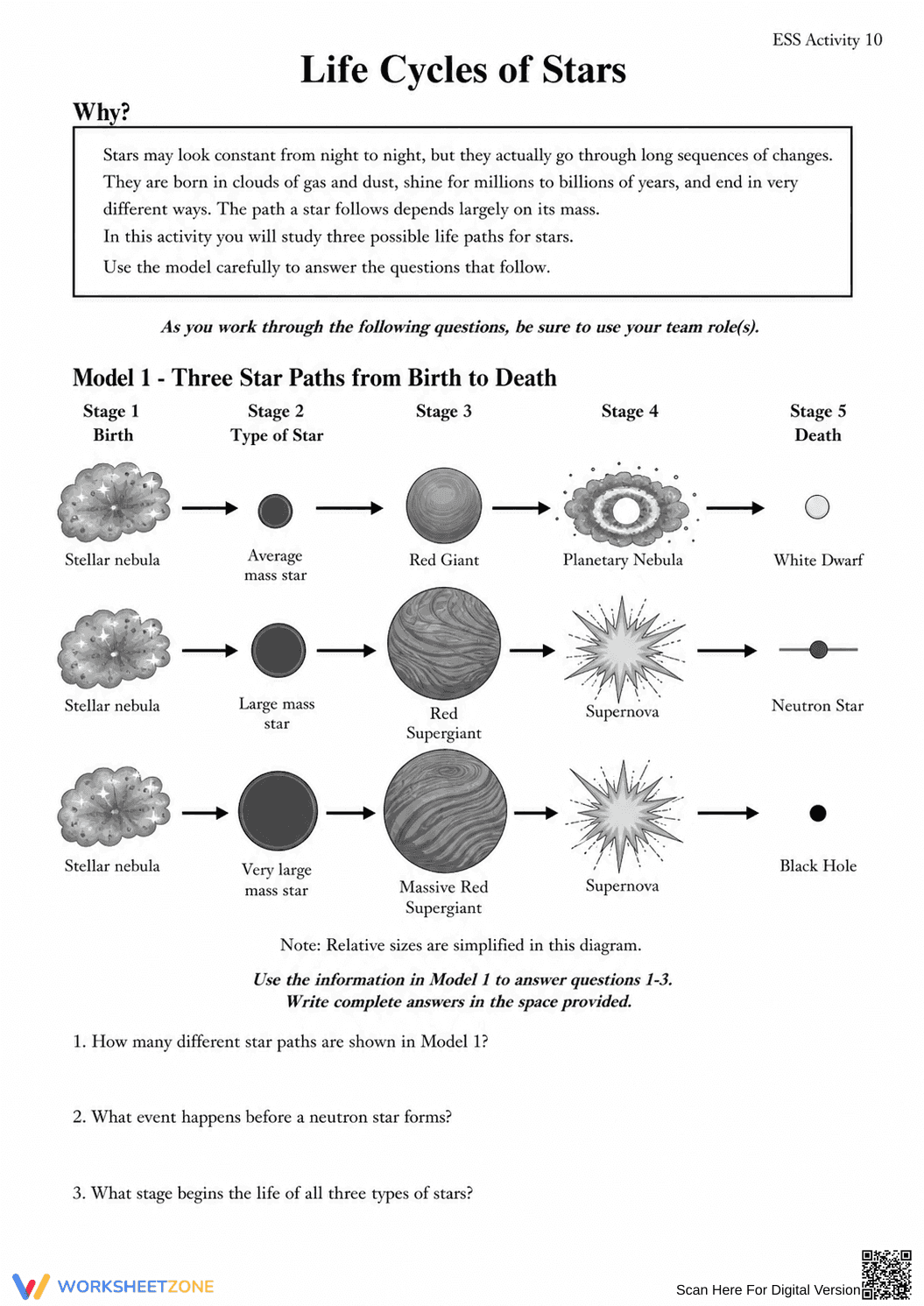
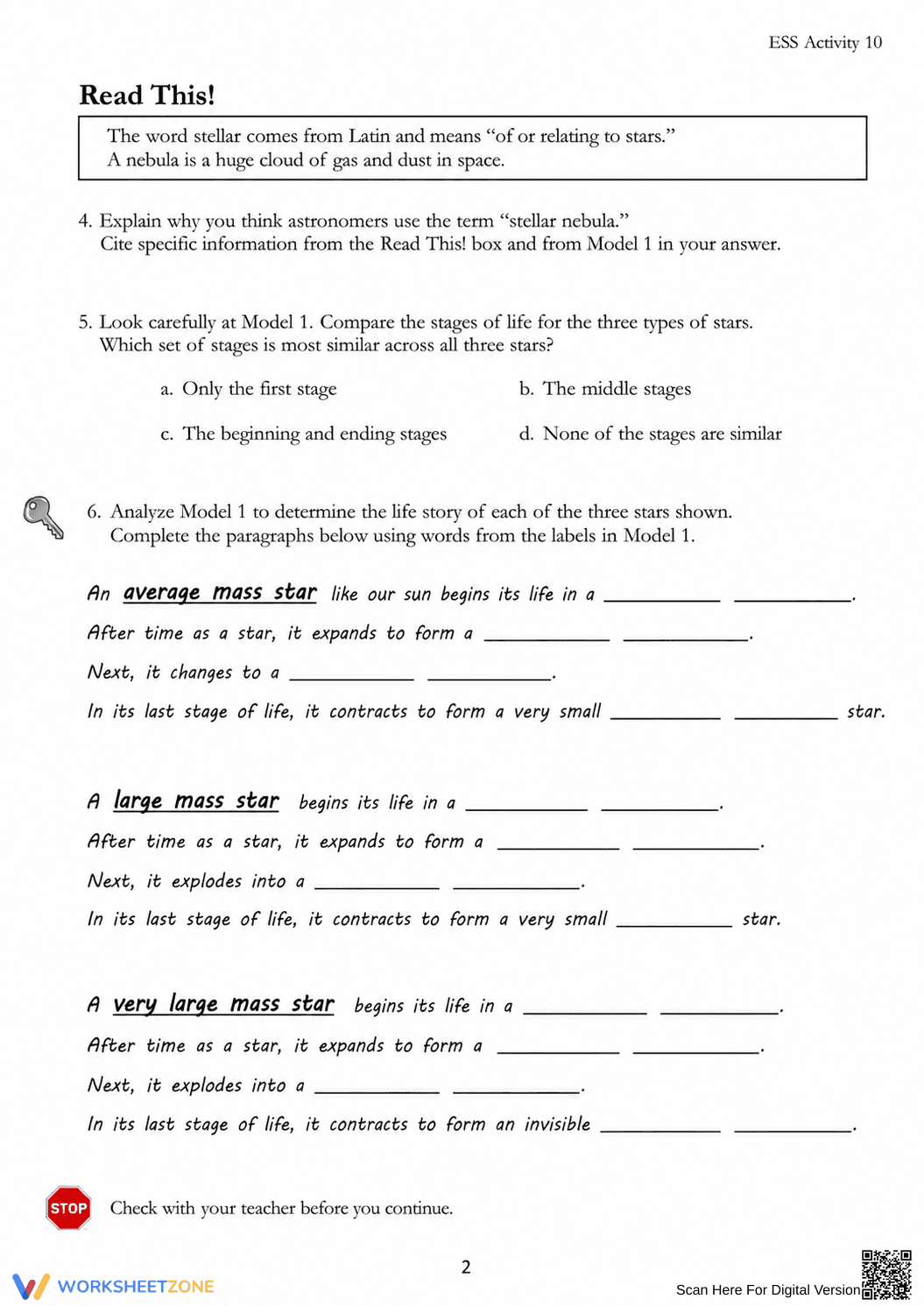
This comprehensive science worksheet guides students through the complex stages of stellar evolution. By analyzing three distinct models, learners identify how initial mass dictates a star's path from a stellar nebula to its final state. It transforms abstract astronomical concepts into concrete, observable patterns.
At a Glance
- Grade: 6-9 · Subject: Science
- Standard:
MS-ESS1-2— Explain the role of gravity in star life cycles- Skill Focus: Stellar Evolution & Data Analysis
- Format: 6 pages · 17 problems · Answer key included · PDF
- Best For: Guided inquiry and small group instruction
- Time: 45–60 minutes
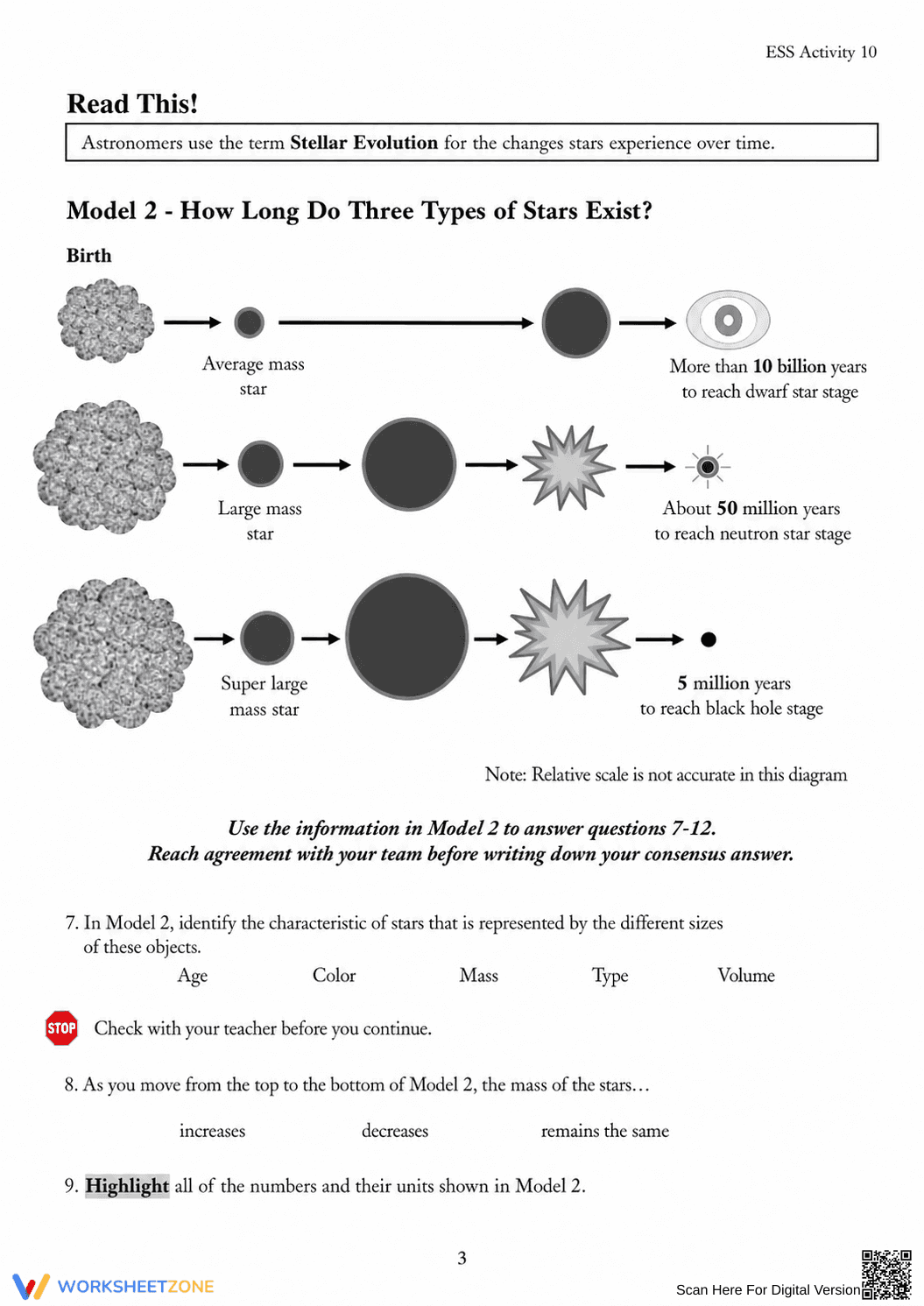
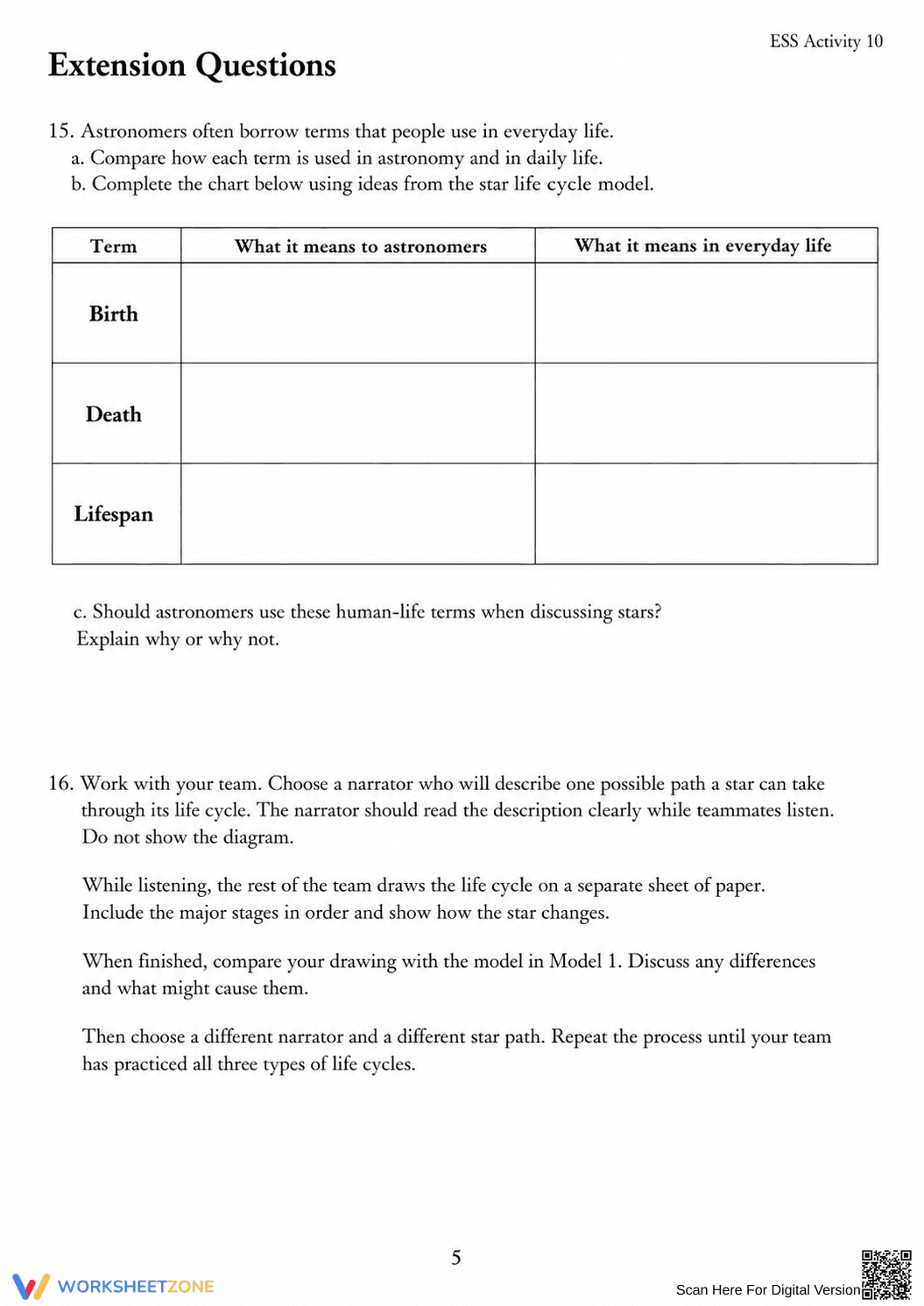
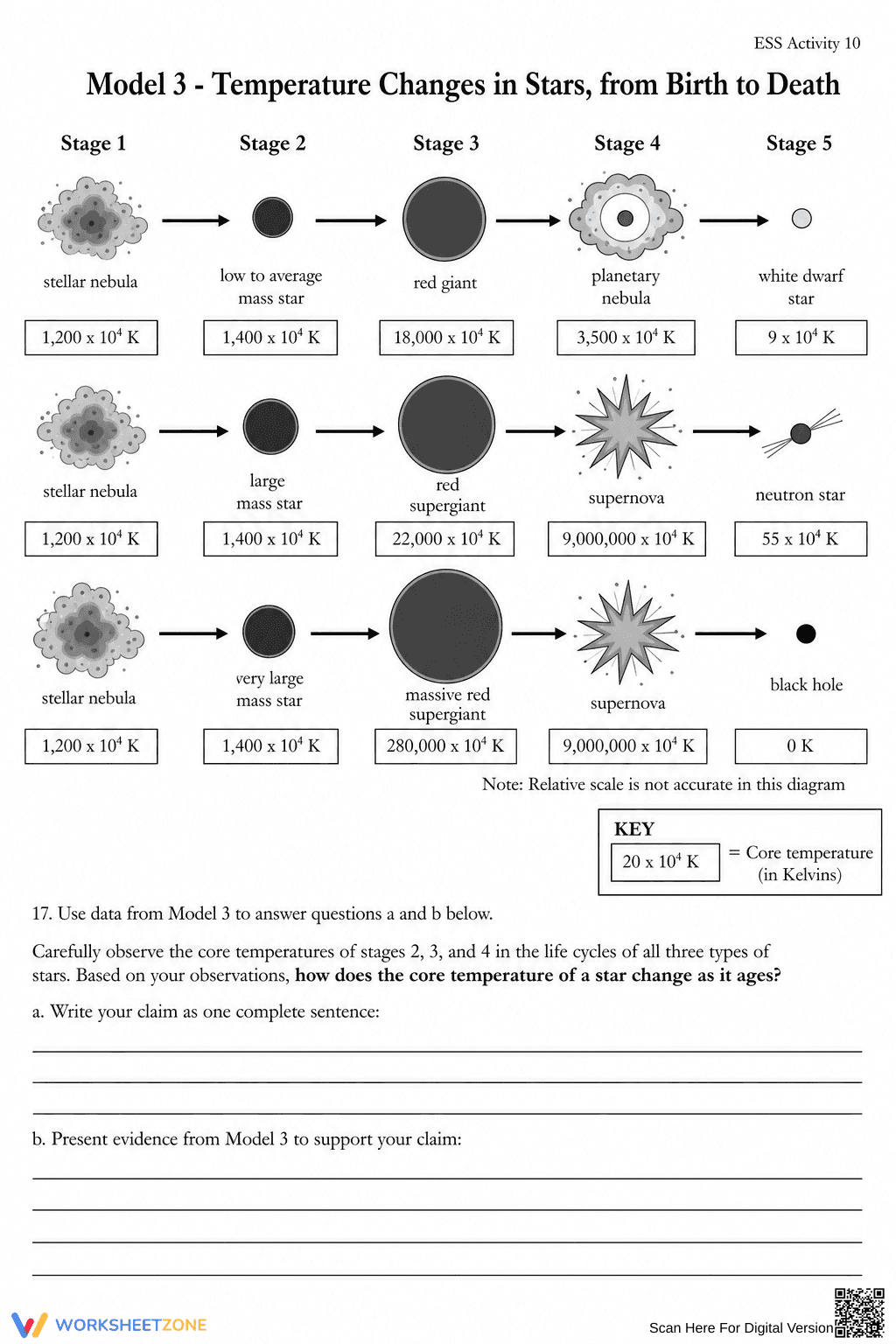
The packet contains six pages of structured inquiry featuring three visual models: a life cycle flow chart, a lifespan comparison, and a core temperature table. Students engage with fill-in-the-blank narratives, pattern recognition, and evidence-based claim writing. An extension section compares human and stellar life stages. A complete answer key is included.
Mastery Evidence
- Approaching: Questions 1-6 focus on identifying stages and vocabulary like nebula and supernova using visual cues from the first model.
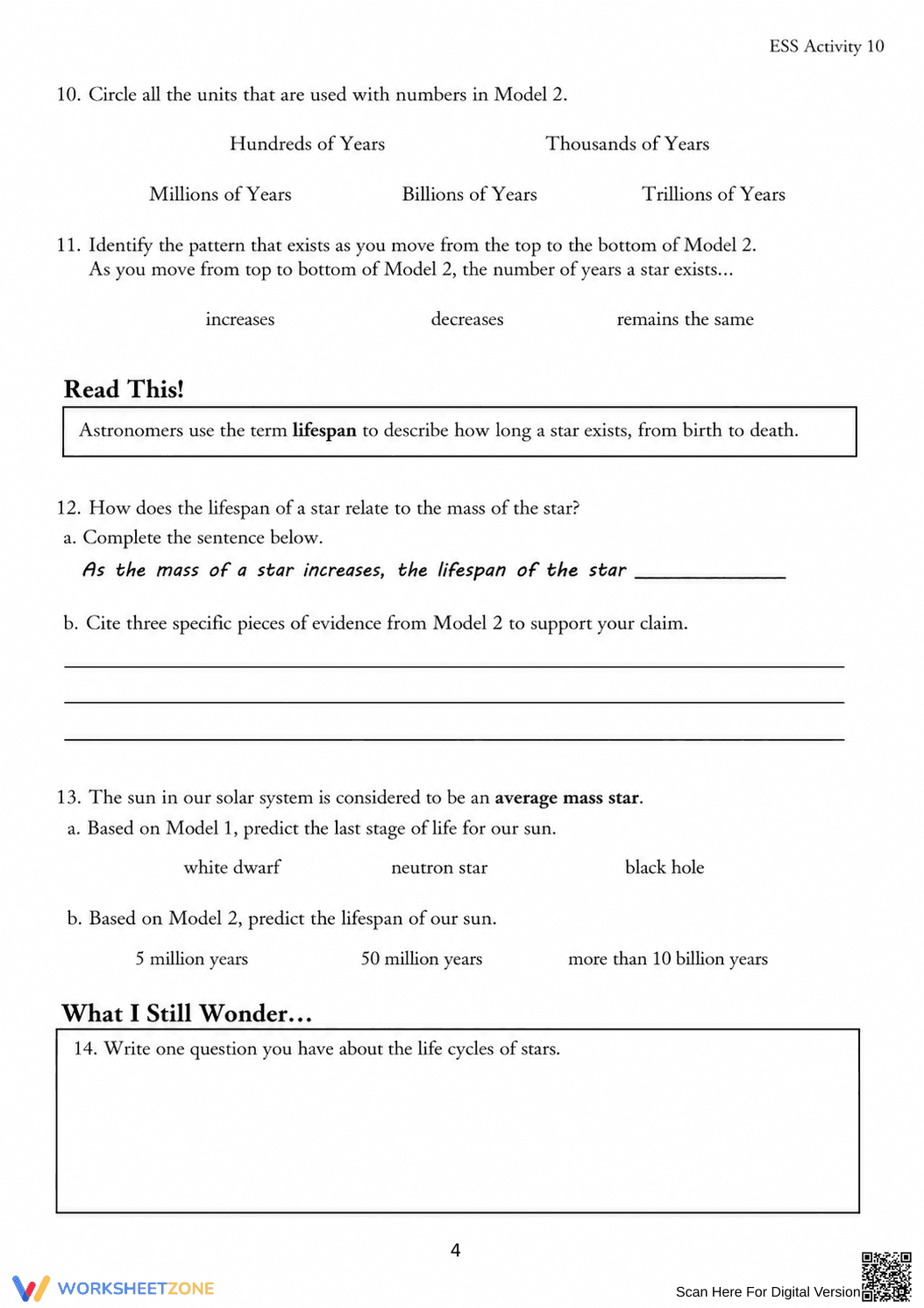
- Meeting: Questions 7-13 require students to correlate star mass with lifespan, identifying the inverse relationship between size and longevity.
- Exceeding: Questions 14-17 challenge students to synthesize temperature data to form scientific claims about energy changes as stars age.
Scores from these tiered tasks can be entered directly into gradebooks or used to track IEP progress toward NGSS Earth and Space Science goals.
Standards Alignment
This resource is primarily aligned with MS-ESS1-2: Develop and use a model to describe the role of gravity in the motions within galaxies and the solar system. While focusing on life cycles, it provides the foundational data needed to understand how mass and gravity govern stellar behavior. It also supports HS-ESS1-1 by exploring the nuclear fusion processes that define a star's life. Both standard codes can be copied directly into lesson plans, IEP goals, or district curriculum mapping tools.
How to Use It
Use this as a primary instructional tool during your unit on the universe. It works best after an introductory lecture on nebulae but before a summative assessment on the H-R diagram. For formative assessment, observe student discussions during the analysis of Model 2 to see if they grasp why larger stars burn through fuel faster. Expected completion time ranges from 45 to 60 minutes depending on reading levels.
Who It's For
This is designed for middle school Earth science students and early high school astronomy learners. The guided inquiry format provides essential scaffolding for English Language Learners through visual models and structured sentence frames. It pairs naturally with a digital planetarium simulation or a physical anchor chart of the stellar life cycle to reinforce the visual progression of different star types.
This worksheet utilizes the MS-ESS1-2 standard to bridge the gap between observational data and theoretical physics. By requiring students to explain the role of gravity in star life cycles using provided models, the activity mirrors the Science and Engineering Practices outlined in the NGSS framework. According to EdReports 2024, instructional materials that integrate visual data models with guided inquiry significantly improve student retention of complex astronomical phenomena. This resource provides a gradual progression, ensuring students understand the underlying physical variables of mass and temperature that drive these changes. It is a robust tool for any curriculum focused on evidence-based astronomical inquiry, giving educators a reliable method to assess student mastery.


