




























Views
Downloads
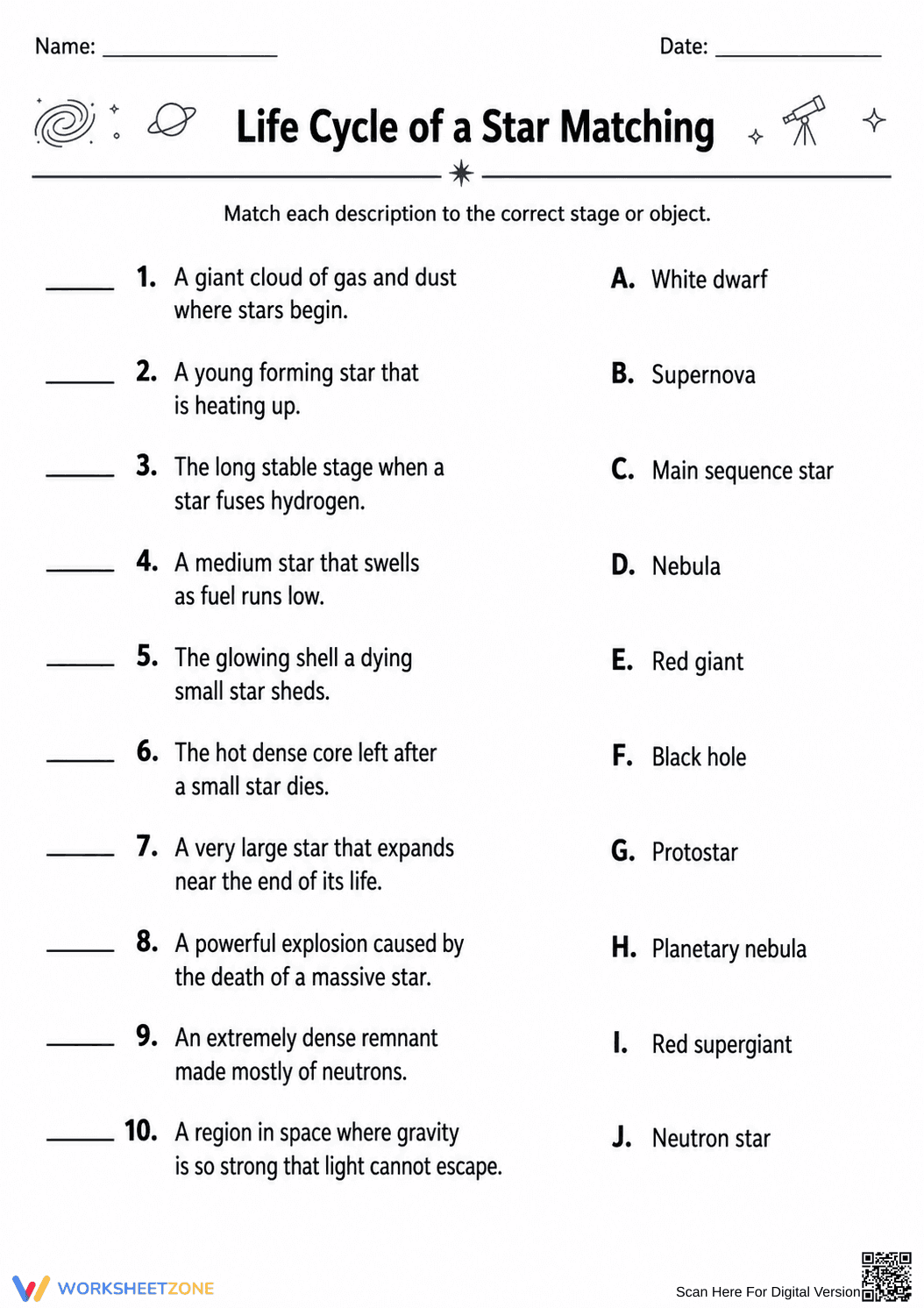

Life Cycle of a Star Matching | Essential Science Worksheet

Paste this activity's link or code into your existing LMS (Google Classroom, Canvas, Teams, Schoology, Moodle, etc.).
Students can open and work on the activity right away, with no student login required.
You'll still be able to track student progress and results from your teacher account.
This Life Cycle of a Star matching worksheet helps students master the complex vocabulary of stellar evolution. By connecting descriptive definitions to specific astronomical terms, learners develop a clear mental model of how stars form, age, and eventually expire. It provides a structured way to reinforce key concepts like nuclear fusion and gravitational collapse.
At a Glance
- Grade: 5-7 · Subject: Science
- Standard:
MS-ESS1-2— Explain the role of gravity in the motions within galaxies and the solar system- Skill Focus: Stellar Evolution Vocabulary
- Format: 1 page · 10 problems · Answer key included · PDF
- Best For: Quick vocabulary check or sub plans
- Time: 10–15 minutes
What's Inside
This single-page PDF features 10 distinct matching tasks designed for clarity and ease of use. On the left, students find detailed descriptions of stellar phenomena, such as "a large cloud of gas and dust" or "the blue-white core of the star that is left behind." On the right, a lettered list of terms includes nebula, protostar, main sequence, and supernova. A comprehensive answer key is provided for rapid grading and immediate student feedback.
Zero-Prep Workflow
- Print: Generate the single-page PDF in under 30 seconds for your entire class.
- Distribute: Hand out the sheets as a bell-ringer, exit ticket, or quiet independent study task.
- Review: Use the included answer key to review the 10 terms as a whole-class activity, requiring only 1 minute of teacher time.
Its self-explanatory layout makes it an ideal component for emergency sub plans or supplemental homework assignments.
Standards Alignment
The primary focus is `MS-ESS1-2`, which requires students to understand the role of gravity and fusion in the life cycles of celestial bodies. By identifying stages like the red giant and neutron star, students demonstrate knowledge of how mass and gravity dictate a star's path. Both standard codes can be copied directly into lesson plans, IEP goals, or district curriculum mapping tools.
How to Use It
Use this worksheet as a formative assessment after a direct instruction lesson on space science. Teachers should observe if students can distinguish between the "nebula" and "protostar" phases, as this indicates a grasp of early stellar formation. It also serves as an excellent review tool before a unit test, typically taking students 10 to 15 minutes to complete independently during a science station rotation.
Who It's For
This activity is tailored for middle school students in grades 5 through 7. It supports diverse learners by providing clear, concise definitions that act as context clues for vocabulary acquisition. It pairs naturally with an anchor chart showing the visual progression of low-mass and high-mass stars, helping visual learners bridge the gap between text and imagery.
According to the RAND AIRS 2024 analysis of middle school science materials, structured vocabulary reinforcement is a critical predictor of student success in complex domain-specific subjects like astronomy. This worksheet addresses the MS-ESS1-2 standard by requiring students to categorize the 10 essential stages of stellar evolution, from the initial nebula phase to the final stages of a black hole or white dwarf. Research indicates that matching activities reduce cognitive load during the initial acquisition of scientific terminology, allowing students to focus on the conceptual relationships between gravity, mass, and energy. By providing a clear, one-to-one correspondence between definitions and terms, this resource ensures that learners build a foundational lexicon necessary for higher-order analysis of galactic motions. The inclusion of an answer key facilitates immediate feedback, a practice Fisher & Frey (2014) identify as vital for correcting misconceptions in the gradual release of responsibility instructional framework.


