




























Views
Downloads

Essential Life Cycle of a Star Worksheet | Grade 5

Paste this activity's link or code into your existing LMS (Google Classroom, Canvas, Teams, Schoology, Moodle, etc.).
Students can open and work on the activity right away, with no student login required.
You'll still be able to track student progress and results from your teacher account.
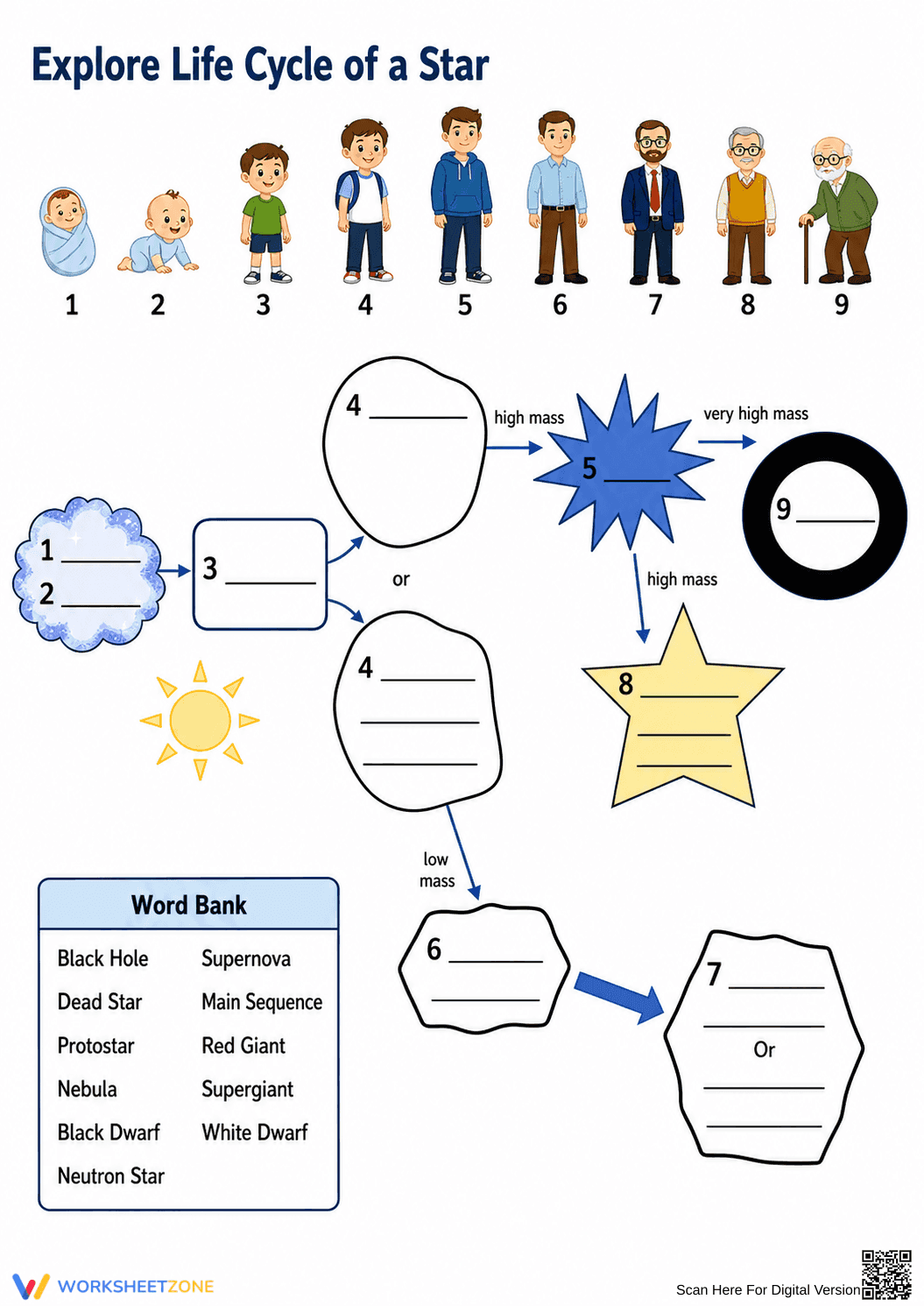
This Grade 5 science worksheet provides a visual model of stellar evolution, helping students identify stages from nebula to black hole. By matching vocabulary to a diagram, learners understand how mass dictates a star's outcome. It is an effective tool for mastering astronomical concepts.
At a Glance
- Grade: 5 · Subject: Science
- Standard:
5-ESS1-1— Support an argument about stars and their brightness based on distance and life stages- Skill Focus: Stellar Evolution Stages
- Format: 1 page · 9 problems · Answer key included · PDF
- Best For: Independent practice or formative assessment
- Time: 15–20 minutes
What's Inside
The worksheet features a diagram tracing two paths of stellar evolution: low mass and high mass. It includes a word bank with 10 terms, such as Protostar and Supernova. A visual analogy at the top compares star stages to human aging, providing a scaffold for understanding the "life cycle" concept.
Zero-Prep Workflow
- Print: Generate the single-page PDF in under 30 seconds.
- Distribute: Hand out to students for immediate independent work supported by the word bank.
- Review: Use the included answer key to grade all 9 tasks in less than 2 minutes.
This streamlined process makes the resource an ideal choice for emergency sub plans or quick classroom transitions.
Standards Alignment
Aligned to `5-ESS1-1`, students explore star characteristics. Understanding the life cycle is foundational to explaining why stars differ in luminosity. This worksheet also supports MS-ESS1-2. Both standard codes can be copied directly into lesson plans, IEP goals, or district curriculum mapping tools.
How to Use It
Use this as a mid-unit check. It works well as an activity where students use textbooks to find the sequence. For formative assessment, observe if students distinguish between the "high mass" path and the "low mass" path. Completion takes 15-20 minutes.
Who It's For
This resource is tailored for Grade 5 but works for middle school review. It supports visual learners and provides scaffolding for ELLs via the word bank. It pairs naturally with a digital planetarium simulation or an anchor chart.
According to research by Fisher & Frey (2014) on the gradual release of responsibility, visual scaffolds like the labeling tasks in this 5-ESS1-1 aligned worksheet are critical for transitioning students from guided instruction to independent mastery of abstract scientific concepts. By providing a word bank and a clear flowchart of stellar evolution, the resource reduces cognitive load, allowing students to focus on the relationships between different stages of a star's life. The inclusion of 9 specific tasks ensures that learners engage with the full spectrum of the life cycle, from the initial nebula to the final black hole or white dwarf. This structured approach is supported by the RAND AIRS 2024 report, which emphasizes that high-quality science materials must integrate vocabulary with visual models to improve long-term retention. This worksheet serves as a reliable evidence-based tool for classroom teachers and curriculum specialists.


