




























Views
Downloads
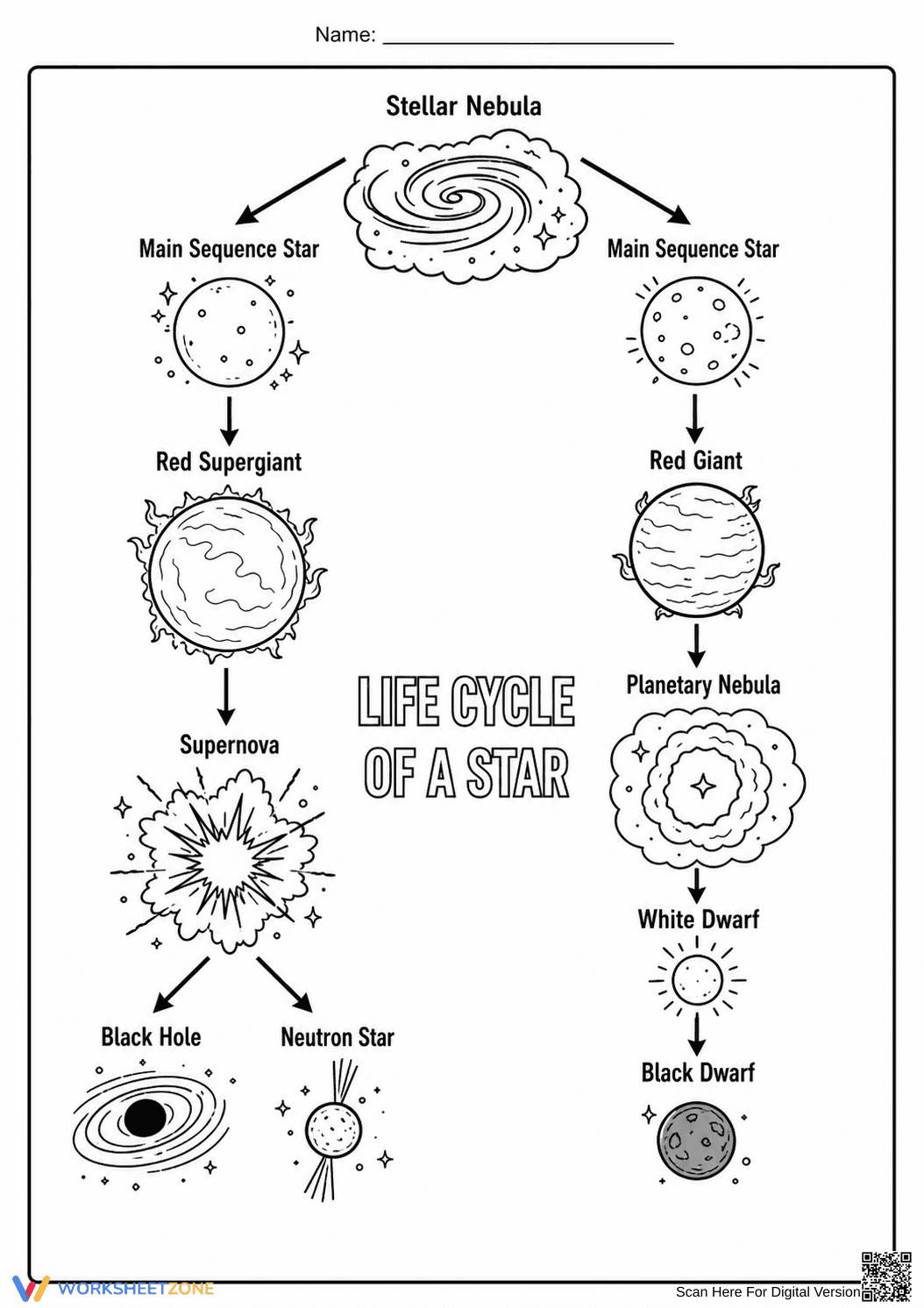

Grade 5 Life Cycle of a Star — Printable No-Prep Worksheet

Paste this activity's link or code into your existing LMS (Google Classroom, Canvas, Teams, Schoology, Moodle, etc.).
Students can open and work on the activity right away, with no student login required.
You'll still be able to track student progress and results from your teacher account.
This Grade 5 science worksheet provides a visual model of the life cycle of a star to help students understand stellar evolution. By tracing pathways from a stellar nebula to a black dwarf or black hole, students build astronomy vocabulary and grasp complex cosmic processes.
At a Glance
- Grade: 5 · Subject: Science
- Standard:
5-ESS1-1— Understand the properties and life cycles of stars- Skill Focus: Stellar Evolution
- Format: 1 page · 0 problems · No answer key · PDF
- Best For: Visual reference and science notebooks
- Time: 10–15 minutes
Inside this single-page resource, educators will find a labeled diagram illustrating the evolutionary paths of stars. The flowchart begins with a Stellar Nebula and splits into the life cycle of an average star and a massive star. The clean line art makes it an excellent interactive notebook insert, requiring no answer key since it serves as a factual reference guide.
This resource is designed for immediate classroom implementation with a streamlined workflow:
- Print (1 minute): Print the single-page PDF. The black-and-white design saves ink.
- Distribute (1 minute): Hand out the diagram for a quick transition activity.
- Review (5 minutes): Walk through the flowchart together, having students trace the arrows to reinforce the sequence.
With under two minutes of total teacher prep time, this diagram is an ideal addition to any emergency sub plan.
This visual guide aligns with 5-ESS1-1, supporting students as they understand the properties and life cycles of stars. Understanding a star's life stage provides crucial context for why stars look different from Earth. Both standard codes can be copied directly into lesson plans, IEP goals, or district curriculum mapping tools.
Use this diagram before direct instruction as an inquiry tool, asking students to predict what happens to a star based on visual cues. Alternatively, use it during a lesson as a guided coloring activity. As a formative assessment observation tip, watch how students trace the arrows; ensure they understand a single star follows one specific branch based on its mass. Expected completion time is 10 to 15 minutes.
Designed for 5th-grade students exploring space systems, this resource scales easily for middle school astronomy. The visual flowchart provides excellent differentiation for visual learners who benefit from seeing scientific processes mapped out spatially. It pairs perfectly with a direct instruction lesson on the solar system.
Incorporating visual models like this stellar evolution diagram is essential for making abstract astronomical concepts accessible to young learners. Aligned with 5-ESS1-1, this resource helps students understand the properties and life cycles of stars through clear, sequential mapping. According to Fisher & Frey (2014), providing students with graphic organizers and visual flowcharts significantly reduces cognitive load, allowing them to process and retain complex, multi-step scientific phenomena more effectively. By tracing the distinct pathways from a stellar nebula to a black hole or black dwarf, students build a robust mental framework that supports deeper inquiry into space science. This foundational understanding of how mass determines a star's ultimate fate prepares students for more advanced physics and earth science curricula in later grades, ensuring they have the visual vocabulary necessary to succeed in future STEM coursework.


