


























Views
Downloads

Essential Life Cycle of a Star Worksheet | Grades 6-9
Paste this activity's link or code into your existing LMS (Google Classroom, Canvas, Teams, Schoology, Moodle, etc.).
Students can open and work on the activity right away, with no student login required.
You'll still be able to track student progress and results from your teacher account.
This Grade 6-9 science reading worksheet provides a comprehensive overview of stellar evolution, guiding students through the complex transitions from nebulae to black holes. By engaging with the text, learners develop a technical understanding of how gravity and nuclear fusion dictate a star's lifespan. It is designed to bridge the gap between abstract astronomical concepts and concrete reading comprehension.
At a Glance
- Grade: 6-9 · Subject: Science
- Standard:
MS-ESS1-2— Explain the role of gravity in the motions within galaxies and the solar system- Skill Focus: Stellar Evolution & Nuclear Fusion
- Format: 1 page · 7 informational segments · Answer key included · PDF
- Best For: Science literacy and independent study
- Time: 20–30 minutes
What's Inside
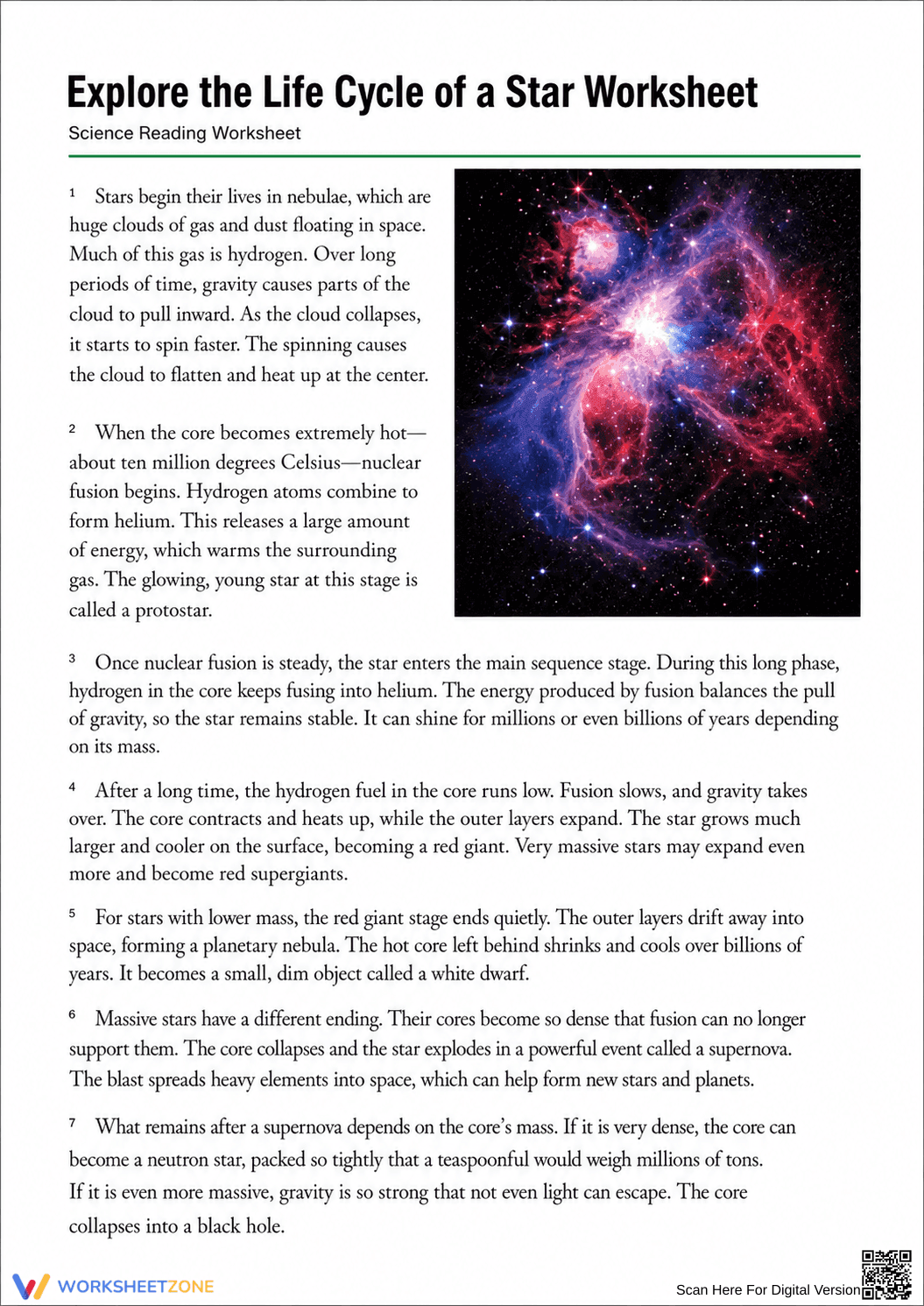
The resource contains a high-quality informational text divided into seven numbered paragraphs for easy reference and evidence-based answering. It covers the birth of stars in nebulae, the onset of nuclear fusion in protostars, the stability of the main sequence, and the various terminal stages including red giants, white dwarfs, supernovae, and black holes. A vivid astronomical image of a nebula provides visual context for the initial stage of the stellar cycle.
Zero-Prep Workflow
- Print: Generate the single-page PDF in less than 30 seconds for your entire class.
- Distribute: Hand out the reading during transitions; no specialized lab equipment or teacher setup is required.
- Review: Use the included answer key to facilitate a 5-minute whole-class check or for rapid grading.
This structured approach makes it an ideal candidate for emergency sub plans or literacy-focused science blocks where teacher prep time is limited to under 2 minutes.
Standards Alignment
The primary focus is `MS-ESS1-2`, which requires students to develop and use a model to describe the role of gravity in the motions within galaxies and the solar system. This text specifically addresses how gravity triggers the collapse of nebulae and maintains the balance of main sequence stars. Both standard codes can be copied directly into lesson plans, IEP goals, or district curriculum mapping tools.
How to Use It
Use this as a "Close Reading" exercise during a unit on Earth and Space Science. Have students highlight the specific elements, such as hydrogen and helium, mentioned in paragraph 2 to practice identifying key details. Alternatively, assign it as a formative assessment after a lecture on the Hertzsprung-Russell diagram to see if students can connect textual descriptions to visual data. Completion typically takes 25 minutes.
Who It's For
This resource is tailored for middle school students in grades 6 through 9, as well as introductory high school astronomy classes. It supports English Language Learners (ELL) through clear, sequential paragraph structures and defined scientific vocabulary. It pairs naturally with a star life cycle diagram or an interactive digital simulation of stellar collapse.
According to the RAND AIRS 2024 report on secondary science literacy, integrating high-quality informational texts into STEM curricula significantly improves student retention of abstract physical concepts like nuclear fusion and gravitational equilibrium. This worksheet aligns with these findings by providing a structured narrative of the life cycle of a star, moving from the initial nebula phase to terminal events like supernovae. By focusing on the standard MS-ESS1-2, the material ensures that students are not just memorizing facts but are understanding the underlying physical forces that govern the universe. Research from Fisher & Frey (2014) suggests that numbered informational segments, like the seven paragraphs used here, assist students in citing evidence during classroom discussions. This resource serves as a vital tool for educators seeking to meet NGSS requirements while simultaneously building the disciplinary literacy skills necessary for success in advanced high school science courses and beyond.


